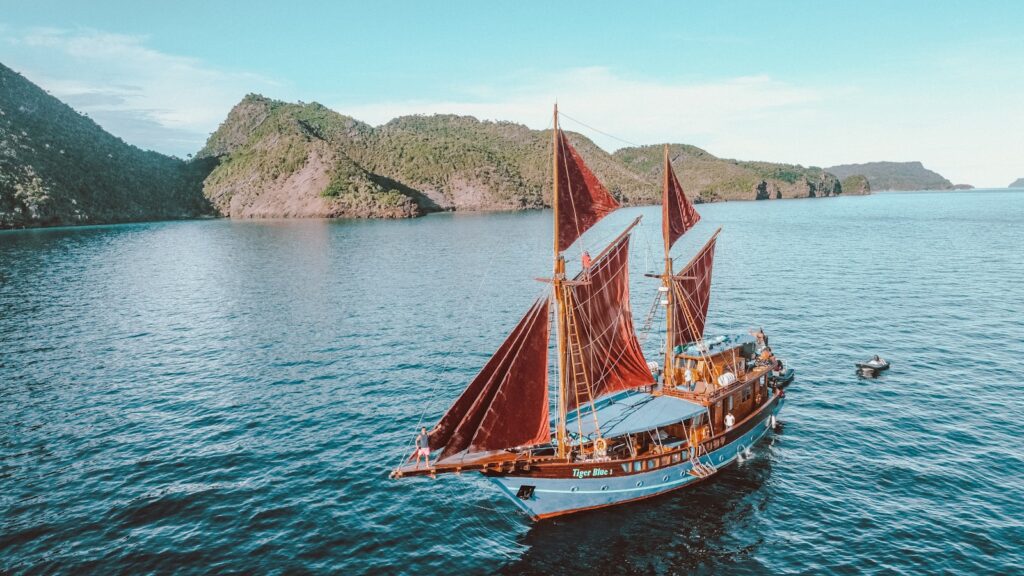
A Komodo day trip is a one-day speedboat excursion from Labuan Bajo that typically covers five or six sites — Padar viewpoint, Pink Beach, Komodo island (Loh Liang), Taka Makassar sandbar, Manta Point, and a final snorkel stop — departing around 06:00–07:00 and returning by 16:30–18:00. A Komodo liveaboard is an overnight or multi-night sailing trip on a phinisi or motor vessel where you sleep on the boat, reach the same islands (plus remote sites that day boats skip), and move at a different pace entirely. Deciding between the two is not about which is objectively better. It is about what you are actually going for and how many days you have.
I have watched this decision play out on the dock more times than I can count. People who pick wrong are easy to spot. The diver who takes a shared speedboat and has to skip two dives because the group is leaving. The slow-moving traveler on a three-night liveaboard who spends the first evening mildly green and wishes they had just done the day run. Neither option is a mistake if you understand the tradeoffs before you buy.
What Each Format Actually Gives You
The Day Trip: What the Day Looks Like in Practice
A shared speedboat day trip from Kampung Ujung port runs roughly 10 to 12 hours door-to-door. Pickup begins around 05:30 to 06:30 depending on where your accommodation sits. You are on the water by 06:00 to 07:00. The leg to Padar takes close to an hour at speedboat pace (Komodo island sits roughly 60 to 65 km from Labuan Bajo; Padar is about 45 to 50 km). From there the route hops between stops with 20 to 30 minute crossings in between, and you are back at the marina by late afternoon.
Here is how that time actually breaks down across stops:
| Stop | Time on site | What you do |
|---|---|---|
| Padar viewpoint | ~75 min total | Hike to the three-bay ridge (~800 steps, 30–40 min up at moderate pace); photographs; descent |
| Pink Beach | ~50–60 min | Swim, snorkel over fringing reef; visibility varies and currents can be strong |
| Loh Liang / Komodo | ~80 min | Short ranger-guided trek (~45–60 min walking time); dragon sightings near the shelter and along the trail |
| Taka Makassar sandbar | ~45 min | Wade, swim, photograph the exposed white sandbar at low tide |
| Manta Point (Karang Makassar) | ~30 min | Drift snorkel over the cleaning station; mantas possible but not guaranteed |
| Final snorkel (Siaba, Kelor, or Kanawa) | ~30 min | Coral and reef fish; varies by operator and sea state |
Lunch is served on board between stops — almost always a simple hot meal of rice, grilled fish or chicken, and vegetables. It is functional, not a highlight. The boat is moving most of the day; you never have a long window of still time anywhere.
The Liveaboard: What Changes When You Sleep on the Boat
A 2D1N or 3D2N phinisi sailing trip covers the same headline stops but adds something the day trip structurally cannot: early morning access before the crowds arrive, remote snorkel and dive sites that would mean three extra hours of transit for a day boat, and the anchor-at-dusk experience in a quiet bay. You eat better, the pace is slower, and the boat doubles as your hotel.
Divers get three to five dives per day on a liveaboard itinerary rather than the single Manta Point drift snorkel that day-trippers get. Sites like Batu Bolong, Crystal Rock, and Castle Rock — widely considered some of the most biodiverse dive spots in the park — are within reach on overnight trips but effectively off the day-trip map. The crossing time alone makes them impractical for a 10-hour loop.
Dawn hours matter. Padar at sunrise looks completely different from Padar at 07:30 when the first speedboat loads are already climbing. Dragon activity at Loh Liang is better in the morning before midday heat sends the animals into shade. A liveaboard anchors nearby overnight and walks you in at first light; a day trip gets there when it gets there, usually 07:30 to 09:00 depending on the schedule.
For a deep look at liveaboard options, itineraries, and what to expect on a phinisi trip, see our partner site Komodo Liveaboard Cruises — they cover that format in full detail. This page focuses on helping you decide which format suits your trip.
Cost Comparison (Ranges, Not Fixed Prices)
All figures below exclude park fees, which you pay in cash on the day. Park fees for foreigners run roughly IDR 300,000 to 500,000 per person all-in for a standard day (entrance, ranger, harbour fee, snorkeling — composition varies; last verified June 2026, confirm with your operator before travel). The 1,000-visitor daily park cap introduced in 2026 has pushed some operators to add advance reservation fees; ask about this when you book.
| Format | Indicative price per person | What is included (typically) |
|---|---|---|
| Shared speedboat day trip (6 stops) | IDR 1,200,000–1,800,000 (~USD 75–120) | Boat, crew, simple lunch, basic snorkel gear, onboard guide; park fees excluded |
| Private speedboat charter (small, ~6 pax) | IDR 8,000,000–12,000,000/boat (~USD 500–800) | Same inclusions; flexible stop order; confirm gear and meal quality |
| Shared phinisi / slow boat day (4 stops) | IDR 500,000–1,200,000 (~USD 30–80) | Slower vessel, fewer stops reachable; adequate for the shorter loop; longer at sea |
| Liveaboard 2D1N (shared cabin) | IDR 2,500,000–5,500,000 per person (~USD 160–360) all-in | Accommodation, all meals, snorkeling gear, guide; dive equipment usually extra |
| Liveaboard 3D2N (shared cabin) | IDR 4,000,000–9,000,000 per person total (~USD 260–590) | Same inclusions; wider itinerary; dedicated dive packages priced separately |
These are indicative ranges only. Peak season (June–August, Christmas, New Year) adds 10 to 30 percent. Liveaboard pricing especially varies sharply by vessel quality, cabin type, and whether diving is bundled. Always request a full quote — comparing a headline price without knowing what is included leads to bad decisions. Use our planning form or reach out on WhatsApp and we can help you decode what a quote actually covers.
The Six Honest Tradeoffs
1. Time Available
This is usually the deciding factor before anything else. If you have one day in Labuan Bajo — flying in from Bali the previous evening and out the next morning — the day trip is your only real option. If you have three or four days in the area, a 2D1N or 3D2N liveaboard becomes viable and arguably better value per experience.
Do not try to do a Komodo day trip the same day you fly in from Bali. The first DPS departure gets you into Labuan Bajo around 08:10 at the earliest; day boats leave at 06:00 to 07:00. You will miss the window entirely and spend a day doing nothing productive. Fly in the evening before. This is standard advice from every operator on the strip and it has become more important since the park introduced the 1,000-visitor daily cap in 2026 — last-minute same-day walk-ins are no longer possible.
2. Diving vs Non-Diving
If you dive, a liveaboard is almost always the better investment. The park’s best dive sites — Batu Bolong, the north end of Gili Lawa, Crystal Rock — are accessible from a liveaboard’s multi-day itinerary in a way that is simply not practical from a day speedboat. The day trip offers one drift snorkel at Manta Point. That is it for underwater time at the headline site. A liveaboard diver gets multiple dives per day across varied sites.
If you snorkel but do not dive, the day trip is genuinely sufficient for the main experiences. Pink Beach, Manta Point (snorkel access), and the coral stops are all on the standard day route. You are not missing a structural part of the experience — you are missing depth, literally and figuratively.
3. Seasickness Exposure
This one surprises people. Speedboats actually give many passengers a rougher ride than a phinisi sailing vessel. A 6- to 8-pax fiberglass speedboat slapping over two-foot chop in the Flores Sea is uncomfortable; slower wooden vessels pitch and roll but do it more gradually. Peak season (June to August) coincides with southeast trade winds that build seas to 1 to 2 meters; the crossing to Padar and Komodo takes roughly an hour each way at speed on those days, and it is not mild.
If you are prone to motion sickness, take medication at least two hours before boarding regardless of which format you choose. On a liveaboard, the first night at anchor usually helps; the second morning tends to be easier than the first. On a day trip, if you are miserable on the outbound crossing, you have no escape until you are back at the dock seven or eight hours later.
The Flores Sea can close Labuan Bajo port to small craft in genuinely bad weather. The harbour master (syahbandar) does make this call. It happens most often December through February; June to August crossings are usually passable but choppy. Check the forecast and have a flexible plan if you book in peak season.
4. What You Genuinely Miss on a Day Trip
Being honest about this matters. A day-tripper misses:
- Dawn access at Padar and Loh Liang before the speedboat fleet arrives
- Remote dive and snorkel sites that require overnight positioning to reach (Batu Bolong, Crystal Rock, north Gili Lawa)
- The quality of the morning light over the park — the hour between sunrise and 07:00 is genuinely different from 09:00
- Dragon behaviour in the cooler morning — the animals are more active before midday heat
- The experience of being in the park after the day boats leave — by 17:00 the shared fleets are heading home; liveaboard guests have the anchorages to themselves
- Rinca (Loh Buaya) — most 6-stop day-trip routes skip Rinca entirely in favour of Padar and Komodo; if you want both dragon islands, a liveaboard is the easier way to fit both in
None of these are trivial omissions if the full experience is what you are paying for. They are real differences.
5. What the Day Trip Does Better
The day trip wins on one thing clearly: it returns you to a real bed in Labuan Bajo each night. For travelers who sleep poorly on boats, suffer significant seasickness, or simply do not want to give up their hotel room and evening restaurant options, that matters. The day trip is also considerably cheaper on a per-day basis even when park fees are factored in, which matters if your budget is genuinely tight.
It also delivers the headline experiences. You will see Komodo dragons on a guided trek, you will climb Padar, you will swim at Pink Beach, and you will drift over Manta Point hoping to spot a manta (sightings are possible year-round but not guaranteed — any operator who promises otherwise is selling you something). For a first-time visitor with one day to spare, the day trip checks the boxes that most people actually came for.
6. Pacing and Group Dynamics
Shared speedboat day trips run on a fixed schedule. The guide controls the timing. If you need more time at Loh Liang because you are a slow hiker, the boat does not wait indefinitely — there are 20-odd other passengers and a departure window to maintain. On a private charter, you have real flexibility: spend 90 minutes at Padar instead of 45, skip a stop that does not interest you, adjust the order based on conditions. A liveaboard with eight to twelve guests has similar flexibility built in.
This is not a knock on shared trips — they work well for most people. But if your group has mixed fitness levels or you are traveling with young children, the fixed-schedule shared format can create pressure. A private day charter or a liveaboard with a small group removes that pressure.
Who Each Format Is Actually For
Day trip is the right call if: you have one day in the park; you do not dive; you want the main highlights without the sleep-on-a-boat variable; you are on a tighter budget; or you have a firm departure flight the next morning.
Liveaboard is the right call if: you dive and the underwater sites are a significant part of why you came; you want the dawn and early-morning experience on the key viewpoints; you have three or more days in the area; you want to see Rinca and Komodo on the same trip without feeling rushed; or you are willing to pay for the quality difference.
There is a middle option that fewer people consider: a 2D1N trip that includes both a full day of activity and one overnight at anchor, then returns the next morning. It captures the early-access advantage without requiring three nights on the boat. Prices for 2D1N trips vary considerably by vessel quality and inclusions — treat any headline figure as a starting point and ask for the full breakdown. If you want help comparing specific quotes, send us your dates and group size and we will walk through the numbers with you. Our concierge is also reachable on WhatsApp for quick questions. No one can pay us to change what we publish; if you use our free guidance and proceed with an operator, they may pay us a referral fee at no extra cost to you.
A Note on the 2026 Visitor Cap
Since approximately April 2026 the park has been enforcing a 1,000-visitor daily limit park-wide (announced by the Ministry of Forestry in early 2026; reported as a trial transitioning to enforcement). Bookings are managed through the SiORA online reservation system, and in practice your day-trip operator handles the reservation on your behalf. The practical implication: you cannot walk up to the port in peak season and expect a spot on a boat. Book at least two weeks ahead in June through August — operators advise booking around 15 days out during peak periods. This applies to liveaboard departures as well, not just day trips.
The cap may also gradually push prices upward as limited slots command more from demand. Both the daily limit and the SiORA booking requirement are new in 2026; verify the current status with your operator before travel, as the enforcement details are still evolving.
Frequently Asked Questions
Is one day enough to see Komodo, or should I do a liveaboard?
One day is enough to see the main highlights — Padar viewpoint, Komodo dragons at Loh Liang, Pink Beach, Manta Point snorkel, and a sandbar stop. You will not see dawn light over the park, you will not access the best dive sites, and you will feel the pace. For most first-time visitors with limited time, a well-run 6-stop day trip is genuinely satisfying. If you dive or have three or more days available, a liveaboard returns meaningfully more per day spent in the park.
What is the price difference between a day trip and a Komodo liveaboard?
A shared speedboat day trip runs approximately IDR 1,200,000 to 1,800,000 per person (roughly USD 75–120), park fees excluded. A shared-cabin 2D1N liveaboard typically starts around IDR 2,500,000 to 5,500,000 per person all-in (roughly USD 160–360), with diving packages on top. Per day the liveaboard is more expensive; per experience delivered — especially for divers — many travelers find it better value. Confirm exact inclusions before comparing headline prices, because the gap in what is covered is often as wide as the gap in sticker price.
Is a day trip or liveaboard worse for seasickness?
Speedboats are often harder on passengers prone to motion sickness than slower phinisi vessels, which roll more gently even if the crossing takes longer. On the day trip, you ride a fast boat for roughly two hours of total transit time in open water. On a liveaboard, the first evening at anchor tends to be the worst point for most people; it usually improves. If you are sensitive, take anti-nausea medication at least two hours before boarding either option, eat lightly before departure, and choose a seat near the middle-rear of the boat where motion is least pronounced.
Can I see Komodo dragons on a day trip, or do I need to stay longer?
Yes, you will see Komodo dragons on a standard day trip. The short ranger-guided trek at Loh Liang (Komodo island) takes 45 to 60 minutes and reliably passes known resting and feeding areas. Morning arrivals have better results because the dragons are more active before midday heat. A liveaboard with early-morning access gets you there before the day-boat crowds but does not fundamentally change the dragon encounter — the ranger protocol, group size, and trail are the same.
What does a liveaboard have that a day trip genuinely cannot offer?
Three things that matter most: first, dawn access to Padar and Komodo before the shared fleet arrives; second, the dive sites — Batu Bolong, Crystal Rock, and Gili Lawa north end — that are logistically out of reach on a one-day speedboat loop; and third, the experience of the park in the late afternoon and evening when the day boats are gone. If any of these are reasons you are making this trip, a liveaboard is worth the extra cost and days.