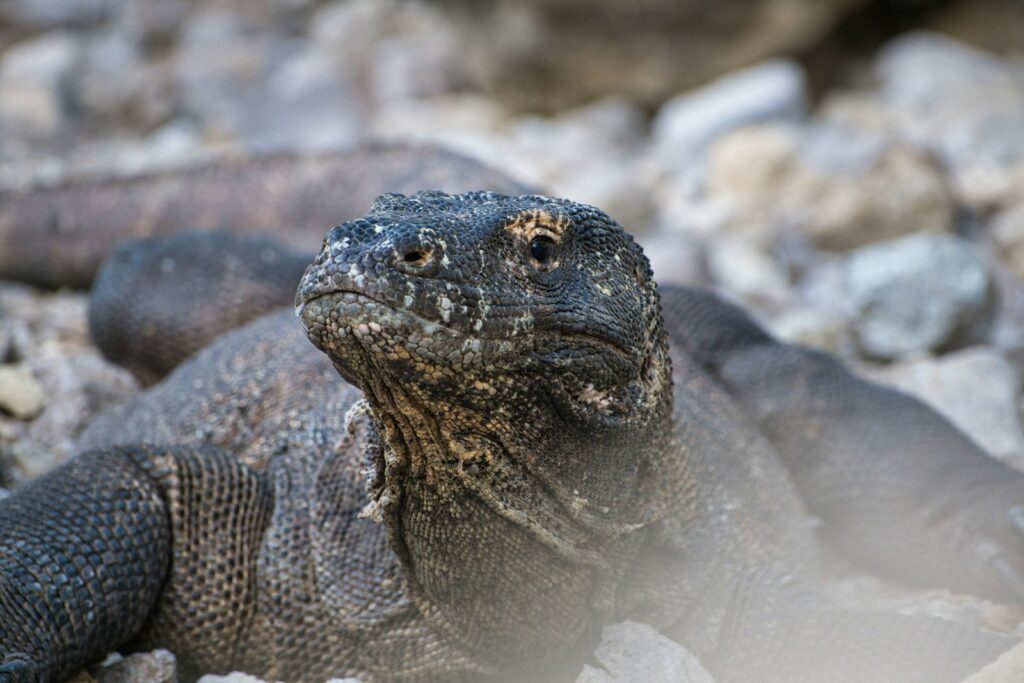
Loh Liang is the sole ranger station on Komodo Island and the only legal entry point for trekking in Komodo National Park’s largest island. Every day-trip boat that calls at Komodo Island docks at Loh Liang’s jetty — there is no other way in. From here, visitors choose from three signed trek routes that range from roughly 45 minutes to a full three hours, all led by a licensed ranger assigned on arrival.
I’ve routed dozens of groups through this bay over the years, and I still think Loh Liang gives the most genuinely wild dragon encounter available on a standard day trip. Rinca’s Loh Buaya was rebuilt around elevated boardwalks after 2021 — practical, photogenic, controlled. Loh Liang has boardwalks near the station but then opens onto dry savannah and forest paths where you are walking in the dragons’ actual territory. That distinction matters when you’re deciding which island to prioritise if your itinerary only has time for one.
The Three Trek Routes at Loh Liang
The park authority does not publish official trail distances in kilometres, so every figure you’ll see online is an estimate. Durations are the reliable benchmark, and they assume a moderate walking pace with a ranger leading.
- Short trek — approximately 45 to 60 minutes
- The loop most day-trippers take. It covers the area immediately around the ranger station: feeding grounds, shaded resting spots, and the open ridge where dragons congregate in the morning. Estimated at roughly 1 to 2 kilometres, though no official figure is published. This is what fits into a day-trip’s approximately 80-minute island window after docking, registering, and walking back to the jetty.
- Medium trek — approximately 90 minutes
- Extends into the hillside forest and gives a broader view of the island’s interior. Estimated around 3 kilometres. Rarely taken on a six-stop speedboat day trip because it would eat too deeply into the schedule — better suited to guests who book a private charter or a slower phinisi cruise with a flexible itinerary.
- Long trek (adventure trail) — 2 to 3 hours
- A serious commitment: crosses ridges, drops into valley forest, and reaches viewpoints well clear of the main bay. Estimated at 4 to 5 kilometres. This is a liveaboard or overnight-Labuan-Bajo itinerary feature, not a day-trip option unless the entire day is devoted to Komodo Island alone.
Day-trippers nearly always take the short trek. That is not a compromise — sightings on the short route are the norm on most days. Rangers see dragons at the station and along the lower ridge routinely. But no sighting is ever guaranteed, and no official statistics on daily sighting rates are published by the park authority (BTNK). Any operator who quotes a percentage is estimating from their own records.
When to Trek: Morning Light and Dragon Biology
Morning is the better time to trek at Loh Liang. This is straightforward biology: Komodo dragons are ectotherms. In the heat of the day — typically after 10 or 11 in the morning — they move into shade and become less active. A dragon lying motionless under a tree is still a dragon worth seeing, but the more animated behaviour, the foraging and territorial displays, happens in cooler morning temperatures when the animals are warming up and starting to move.
On a standard six-stop speedboat day trip departing Labuan Bajo at 06:00 to 07:00, the itinerary usually runs Padar first (for sunrise light on the viewpoint), then Pink Beach, then Komodo Island. That puts Loh Liang arrival somewhere between 09:30 and 11:00 depending on sea state and stops. It is not the ideal 07:00 window, but it is solidly within the active morning period for most of the year.
During the mating season (roughly May through August) and the nesting and hatching period (roughly September through December), dragon behaviour shifts — males are more active and territorial during mating, females are protective near nesting sites. These are general seasonal patterns from life-history research; rangers will know current conditions on the day. What remains constant: early is better, and midday heat sends every dragon looking for shade.
Ranger Protocol: What It Actually Means on the Ground
The rules at Loh Liang are not theatre. A licensed ranger accompanies every group — this is mandatory and non-negotiable regardless of your group size or experience. You cannot wander independently. Rangers carry forked wooden sticks, which are used to redirect a dragon by placing the stick in its path, not to harm it.
The key rules, stated plainly:
- Minimum 3 to 5 metres distance from any dragon. This is a biological safety margin, not an arbitrary number. Komodo dragons can accelerate over short distances faster than most people expect.
- Stay grouped and stay on the single signed trail. Splitting the group confuses the ranger’s ability to keep everyone in view and creates unpredictable movement around the animals.
- No open food on the trek. Food smells are a trigger. Keep anything edible sealed in your bag and do not eat on the trail.
- No crouching low near dragons. Lowering yourself to eye level activates predatory attention. Stay upright.
- No sudden movements, no loud noise. Steady pace, quiet voices.
- No touching or feeding under any circumstances.
On the menstruation question: women are asked to inform the ranger before the trek. This is an operational safety advisory based on the ranger’s judgment about scent and behaviour — it is not a verified written ban in any published park regulation. In practice it means the ranger can make an informed decision about route and distance on that day. It is a practical disclosure, nothing more.
As for the risk level: serious dragon incidents are extremely rare. The last reported tourist fatality is cited in safety guides as 2009. No official year-by-year bite statistics are published by the park authority, so any specific incident count you see cited online is anecdotal. The combination of mandatory licensed rangers and strict trail discipline keeps risk low. The protocol exists because the risk is real, not because it sounds dramatic.
Park Fees and Ranger Fees at Komodo Island (2026)
Fees at Komodo National Park are paid in cash on arrival — they are almost universally excluded from tour prices. Budget for this separately.
| Fee item | Amount (IDR) | Notes |
|---|---|---|
| Foreigner entrance ticket | 150,000–250,000 per person per day | Sources conflict on weekday vs Sunday/holiday rates; one set of operators cites 250,000 flat, others cite 150,000 weekday / 250,000 weekend. Confirm on the day. Ticket is valid park-wide — you do not pay again for each island. |
| Indonesian citizen entrance | 50,000 weekday / 75,000 weekend-holiday | Single-source figure; widely repeated. Confirm on the day. |
| Ranger/guide fee at Loh Liang | 200,000 per group (up to 5 people) | Solid across multiple 2026 sources. Per trekking site — if you also trek Padar, there is a separate ranger fee there (150,000 for Padar). |
| Snorkelling surcharge | None | Base ticket covers snorkelling. No additional snorkel fee. |
| Diving surcharge | 25,000 per diver per day | Reported across three sources; one outlier cited 100,000. Confirm. |
| Port/harbour fee | ~25,000 per person per day | Typically bundled by operators; included for reference. |
For a standard day trip covering Padar, Komodo Island (Loh Liang), and snorkel stops: a practical cash budget of IDR 300,000 to 500,000 per person for all park fees combined is a reasonable working estimate. Viator’s current listings cite approximately IDR 475,000 per person collected on the day. The once-discussed IDR 3,750,000 annual conservation membership (announced 2022) was officially cancelled and is not in force in 2025–2026.
From 2026, advance booking via the SiORA online reservation system is in effect, and a 1,000 visitors per day park-wide cap began as a trial from approximately March 2026 and was reported as enforced from around April 2026. In practice, most reputable tour operators handle SiORA reservations for their guests. If you are booking independently or very close to a peak-season date (June through August, Christmas, New Year), confirm availability before you arrive in Labuan Bajo. These are new measures as of 2026 — verify current status with your operator.
What a Day Trip to Loh Liang Actually Looks Like, Minute by Minute
Here is the realistic shape of the Komodo Island portion of a standard six-stop speedboat day trip, based on the published Green Rinjani itinerary and consistent patterns across operators:
Your boat left Labuan Bajo at around 06:00 to 07:00. After Padar’s viewpoint hike and Pink Beach, the speedboat covers the roughly 20-minute crossing from Pink Beach to Loh Liang. You dock, register at the ranger station, pay ranger fees in cash, and are assigned a ranger. The short trek takes 45 to 60 minutes on the trail. Back at the station, there is usually time to look around the immediate area — dragons often shelter under the raised floors of the station buildings — before returning to the boat. Total island time is typically around 80 minutes.
What that leaves no time for: the medium trek, which needs 90 minutes minimum just on the trail. If seeing more of the island’s interior matters to you, a private charter gives you the schedule flexibility to request it. On a shared open trip, you have the short trek and that is the practical reality.
From Komodo Island, the speedboat heads to Taka Makassar sandbar (about 30 minutes transit), then Manta Point / Karang Makassar (about 5 minutes further), then a final snorkel stop — Siaba Bay, Kelor Island, or Kanawa — before the roughly one-hour return to Labuan Bajo. You are back in port between 16:30 and 18:00.
If you want to plan the right boat type and itinerary for your priorities — including whether a private charter makes sense so you can take the medium trek — plan your trip with our concierge. We can also walk you through options over WhatsApp before you commit to anything.
Loh Liang vs Loh Buaya: Which Dragon Site Is Better for a Day Trip?
This is the question I get most often from people building a first Komodo itinerary. The honest answer depends on what you mean by “better.”
Rinca’s Loh Buaya is closer to Labuan Bajo — roughly 25 to 30 kilometres compared to Komodo Island’s 60 to 65 kilometres. That matters for a slow wooden boat. On a speedboat it is less significant. Since the redevelopment after 2021, Loh Buaya’s viewing experience is largely centred on an elevated boardwalk complex. The boardwalks are well-engineered and you will almost certainly see dragons from them — the kitchen and feeding areas attract congregations. It is managed, safe, and photogenic. It also feels managed.
Loh Liang on Komodo Island still takes you onto actual ground-level paths in the open savannah. The setting is larger, wilder, and the short trek puts you among the animals rather than above them on a platform. For a first visit where the trekking experience itself matters, Loh Liang is the more memorable choice. For families with very young children or visitors who find rough paths difficult, Loh Buaya’s boardwalk structure may be easier to navigate.
Some operators include both islands on a single day. That is possible on a speedboat, and it extends the day and the cost. Most six-stop itineraries choose one or the other, not both, because fitting two ranger treks plus three or four snorkel stops into a 10 to 12 hour day is already tight.
Practical Checklist for Loh Liang
- Cash in rupiah: Minimum IDR 200,000 for the ranger fee plus your share of the entrance ticket. Bring IDR 500,000 per person to cover all park-day fees comfortably. No card machines at the station.
- Closed shoes: The trail is uneven packed earth and dry grass. Sandals work but a shoe with grip is noticeably more comfortable on the ridge sections.
- Water: Bring your own from the boat. Nothing is sold at the station. Expect operators to enforce a no-single-use-plastic policy — bring a refillable bottle.
- Sun protection: The short trek is partly open savannah. Hat, sunscreen, long sleeves in the hottest months.
- No food in your hands on the trail: Pack it sealed in your bag. Ranger will remind you, but don’t put yourself in the position of needing reminding near a four-metre dragon.
- Camera on a strap: Tripping while holding a camera out is how people stumble at exactly the wrong moment. Secure it.
- Drones: Effectively prohibited for casual visitors. Aerial work requires a SIMAKSI filming permit through BTNK plus a reported fee of around IDR 2,000,000 per unit per day (reported by two operator sources — confirm with BTNK before travel). Do not bring a drone expecting to fly it.
Frequently Asked Questions
Will I definitely see Komodo dragons at Loh Liang?
Sightings are common on most days — rangers see dragons at and around the station with regularity. But no sighting can ever be guaranteed, and the park authority publishes no official sighting statistics. Dragons are wild animals in their own territory, and their movements shift with weather, season, and temperature. What rangers can do is read the conditions on the day and route the trek accordingly. If your visit is in the midday heat, expect less active behaviour. Morning treks during the active season offer the best odds.
How long do we actually spend at Komodo Island on a day trip?
On a standard six-stop speedboat day trip, the island window is roughly 80 minutes total — from docking to casting off. That covers registration at the ranger station, ranger fee payment, the short trek (45 to 60 minutes on trail), and walking back to the jetty. It is enough for a genuine short-trek dragon encounter. It is not enough for the medium or long trek. If you want more time on the island, a private charter lets you negotiate a longer stop, or you can structure a two-day trip that spends a full morning at Loh Liang.
Is the ranger fee on top of the entrance ticket, and how much cash should I bring?
Yes, the ranger fee is separate from the park entrance ticket. The entrance ticket (last verified figures: IDR 150,000 to 250,000 per person for foreigners, with some sources applying the higher rate on Sundays and holidays) is paid per person. The ranger fee at Loh Liang is IDR 200,000 per group of up to five people — so if you are on a shared open trip with strangers, the group may split it, or the operator may collect it centrally. A practical all-in cash budget of IDR 300,000 to 500,000 per person covers entrance, ranger fees, and port fees for a full park day. Bring cash; no card facilities at the ranger station.
What is the menstruation rule at Komodo Island?
Women trekking at Loh Liang are asked to inform the ranger before the trek if they are menstruating. This is an operational safety advisory — the ranger uses that information to decide on route and distancing on that particular day, because scent can attract dragon attention. It is not a verified written ban in any published park regulation, and it does not automatically prevent you from trekking. It is a practical disclosure that helps the ranger do their job. Inform the ranger honestly and follow their guidance.
Can I do the long trek at Loh Liang on a day trip?
Almost certainly not on a shared six-stop speedboat day trip — the long trek takes two to three hours on the trail alone, and your island window is around 80 minutes. The medium trek at roughly 90 minutes is also beyond what a standard open-trip schedule allows. To do the medium or long trek properly, you need either a private charter with a negotiated extended stop at Komodo Island, a phinisi day cruise with a flexible itinerary, or a multi-day trip that devotes a full morning to Loh Liang. If this is a priority for you, tell us when you plan your trip and we will help you find the right format — or you can ask us over WhatsApp before booking anything.