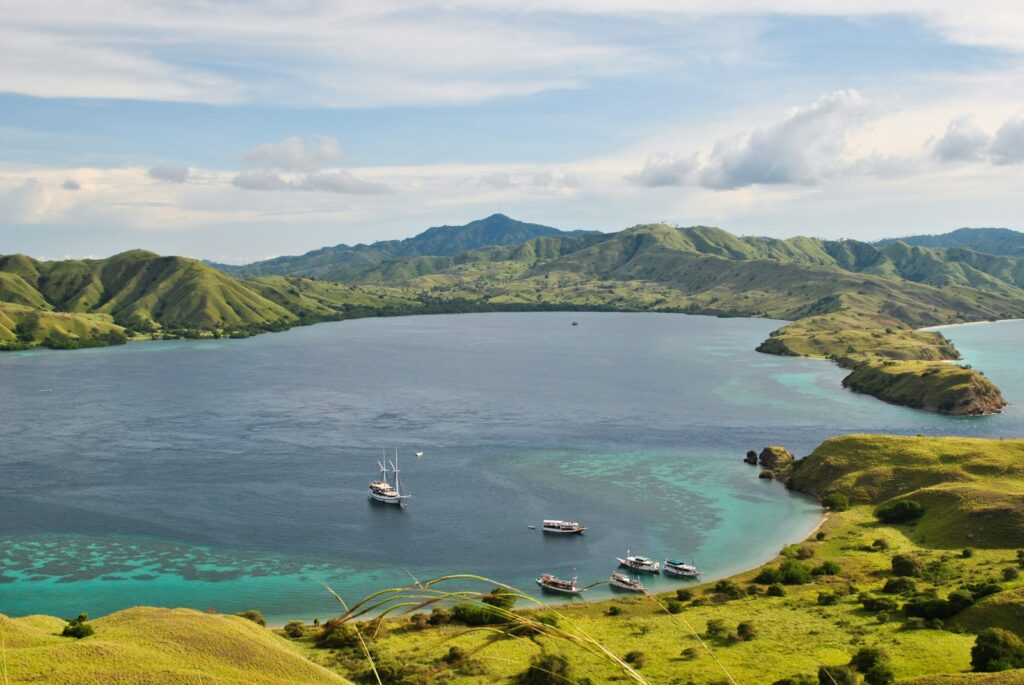
The Padar Island hike is a scramble up a dry volcanic ridge to a viewpoint that looks down simultaneously onto three bays — one pale blue, one green, and one with a faint pink-sand fringe. The climb takes most people 20 to 40 minutes at a moderate pace; the descent is 15 to 30 minutes. On a standard six-stop day trip from Labuan Bajo, you have roughly 75 minutes on the island from the time the boat ties up to the time it calls you back aboard. That window is tight enough that knowing exactly what to expect beforehand makes a measurable difference to whether you stand at the top in peace or sprint there in a sweat.
Quick Facts: Padar in Numbers
- Steps to the viewpoint
- Roughly 800 — no official count exists and figures in common circulation vary; treat this as an order of magnitude, not a precise tally.
- Elevation gain
- Approximately 180–200 m (an estimate derived from topographic charts — use as a guide, not a survey measurement).
- Climb time
- 20–40 minutes up at a moderate hiking pace; fit walkers move faster, but the heat slows nearly everyone down by the upper section.
- Descent time
- 15–30 minutes down; loose scree near the top demands attention on the way back.
- Time on site (day-trip window)
- ~75 minutes — the typical stop window on a speedboat day tour. Enough for the hike and a few minutes at the top; not enough to linger long.
- Ranger fee (Padar-specific)
- IDR 150,000 per group of up to 5 people — lower than the IDR 200,000 per group charged at Komodo (Loh Liang) and Rinca (Loh Buaya). Verified from multiple 2026 sources; still cash on the day.
- Park entrance ticket
- IDR 150,000–250,000 per person for foreigners depending on the day (weekday vs Sunday/public holiday — the split is genuinely contested across sources; budget IDR 250,000 to be safe). This covers all islands visited that calendar day; you do not pay a separate entrance per island, but ranger fees stack per trekking site.
- Shade on the trail
- None above the first 50 metres. The ridge is exposed volcanic hillside with dry grass and scattered low shrub.
- Visitor cap (2026)
- A park-wide cap of 1,000 visitors per day came into effect as a trial from around March 2026, reportedly fully enforced from April. One secondary source suggests a Padar-specific sub-quota of 50 — this is single-source and unconfirmed; treat as a reason to book early, not a guaranteed hard limit you can rely on.
What the Trail Actually Looks Like
Padar sits roughly 45–50 km southeast of Labuan Bajo harbour — about an hour by speedboat. The island is narrow and elongated, with a steep central ridge that runs its length. The main trail starts at a small jetty on the northern bay, climbs wooden steps and compacted earth for the first third, then transitions to looser rocky ground and uneven natural stone as it nears the summit ridge. There are fixed handrails at the steeper sections near the top, which matter more on the way down than the way up.
The three-bay viewpoint sits at the highest accessible point of the ridge. What makes it worth the effort is that the three bays are visible simultaneously from a single position — they fan out below you at angles that only work from that exact spot. The colours differ because the seafloor composition and water depth vary between the bays; the pale pink tinge in one bay comes from fragments of red foraminifera (specifically Homotrema rubrum) mixed with coral sand, similar to the famous Pink Beach on the other side of the park.
The trail does not require special equipment and is manageable for most people with reasonable fitness. That said, it is not flat or easy, and the combination of gradient and heat eliminates the option of taking it slowly and casually if you are on a 75-minute day-trip window.
Heat and Sun: The Overlooked Difficulty
The Padar Island hike is not technically difficult. The challenge is almost entirely thermal. The ridge faces full sun from around 07:30 onwards, and there is no canopy, no shade, and no relief once you are above the first few dozen steps. In peak season — June through August, which aligns with the dry season and maximum visitor volume — surface temperatures on the dark rock can be intense by 09:00. Midday arrivals are significantly harder than early-morning ones, even for people who hike regularly in temperate climates.
Bring more water than you think you need. A litre per person is a minimum for a 75-minute stop in June; 1.5 litres is better. Most speedboat day tours include a simple lunch and water on board, but the water you carry onto the island is your own responsibility. There are no refreshments or stalls on Padar. Sunscreen matters on this trail more than almost anywhere else in the park — you are exposed for the entire climb and the ridge walk along the top.
Physical fitness aside, the people who find the hike hardest are those who underestimate the sun and arrive without a hat or with barely any water. Neither of those is a fitness problem.
Footwear: Trainers Fine, Sandals Risky
There is no official footwear requirement for the Padar hike, and many people do it in sports sandals or flip-flops without incident. But the upper section has loose scree and uneven rock, and the descent — especially when your legs are tired and the sun has been on you — is where ankle rolls happen. A closed trainer with a rubber sole gives you adequate grip and ankle support for what is a short but genuinely uneven trail. Lightweight hiking shoes are comfortable but not necessary.
Sandals are the risk scenario. Flat sandals with no heel strap are genuinely problematic on loose scree; they can slip under foot or catch on raised rock edges. If sandals are all you brought on the trip, go slowly and use the handrails. If you are planning in advance, a basic pair of running shoes solves the problem entirely.
Sunrise vs Midday: The Real Trade-Off
The Padar sunrise is something people post about. The ridge catches the first light from the east, and the three bays fill with colour from above before the sun has cleared the horizon — the light is directional and low, which makes the topography read clearly from above. If this is the photograph you came for, sunrise is the time to be there.
The catch is operational. Standard shared speedboat day trips leave Labuan Bajo harbour between 06:00 and 07:00 and take around an hour to reach Padar. By the time you are on the island, the sun is already risen or rising. You will see good light on most clear mornings in the dry season, but the pre-dawn golden hour on the ridge is not reliably achievable on a shared tour.
Sunrise at Padar in the way you see in photographs — dark sky, ridge silhouettes, first light hitting the bays — typically means a private charter that departs Labuan Bajo around 03:30–04:00 and arrives at Padar before dawn. Private speedboat charters are available from around IDR 8–12 million per boat for a small group (roughly 6 people), rising to IDR 12–18 million for larger boats (last verified June 2026; quote-on-request market, peak season adds 10–30%). If the sunrise shot is the reason you are here, a private charter is the honest answer — not because shared tours are bad, but because the maths of the crossing time make pre-dawn arrival on a shared tour nearly impossible.
Midday or late-morning Padar is still worth doing. The light is harsher, the colours more saturated, and the bay contrast can actually be sharper on a clear sky. What changes is the experience of the climb — the heat is at its worst and the trail more crowded if multiple boats arrived in the same window.
| Factor | Sunrise (private charter) | Standard day trip (shared speedboat) |
|---|---|---|
| Typical arrival at Padar | 04:30–05:30 (before dawn) | 07:00–09:00 (after departure 06:00–07:00) |
| Light quality for photography | Pre-dawn through golden hour — best for dramatic shots | Morning to mid-morning — clear, usable, less directional |
| Heat on the climb | Cooler — dark or early dawn, trail not yet baked | Warmer — sun already active, increases through the stop |
| Crowd level | Near-empty — very few boats depart this early | Moderate to busy — multiple shared tours arrive in similar windows |
| Boat type | Private speedboat or private phinisi — necessary for pre-dawn departure | Shared speedboat (IDR 1,200,000–1,800,000/person, park fees extra) |
| Cost difference | Significantly higher — private charter from IDR 8M+/boat | Lower per person — standard shared open-trip pricing |
| Rest of itinerary | Operator-customised — full day still possible after sunrise stop | Six-stop day continues: Pink Beach, Komodo/Loh Liang, Taka Makassar, Manta Point, Siaba |
The 75-Minute Window: Making It Work
Seventy-five minutes sounds like enough. It often is, but the margin for error is small. Here is where it goes wrong on day trips: the boat arrives, everyone gathers gear, the ranger fee is collected and paid (budget a few minutes for this — it is per group, so larger groups wait for everyone to pool cash), and the hike begins. Thirty to forty minutes up, ten minutes on top, twenty-five minutes down, and you are back at the jetty. That is approximately 75 minutes with nothing going wrong.
What eats the buffer: slow-moving members of the group who were not expecting the gradient; the sun making people stop more than planned; the descent being slower than the ascent due to loose rock. If your group has mixed fitness levels, factor in extra time on the way down specifically — the descent is where gaps open up.
If there are people in your group who are less mobile or have knee problems, the trail is doable but uncomfortable on the descent. The upper section in particular has uneven natural stone that requires stepping carefully. Rangers are present and can assist with pacing. This is not a technical trail, but it is not a flat boardwalk either.
One practical thing: establish at the jetty where the boat is, when it is leaving, and confirm with the guide. The 75-minute window is an average — your operator controls the actual schedule and some stops run shorter in high season when the boat is trying to fit in all six stops before dark. Ask directly rather than assuming.
Ready to figure out which trip structure gives you the Padar timing you want? Use our planning form or reach us on WhatsApp — we can tell you which operators currently offer pre-dawn Padar departures and what the honest cost difference looks like for a couple or small group.
The Ranger Fee and Park Fees at Padar
Every trekking site in Komodo National Park charges a ranger fee, payable in cash to the ranger at the site. At Padar, this fee is IDR 150,000 per group of up to 5 people (verified from multiple 2026 operator sources). If your group is larger than five, a second fee applies — at 6 or more people you are paying for two ranger groups. For a boat of 20 people on a shared tour, this divides to IDR 30,000 per person at most; it is not individually significant, but it comes in addition to the park entrance ticket and any other trekking fees that day.
The park entrance ticket covers all islands for the calendar day. Foreigners pay IDR 150,000–250,000 per person — the exact rate depends on whether it is a weekday or a Sunday/public holiday, and this split is genuinely contested across sources (some apply IDR 250,000 flat; others cite a lower weekday rate). Budget IDR 250,000 per person and treat anything less as a bonus. Indonesian nationals pay a lower rate (around IDR 50,000–75,000, though this is less widely documented). All fees are paid cash on the day; park fee payment collection on the boat or at the pier varies by operator.
If your day includes both Padar and Komodo (Loh Liang), you pay the ranger fee twice — IDR 150,000 at Padar and IDR 200,000 at Komodo. This is not hidden or unusual; the fee structure is per trekking site. Budget accordingly before you leave Labuan Bajo, as there are no ATMs in the park.
The 2026 Visitor Cap: What It Means for Padar Specifically
From around March–April 2026, Komodo National Park introduced a 1,000-visitor-per-day cap across the park, enforced through the SiORA online booking system. In practice, your operator handles the reservation — you almost never interact with SiORA directly. What matters for planning is that walk-in availability is no longer reliable during peak season, and the park can reach its daily limit on busy days in June through August.
One source has suggested a Padar-specific sub-quota of 50 visitors. This is single-source and we have not found corroborating evidence. It may reflect an operational practice at peak times rather than a published regulation, or it may simply be inaccurate. Flag it when you speak to operators: ask whether Padar access has been limited on specific days. Do not plan your trip around this number being correct or incorrect — plan around booking in advance, which the 1,000-day park cap makes sensible regardless of whether Padar has its own sub-limit.
Where Padar Sits in the Full-Day Itinerary
On a standard six-stop speedboat day trip, Padar is almost always the first stop. Boats depart Labuan Bajo between 06:00 and 07:00, reach Padar approximately an hour later, do the hike, then continue southeast to Pink Beach (~20 minutes away), then to Komodo/Loh Liang (~20 minutes from Pink Beach), then lunch on board, then Taka Makassar sandbar, Manta Point (Karang Makassar), and a final snorkel stop at Siaba, Kanawa, or Kelor before returning to Labuan Bajo between 16:30 and 18:00.
Padar-first makes logistical sense: it is the most demanding physical activity of the day, it is better done before the afternoon heat peaks, and hitting it first means the boat arrives while the morning air is still relatively cool. By the time you finish the hike and motor to Pink Beach, you have earned the swim.
The order of stops can vary slightly by operator and sea conditions. Some routes do Komodo before Pink Beach, or skip Taka Makassar in favour of an extended snorkel. But Padar-first is the dominant pattern, and for good reason.
What to Bring for the Padar Hike
Keep it simple. The hike is short; you do not need a full daypack. What actually matters:
- Water — at least 1 litre per person. The boat usually provides water with lunch, but that water is for later in the day. You carry your own water for Padar. Bring a refillable bottle rather than single-use plastic — most good operators enforce a no-single-use-plastic policy on board.
- Sunscreen. Apply before you get off the boat. There is no shade to reapply in. Operators strongly recommend reef-safe sunscreen given the snorkel stops that follow; this is not a verified park regulation, but it is universal on reputable tours.
- A hat or cap. This is not optional if you are hiking mid-morning in June through August. The rock and the low scrub on the ridge radiates heat back at you from below as well as above.
- Closed shoes. As discussed above — trainers are fine, sandals are a risk on loose scree.
- A phone or camera. The view is the point. Make sure your battery is charged before you leave the boat.
- Cash. The ranger fee is cash. If your boat is collecting it, you should still have cash on you in case the arrangement differs. IDR notes of 50,000 denominations work well.
Leave your snorkel gear on the boat — you will not need it at Padar and there is nowhere to store it on the trail. Leave your fins, wetsuits, and the rest of it on deck.
Is the Padar Hike Worth It if You Are Not a Hiker?
This question comes up constantly. The honest answer is: yes, for most people, with realistic expectations about the climb. The Padar viewpoint is the defining image of Komodo National Park — the one that appears in every travel publication covering eastern Indonesia. Standing at the top and looking down at the three bays is genuinely striking, and it is the kind of scene that a photograph does not fully prepare you for.
The hike is not a casual stroll, but it is also not a mountaineering undertaking. The 20–40 minutes up is uncomfortable in the heat and requires sustained effort on the upper section. People with significant mobility limitations, severe knee problems, or serious heat-sensitivity issues should factor those constraints in honestly. Rangers at the island are experienced with groups of mixed fitness; if someone in your party needs to stop and rest, that is entirely normal.
What the hike is not: flat, shaded, short, or cool. If those four things are dealbreakers for someone in your group, they may prefer to stay on the boat and swim from the jetty while the rest of the group hikes. That is a reasonable choice and operators accommodate it — there is no obligation to hike.
For the majority of physically average travellers in reasonable health, the Padar Island hike is manageable, worth the effort, and the clear highlight of the day trip. Just go prepared for the heat.
Plan Your Padar Timing Before You Book
The decisions that most affect your Padar experience — sunrise vs morning, shared vs private, how much time on site — are booking decisions, not day-of decisions. Once you are on a shared speedboat at 06:00, the schedule is set. If you want flexibility on Padar timing or a private charter for the sunrise, that needs to be sorted before you hand over a deposit.
We do not sell tours directly, but we help you figure out which operator and format genuinely fits what you are after. No one can pay to change what we publish; if you use our guidance and proceed with a partner operator, they may pay us a referral fee at no extra cost to you. The advice stays the same either way.
Start planning your trip here or message us on WhatsApp with your travel dates, group size, and what matters most about the Padar stop — we can point you toward the right boat and timing for your situation.
Frequently Asked Questions
How many steps is the Padar Island hike?
Roughly 800 steps is the figure most commonly cited, but there is no official count and estimates in circulation vary. Treat it as an order of magnitude: it is a proper staircase-and-trail climb, not a gentle path. The total elevation gain is approximately 180–200 metres, derived from topographic estimates rather than a published survey measurement.
Can I do the Padar hike in sandals?
Many people do, but it carries real risk on the upper section. The trail above the midpoint transitions from wooden steps and packed earth to loose scree and uneven rock. Flat sandals without heel straps can slip on loose stone and catch on raised edges — the descent is where ankle rolls typically happen. Trainers or any closed rubber-soled shoe eliminates the problem. If sandals are all you have, take the upper section slowly and use the fixed handrails.
Is the Padar ranger fee separate from the park entrance ticket?
Yes. The park entrance ticket (IDR 150,000–250,000/person for foreigners, depending on day of week — confirm with your operator) covers access to the park across all islands for that calendar day. The Padar ranger fee is an additional IDR 150,000 per group of up to 5 people, paid in cash at the site to the ranger who accompanies your group on the trail. If your day also includes Komodo island (Loh Liang), that trek has its own separate ranger fee of IDR 200,000 per group of up to 5. Budget cash for both before you leave Labuan Bajo.
What is the best time of day for the Padar viewpoint?
Pre-dawn to sunrise gives the most dramatic photography — low directional light, cooler temperatures, near-empty trail. That timing requires a private charter departing Labuan Bajo around 03:30–04:00. Standard shared speedboat day trips reach Padar after the sun has risen, typically between 07:00 and 09:00 depending on departure time — the morning light is still good on clear days, but the full pre-dawn ridge experience is not achievable on a shared tour. Midday is the least desirable timing: harsh light and maximum heat on the climb.
Does the 2026 visitor cap affect access to Padar specifically?
The park-wide cap of 1,000 visitors per day (in effect from approximately April 2026) means that advance booking through an operator — who handles the SiORA reservation system — is essential during peak season (June–August, Christmas, New Year). One source has suggested a Padar-specific sub-quota of 50 visitors; this is single-source and unconfirmed as of our last research pass (June 2026) — verify directly with your operator before travel. Regardless of whether a Padar sub-limit exists, booking at least two weeks ahead in peak season is the safe approach.