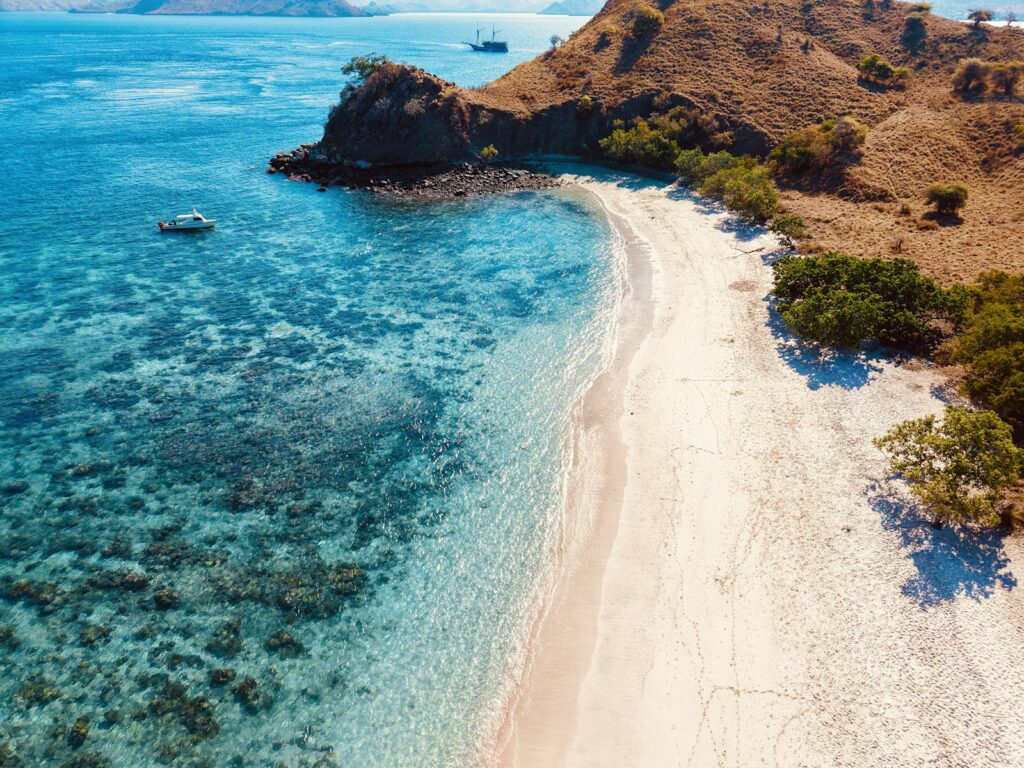
Pink Beach Komodo — known locally as Pantai Merah, which simply means Red Beach — is a stretch of pale coral sand on the southeastern coast of Komodo Island inside Komodo National Park. The pink tint is real, but it is subtle: the colour comes from tiny crushed shells of Homotrema rubrum, a red marine foraminifera that grows on and around the reef, mixed into the otherwise pale coral-fragment sand. What you see in photographs is not a saturated flamingo shoreline. It is a warm blush, and how pink it looks on any given day depends on the light, the tide, and whether the sand is wet or dry.
That gap between Instagram and reality matters. This guide covers what Pink Beach actually is, why the colour varies, how it fits into a standard Komodo day trip, and the currents that make it genuinely risky if you swim without paying attention.
What Makes the Sand Pink: The Science in Plain Terms
Homotrema rubrum is a small single-celled organism — a foraminifera — that secretes a hard red calcium carbonate shell. It lives attached to the underside of coral, inside reef cavities, and on rocky substrate in the shallow waters around Komodo. When it dies, the shell fragments and gets ground down by wave action alongside white coral debris. The resulting mixture, deposited on the beach over thousands of years, is what gives Pantai Merah its characteristic tint.
The foraminifera fragments are red-orange. Mixed in quantity with white coral sand, they read as pink. That ratio is what determines intensity: a beach with a higher concentration of H. rubrum fragments appears more distinctly pink; one where the white coral dominates reads almost white with a warm cast. Pink Beach Komodo sits somewhere in the middle of that spectrum, which is why accounts of it vary so much.
Why Photos Look Different from Reality
A few mechanisms stack against you when you arrive expecting the photographs. Camera sensors and phone processors boost saturation automatically; most travel photographers shoot in the late afternoon when the sun is low and warm, which amplifies the red tones. On the beach at 09:30 on a bright overcast morning — which is roughly when a standard day trip arrives — the light is cool and flat. Wet sand at the shoreline looks considerably pinker than dry sand higher up the beach. If the tide is out and the sand has dried in the sun, the pink fades toward beige.
One travel blogger who visited described it honestly as a mild disappointment after the hype. That reaction is common enough that it is worth naming directly: some visitors leave Pink Beach feeling underwhelmed. That does not make it a bad stop — the underwater reef is the real reason to be there — but adjusting expectations before you arrive is more useful than pretending otherwise.
Pink Beach Komodo vs Padar’s Pink Bay: There Are Two
This is a source of confusion that operators rarely clarify upfront. Komodo National Park has more than one pink-sand beach. The main one on a standard day-trip route is Pantai Merah on Komodo Island’s southeastern coast. There is also a smaller pink bay visible from Padar Island’s summit viewpoint — one of the three bays that give Padar its famous three-colour panorama: white sand, black sand, and pink sand.
- Pantai Merah, Komodo Island (main Pink Beach)
- The primary swim and snorkel stop on standard day-trip itineraries. Accessible directly by boat; allocated approximately 50 to 60 minutes on most shared speedboat tours. The reef here is in reasonable condition and the snorkeling is generally the highlight rather than the sand itself.
- Pink Bay, Padar Island
- Visible from the Padar summit viewpoint but not typically included as a beach stop on day trips — you see it from above, not up close. It is smaller and more remote. Some multi-day liveaboard itineraries include it; standard one-day tours do not land there.
When someone asks whether Pink Beach is worth visiting on a Komodo day trip, they are almost always asking about Pantai Merah on Komodo Island. That is what this guide covers.
What to Expect: The Stop in Real Time
On a standard six-stop speedboat day trip departing Labuan Bajo around 06:00 to 07:00, Pink Beach comes second in the typical sequence — after Padar’s sunrise viewpoint and before the dragon trek at Loh Liang. The boat ride from Padar to Pink Beach is roughly 20 minutes.
Your allocated time on-site is approximately 50 to 60 minutes. That is not a lot. The structure usually runs: the boat drops anchor offshore, you swim or take a dinghy tender to shore, spend time on the beach and in the water, then re-board. The snorkeling directly in front of the beach — off the rocks at each end of the bay — is consistently the best use of that hour. The reef holds diverse hard corals, reef fish, and the occasional sea turtle. Visibility depends on sea conditions and recent rain; calm days in the dry season (April through November) offer the clearest water.
The Tidal Current Problem
Pink Beach sits in water that is subject to strong tidal currents. This is not a rare-conditions risk; it is a structural feature of the marine geography around Komodo, where funnelled channels between islands accelerate water movement significantly. The current at Pantai Merah can run hard enough to carry an average swimmer off course within a few minutes of entering the water — and because the sea surface can look calm, it catches people off guard.
The practical rules: always snorkel with the group, not independently; if you are not a confident swimmer, wear the life jacket the boat provides (request one if it is not offered); stay in the marked or guide-indicated snorkel zone; if you feel the current pulling you along the beach face, swim toward shore immediately, not against the current. Guides on reputable boats will brief you. Listen to that briefing rather than treating it as a formality.
The park’s safety guidance on currents is consistent across sources: strong tidal flow affects Pink Beach, Manta Point (Karang Makassar), and Taka Makassar sandbar. These are not freak-event risks — they are predictable conditions that a prepared visitor manages without drama.
What the Snorkeling Is Actually Like
The reef fringing the headlands at each end of the beach is generally rated as solid, if not exceptional. You are not at a world-class dive site; you are at a protected national park reef that has benefited from that protection over decades. Coral bleaching events have affected parts of the park, and conditions vary by season and location within the bay. Expect a mix of hard coral formations, clownfish, parrotfish, butterflyfish, and occasional larger reef species. Turtles show up regularly enough that guides mention them. The snorkeling is a genuine reason to be excited about this stop — it is the underwater view, not the beach sand, that most visitors remember positively.
Planning a Komodo day trip and want route advice before you commit to an operator? Our planning form or a quick WhatsApp message can help you match the right boat and itinerary to what you actually want from the day — no obligation to book anything.
The Sand-Taking Prohibition: Boats Can Be Checked
Taking sand, coral fragments, shells, or any natural material from Komodo National Park is prohibited under Indonesian conservation law. Pink Beach specifically comes up in enforcement discussions because the pink sand is visually distinctive and visitors have historically pocketed it as a souvenir. Park rangers and boat crews are aware of this. According to operator briefings and publicly available park information, boats can be inspected before departure and passengers’ bags can be checked.
This is not a theoretical risk dressed up as a warning. The sand is part of a living reef system — the Homotrema rubrum fragments that give it colour are derived from organisms that still live on the adjacent reef. Removing sand in bulk degrades the beach over time. The prohibition is genuine, and the enforcement mechanism — boat checks — is a real operational tool, not just a sign on a post.
The same rule applies to coral pieces, shells, and any marine animal material. Leave everything where it is.
Colour Intensity: A Practical Reference
| Condition | What you see | Notes |
|---|---|---|
| Wet sand, morning golden hour | Most distinctly pink — warm rose tone | Best photo conditions; early-morning stops rare on standard day trips |
| Wet sand, mid-morning bright sun | Soft pink-coral, visible but subtle | Typical arrival window on a standard six-stop day trip |
| Dry sand, direct overhead light | Pale beige-pink; the pink is present but muted | High-tide retreat with sand dried by sun |
| Overcast sky, wet sand | Muted warm tone; diffuse light flattens contrast | Common in shoulder months; pink still visible if you look |
| Dry season, flat calm water | Best snorkel visibility; pink sand visible underwater too | April through November window; water clarity varies with recent rain |
How Pink Beach Fits the Six-Stop Day
A typical shared speedboat itinerary runs: Labuan Bajo departure 06:00 to 07:00 → Padar viewpoint (approximately 75 minutes on site) → Pink Beach (approximately 50 to 60 minutes) → Komodo/Loh Liang dragon trek (approximately 80 minutes) → lunch on board → Taka Makassar sandbar (approximately 45 minutes) → Manta Point drift snorkel (approximately 30 minutes) → Siaba Bay or Kelor snorkel (approximately 30 minutes) → return to Labuan Bajo by 16:30 to 18:00. Total door-to-door: 10 to 12 hours.
Pink Beach is the second stop, which means you arrive before the day heats up and before the peak-sun overhead light. That timing is actually better for the sand colour than midday would be. You have been on the boat for roughly two to two-and-a-half hours by the time you arrive — enough time for anyone prone to seasickness to know about it, so if the crossing to Padar was rough, the swim at Pink Beach can be a useful reset.
The 50-to-60-minute stop feels tight to someone who wants to explore both ends of the reef, dry off, and photograph the beach without rushing. It is not enough time for a leisurely morning. On a private charter, you control the schedule and can stay longer; on a shared open trip, the guide calls the re-board and the group moves together.
Private Charter vs Shared Trip at Pink Beach
On a shared speedboat (typically 20 to 22 passengers), Pink Beach becomes crowded as every passenger enters the water at the same time. The snorkel zone gets busy. A private charter of 4 to 8 people has the reef mostly to itself and can linger. If the reef experience rather than the beach sand is your priority, a private boat gives you considerably more of it. Private speedboat charters run approximately IDR 8 to 12 million per boat for smaller vessels (around 6 passengers), IDR 12 to 18 million for medium-sized boats of 10 to 15 people — these are indicative market rates, volatile by season, and quoted on request from operators.
The 2026 visitor cap of 1,000 people per day park-wide (a trial enforcement that reportedly began around April 2026, per Ministry of Forestry announcements — verify this is still in force before you travel) does not change the dynamics at Pink Beach specifically, but it means fewer total visitors in the park on any given day than pre-cap peak seasons saw. Booking through an operator who handles the SiORA online park reservation is the standard process; you should not need to manage it personally.
Reef-Safe Sunscreen and Park Rules at This Stop
Touching or collecting coral is prohibited throughout the park — this applies at Pink Beach as at every snorkel site. Operators running reputable boats will brief you to stay horizontal in the water and avoid fin-kicking near reef structures. Reef-safe sunscreen (mineral-based, without oxybenzone or octinoxate) is strongly encouraged by operators and is good general practice here. A verified park-wide chemical sunscreen ban has not been confirmed in publicly available regulation texts, but expect most operators to ask for it; bring your own rather than relying on the boat supply.
Single-use plastic is another area where operator-level enforcement is common. Many boats have eliminated disposable plastic bottles and run refillable water systems instead. Bring a refillable bottle; you will need it across a full day on the water.
The Honest Verdict: Worth the Stop?
Pink Beach Komodo is worth the stop — primarily for the snorkeling, secondarily for the beach itself. The sand is genuinely pink-tinted, but it is not the electric rose of a colour-graded travel photo. Visitors who arrive calibrated to a soft, warm-toned beach with good coral snorkeling tend to leave satisfied. Visitors who arrive expecting the Instagram version sometimes do not.
The reef in front of Pantai Merah is the point. The beach is the frame. Keep that inversion in mind, manage your current exposure carefully, and leave the sand where it is — and this stop earns its place on the route.
Ready to figure out which boat and itinerary actually fits your group? Use our planning form or reach out via WhatsApp — we will walk through the options without any obligation. No one can pay to change what we publish; if you use our help and proceed with a partner operator, they may pay us a referral fee at no extra cost to you.
Frequently Asked Questions
Is Pink Beach Komodo actually pink, or is it just hype?
It is genuinely pink-tinted, not hype — but the intensity is subtle rather than dramatic. The colour comes from crushed shells of Homotrema rubrum, a red foraminifera, mixed into white coral sand. Wet sand in warm morning light shows the strongest pink tone. Dry sand under midday sun reads closer to warm beige. Most visitors see a clear but gentle tint rather than the saturated rose colour in heavily edited photographs.
How long do day trips stop at Pink Beach Komodo?
Standard shared speedboat tours allocate approximately 50 to 60 minutes at Pink Beach. That is enough for swimming and snorkeling off the reef at the headlands, but it feels rushed if you want to explore the full beach at a relaxed pace. On a private charter, you can negotiate a longer stop directly with your captain.
Is snorkeling at Pink Beach safe? What about the currents?
Snorkeling is the main activity at Pink Beach and conditions are generally good in calm weather. However, the area has strong tidal currents — this is a known, consistent characteristic of the marine geography here, not a rare event. Stay with your guide, stay within the indicated snorkel zone, and wear a life jacket if you are not a confident swimmer. The current can run hard even when the surface looks calm. Listen to the safety briefing from your guide before entering the water; it is not a formality.
Can I take Pink Beach sand as a souvenir?
No. Removing sand, coral, shells, or any natural material from Komodo National Park is prohibited under Indonesian conservation law. This applies specifically to the pink sand at Pantai Merah. Boat inspections do occur — passengers can be checked before departure. Leave everything in place.
Are there other pink beaches in Komodo National Park?
Yes. The main Pink Beach on standard day-trip itineraries is Pantai Merah on the southeastern coast of Komodo Island. There is also a smaller pink-sand bay visible from the Padar Island summit — one of the three bays in Padar’s famous three-colour panorama. Most day-trippers see the Padar pink bay only from the viewpoint above; landing there is not part of a standard one-day itinerary. Some multi-day liveaboard routes include it as a beach stop.