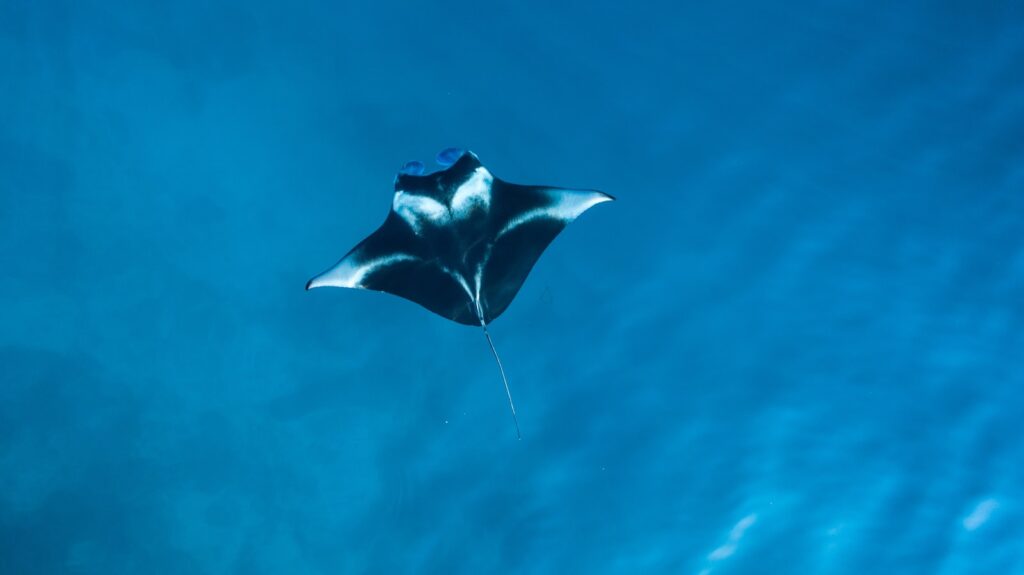
Manta Point Komodo — officially known as Karang Makassar — is a submerged reef plateau inside Komodo National Park where oceanic manta rays come to be cleaned by smaller fish. The stop is a roughly 30-minute drift snorkel: the boat drops you up-current, and you let the water carry you slowly over the cleaning station area while you watch whatever chooses to appear. Mantas are possible on any day of the year. They are not guaranteed on any day of the year. That distinction matters, and any operator who tells you otherwise is selling the fantasy version of the trip.
Where Karang Makassar Sits in the Day-Trip Route
On the standard six-stop speedboat itinerary out of Labuan Bajo, Manta Point comes fifth — after Padar, Pink Beach, Komodo Island’s Loh Liang, and Taka Makassar sandbar. The transit from Taka Makassar is short, around five minutes. From there, a final snorkel stop at Siaba Bay or a beach stop at Kelor or Kanawa Island closes the day before the roughly one-hour return run to Labuan Bajo harbour.
The placement at stop five is deliberate: by that point in the day, the tide window for the cleaning station is typically more reliable in the early afternoon, and the group has already cleared the longer, more physically demanding stops. But sea state and tidal timing shift constantly, and your guide will make the call on the water.
The Honest Manta Picture
Mantas use Karang Makassar as a cleaning station. Small wrasse and other reef fish remove parasites from the manta’s skin — the manta glides slowly in a near-circular pattern, sometimes for extended periods, which is exactly what makes drift snorkeling here work so well when they are present. The cleaning station is the draw, not a feeding aggregation or a predictable migration route.
Operator accounts — not formal survey data — suggest larger aggregations tend to occur in the wetter, plankton-richer months from roughly December through February. Treat that as field lore worth knowing, not a booking guarantee. June through August, which is peak tourist season and the period with the calmest seas, does not correspond to the highest reported manta frequency. That irony is real. You can encounter mantas in any month; you can miss them in any month.
No official body publishes manta sighting statistics for Karang Makassar. Anyone quoting you a percentage probability is extrapolating from their own logs at best, inventing at worst.
Currents: The Part Nobody Undersells Enough
The tidal currents at Manta Point are strong. That is not a dramatic flourish — it is the defining physical fact of the site, grounded in the same oceanographic forces that make the Komodo channel one of the more current-intense passages in Indonesia. Strong swimmers have been caught off guard here. The Flores Sea moves water through these straits on a tidal schedule, not a tourist schedule.
What that means practically:
- Your guide enters the water with the group. This is not optional and not a formality.
- Weak or uncertain swimmers should wear a life jacket in the water. This is not embarrassing — it is sensible, and good operators carry them on deck as standard gear. Watching from the boat is also a legitimate choice and not a waste of the stop.
- The drift direction is set when you enter. Do not swim against the current trying to return to a cleaning station you passed; signal the guide and the boat will reposition you.
- Fins matter here more than at calmer stops. If your tour includes them, use them. If you are on a budget boat where fin availability is inconsistent — check before you leave the harbour.
The boat drops you up-current and shadows your drift from above. A competent crew keeps the vessel close enough for quick retrieval. Ask your operator how they handle current drift management before booking — the answer tells you something about how they run the water.
Manta Etiquette: Best Practice, Not Park Law
There is no single verified, published BTNK regulation that codifies manta interaction rules in enforceable text — at least none that independent sources have confirmed as of mid-2026. What exists instead is a widely adopted best-practice code, consistent across responsible dive and snorkel operators globally, that experienced guides apply here. Treat it as a professional standard, not a suggestion:
- No touching
- Mantas have a protective mucus layer on their skin. Contact — even brief, even well-intentioned — degrades that layer and creates pathways for infection. Keep hands to yourself entirely.
- Maintain approximately 3 metres distance
- This applies horizontally and vertically. Hovering directly above a manta as it circles disrupts the cleaning behaviour. Stay to the side and slightly below or level.
- No chasing
- If a manta decides to move on, it moves on. Chasing causes stress, terminates the cleaning session, and makes the experience worse for every other snorkeler in the water. Let it go.
- No riding
- Self-explanatory, and yet guides still have to say it. Do not attempt to grab a fin, a cephalic lobe, or any other part of the animal.
- Approach from the side
- Never descend from above onto a cleaning manta. If you want a closer look, approach from the lateral plane — this is less disruptive to their field of vision and to the cleaning routine.
- No camera flash
- Flash photography underwater at a cleaning station is disruptive and produces inferior photos anyway. Turn it off before you enter the water.
- Do not block the cleaning station
- The manta needs a clear approach path to circle back to its cleaning fish. Snorkelers clustering directly over the station — particularly a common instinct in groups — is the single fastest way to end the sighting. Drift around the perimeter, not through the centre.
Guides on quality boats brief this before you enter the water. If yours does not, that is a signal worth noting for your review.
What to Expect on the Day: Timing and Duration
The Manta Point stop runs approximately 30 minutes as part of the six-stop itinerary. That is the in-water window, not the on-site total. Depending on sea state, the guide may extend or shorten the stop. If conditions are rough — a common scenario in the wet season from December through February — the guide may cancel the stop entirely and substitute an alternative snorkel site.
Here is where Manta Point fits within the full day-trip timeline:
| Stop | Approx. time on site | Transit from previous stop |
|---|---|---|
| Depart Labuan Bajo | — | 06:00–07:00 (pickups from ~05:30) |
| Padar viewpoint | ~75 min | ~60 min from LBJ |
| Pink Beach | ~50–60 min | ~20 min |
| Komodo / Loh Liang | ~80 min | ~20 min |
| Taka Makassar sandbar | ~45 min | ~30 min |
| Manta Point (Karang Makassar) | ~30 min | ~5 min |
| Final snorkel / Siaba / Kelor | ~30 min | variable |
| Return to Labuan Bajo | — | ~60 min; arrive 16:30–18:00 |
Timings are from a published itinerary cross-referenced against multiple operator sources. They represent the standard speedboat product. Slow wooden boats cannot complete this full six-stop loop in a single day — their transit speed of 6–8 knots makes the Manta Point leg impractical on most slow-boat day trips, which typically cover two or three stops instead.
Is Manta Point Right for Beginner Snorkelers?
It can be, with the right preparation. The site is not a protected lagoon, and the current is real. That said, the drift format actually removes one common beginner problem: you do not have to swim hard to stay in place, because you are not trying to stay in place. The current does the work.
What matters more than raw swimming ability is comfort — with being in open water, with following a guide’s instructions, with letting go of the idea that you can control where you end up. If that description causes anxiety, the boat deck is a genuinely good vantage point on calm days. Binocular-distance manta sightings from the boat are reported regularly.
Children and less confident swimmers should wear life jackets in the water. Operators who push back on that request are not operators you want guiding this stop.
If you are planning a Komodo day trip and want to match your swimming confidence to the right boat type and group size, our planning form lets you flag exactly that — we can help you find an operator whose guide-to-guest ratio and safety approach fit the group you are travelling with. No one can pay to change what we publish; if you use our free help and proceed with a partner operator, they may pay us a referral fee at no extra cost to you.
Reef-Safe Sunscreen and the Plastic Question
The reef ecology around Karang Makassar extends well beyond the mantas. Most operators running quality boats enforce a no single-use plastic policy — bring a refillable water bottle. On the sunscreen question: BTNK has not published a verified park-wide ban on conventional sunscreens in text that independent sources have confirmed, but the reef-safe preference is consistently enforced at the operator level and is well aligned with the site’s ecological value. Apply sunscreen 30 minutes before entering the water regardless of formulation.
Booking Context: Manta Point on Private vs Shared Boats
Manta Point appears on both shared open-trip speedboat itineraries and private charter routes. The difference is not primarily about access to the site — it is about group size in the water and flexibility on timing.
On a shared boat carrying 15–22 passengers, ten or more snorkelers may be in the water simultaneously at Karang Makassar. That volume of people near a cleaning station raises the probability that individual behaviour disrupts the manta. On a private charter with four to eight guests and a single guide, the dynamic changes noticeably.
Shared speedboat day trips from Labuan Bajo run broadly IDR 1,200,000–1,800,000 per person (approximately USD 75–120), with park fees paid separately in cash on the day. Private speedboat charters for a small group of around six passengers run roughly IDR 8–12 million per boat per day (approximately USD 500–800), making the per-person cost comparable or better at group sizes of four and above. All park fees are excluded from tour prices and paid cash on arrival — budget approximately IDR 300,000–500,000 per person for the full fee stack covering entrance, ranger, and harbour fees. Confirm the breakdown with your operator before you go, as the fee structure has shifted in 2025–2026 and figures circulating online are inconsistent.
What Happens If There Are No Mantas
A manta-free Karang Makassar is still a snorkel stop worth doing. The reef structure itself carries marine life — reef fish, the occasional turtle, sometimes a shark patrolling the cleaning station edge. The drift experience over open water with clear visibility is distinctive even without a manta sighting. But if your sole reason for booking a Komodo day trip was the manta guarantee, recalibrate that expectation before departure.
Ask your operator directly: what do you do if conditions at Manta Point are unsuitable or mantas are absent? A good answer names an alternative site. A poor answer restates the guarantee you should not have been given in the first place.
Ready to plan a Komodo day trip that sets realistic expectations and matches you to the right boat and route? Start with our planning form or reach out via WhatsApp — we are happy to walk through the itinerary options, group-size implications, and which operators are running well right now. We can usually respond within a few hours during Labuan Bajo business hours.
Frequently Asked Questions
Is seeing a manta ray at Manta Point Komodo guaranteed?
No. Mantas visit Karang Makassar to use its cleaning stations, and they come and go on their own schedule. Sightings are possible year-round. Operator field reports suggest higher aggregations during the plankton-rich wet months around December to February, but this is not based on formal survey data — treat it as informed lore, not a forecast. Any operator promising a manta sighting is overstating what the site can deliver.
How strong are the currents at Manta Point, and is it safe for weak swimmers?
The currents at Karang Makassar are genuinely strong — driven by the same tidal forces that move water through the Komodo channel. Even capable swimmers have been caught off guard. Weak swimmers and children should wear a life jacket in the water, which any reputable operator carries as standard. Watching from the boat on a calm day is also a viable option — some manta sightings are visible from deck. Your guide enters the water with the group; the boat shadows the drift overhead.
What is the best month to visit Manta Point in Komodo National Park?
Mantas are present year-round, so there is no single best month. Calm sea conditions for comfortable drift snorkeling run broadly April through November, with April–June and September–October being the most settled. The wet-season months December through February bring rougher seas and higher cancellation risk but also the plankton conditions that operators associate with larger manta aggregations — so there is a tradeoff. June through August is peak tourist season with the calmest weather, but not necessarily the highest manta frequency.
Can I do Manta Point on a slow wooden boat day trip?
Realistically, no. Slow wooden boats cruise at 6–8 knots, which means the transit to the far stops — Padar, Komodo Island, Manta Point — takes several hours each way. A slow-boat day trip typically covers two to three stops and runs 12–14 hours even so. Manta Point sits at the deeper end of the park’s standard itinerary and is almost exclusively a speedboat product. If Karang Makassar is a priority, book a speedboat.
Do I need to pay a separate fee to snorkel at Manta Point?
No separate snorkeling surcharge applies at Manta Point. The standard park entrance ticket — IDR 150,000–250,000 per person per day for foreign visitors (some sources apply the higher rate only on Sundays and public holidays; confirm on the day) — covers snorkeling park-wide. A harbour fee of approximately IDR 25,000 per person per day also applies. All fees are paid in cash on the day and are excluded from tour prices. Budget IDR 300,000–500,000 per person for the full fee stack across a six-stop day; confirm the current breakdown with your operator before departure, as the fee regime is reviewed periodically.