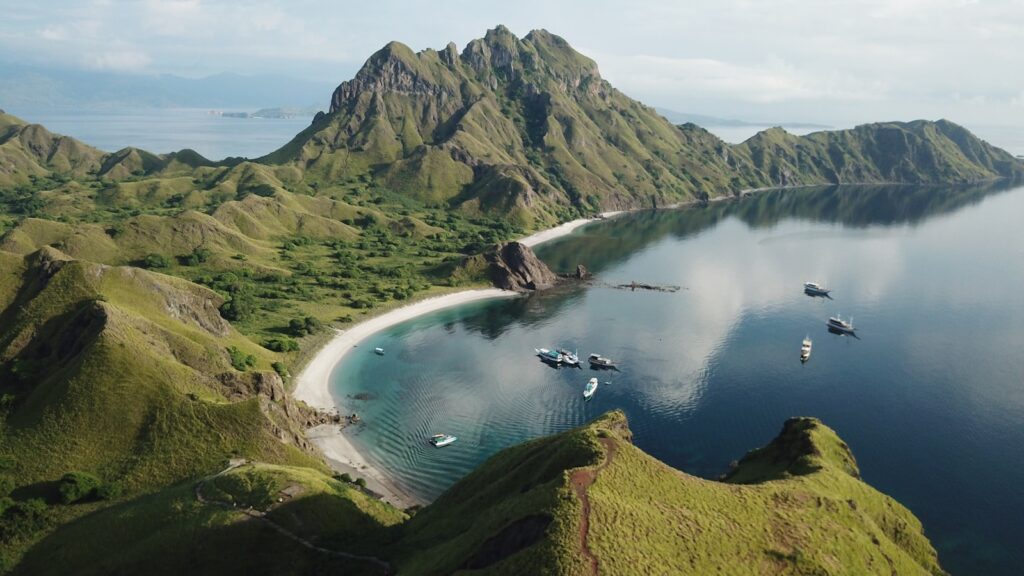
Casual drone flying is effectively prohibited in Komodo National Park. If you want to bring one for personal photography, the practical answer is: leave it at your hotel in Labuan Bajo. For any legitimate aerial filming or commercial photography work, you need a SIMAKSI (Surat Izin Masuk Kawasan Konservasi — the conservation-area entry permit) combined with a separate filming permit, both arranged in advance through BTNK (Balai Taman Nasional Komodo), the park management authority. This is not a technicality that rangers look the other way on — confiscations do happen.
Why the Default Answer Is No
Komodo National Park is a UNESCO World Heritage Site and a protected conservation area under Indonesian law. The authority to grant access for filming and aerial work rests entirely with BTNK, the central park office in Labuan Bajo. There is no walk-up drone permit you can buy at the pier or at the ranger post on Loh Liang. The permit process runs through Jakarta-coordinated channels, takes meaningful lead time, and involves documentation requirements that a day-tripper arriving on a shared speedboat cannot fulfil on the morning of their tour.
Rangers at the landing points — Loh Liang on Komodo Island, Loh Buaya on Rinca, and the Padar viewpoint — do check gear. Unpermitted drones are subject to confiscation. The amounts of any on-the-spot fines are not reliably documented in any public source we have found; we are not going to invent a number here, so treat confiscation risk as the primary deterrent, not a specific penalty figure.
What the Permit Process Actually Requires
For anyone doing legitimate aerial work — documentary teams, commercial photographers, content producers — the process runs through two separate authorisations:
- SIMAKSI (Surat Izin Masuk Kawasan Konservasi)
- The standard conservation-area entry permit required for any activity beyond a standard tourist visit. This is the base-level document that unlocks the right to operate professionally within the park boundary. Applications go to BTNK’s office in Labuan Bajo, with documentation of purpose, team members, equipment list, and dates.
- Filming / aerial photography permit
- A separate permit on top of the SIMAKSI, specifically covering filming, commercial photography, and drone operations. This typically requires a letter of intent, a detailed shot plan, equipment specifications, and coordination with the BTNK communications or conservation division. For larger productions, approval may need to be routed through higher ministerial channels.
- Drone fee (reported — unverified)
- Two operator sources have cited a fee of approximately IDR 2,000,000 per unit per day. We are publishing this as reported and unverified. Before planning a shoot budget around this figure, confirm the current tariff directly with BTNK. Park fees in Indonesia are set as national non-tax state revenue (PNBP) and can change without wide public notice.
- Lead time
- There is no same-day or next-day option. Budget at minimum one to two weeks of lead time for the paperwork; for complex productions, longer. Applications submitted from abroad need extra time for document verification.
The drone fee above — approximately IDR 2,000,000 per unit per day — is the only figure circulating among operators, and it comes from two independent sources rather than a published government tariff sheet. Treat it as a planning indicator, not a confirmed number. Always confirm with BTNK directly before committing to a shoot schedule.
The Reality for Day-Trippers
Almost everyone reading this page is planning a standard day trip from Labuan Bajo — a shared speedboat, six stops, back before sunset. For that trip, the drone question resolves quickly: there is no practical path to legal drone operation on a standard day trip. The permit process requires advance paperwork that must be arranged before you arrive in Labuan Bajo, a documented purpose, and specific authorisation from BTNK for the dates and locations you intend to fly.
The tour operator running your boat has no authority to grant you drone access. The rangers on Padar, Komodo, and Rinca have no mechanism to approve it on the day. Pulling out a drone on the Padar viewpoint or on the beach at Pink Beach is the kind of thing that ends with the equipment being held until you leave the park, and potentially the whole group’s day being disrupted.
If you are a serious photographer planning the trip around aerial work, the right sequence is: contact BTNK weeks before travel, get the SIMAKSI and filming permit confirmed in writing, budget for the reported per-unit fee, and build your shoot dates around the permit window — not the other way around.
Planning a day trip and want to know what gear is actually worth bringing? Our full packing list for a Komodo day trip covers cameras, snorkel gear, footwear for the Padar hike, and everything that fits in a small dry bag without creating any problems at the ranger post.
Why Enforcement Is Stricter Than It Used to Be
Komodo National Park introduced a hard cap of 1,000 visitors per day park-wide in 2026, moving from an announced trial in early March to active enforcement by April. The visitor management apparatus has tightened considerably alongside that change. Rangers are more present, more coordinated, and the SiORA online booking system means visitor identities and equipment are more traceable than they were when enforcement was looser.
There is also a straightforward conservation rationale. Komodo dragons are sensitive to disturbance. The savannah habitat on Komodo and Rinca — dry, grassland, with specific resting and feeding patterns for the dragons — is exactly the kind of terrain where low-altitude drone noise can disrupt wildlife behaviour. The same applies to the marine environment: manta rays at Karang Makassar, sea turtles at Siaba Bay, and the reef communities throughout the park are all on the sensitive side of the spectrum. BTNK’s position on drones reflects genuine management priorities, not bureaucratic friction for its own sake.
Alternatives for the Photography-Focused Traveller
The good news is that Komodo National Park produces extraordinary photography without any drone work. The Padar Island viewpoint — after roughly 800 steps and 30 to 40 minutes of moderate climbing — gives you one of the most composed landscape frames in eastern Indonesia: three bays, three distinct beach colours, Flores Sea on both sides. The light at sunrise and in the early morning hour after is genuinely different from midday.
At Loh Liang on Komodo Island, the short trek puts you within a few metres of Komodo dragons in open savannah. Rangers carry forked sticks and keep the group at a minimum of three to five metres — which is close enough for a standard telephoto lens to fill the frame. Pink Beach offers underwater photography if you have a waterproof housing; the sea life around the reef edge is dense. Manta rays at Karang Makassar move through a cleaning station that the guides position you above, drifting in the current — a wide-angle underwater shot here can be spectacular.
None of this requires aerial equipment. If your creative brief specifically requires aerial footage, the permit path is open — it just requires planning lead time that most day-trippers do not have.
How to Contact BTNK for Permit Enquiries
The Balai Taman Nasional Komodo (BTNK) main office is in Labuan Bajo, the gateway town for all park visits. For filming and drone permit enquiries, contact should go to the BTNK office directly — either in person if you are already in Labuan Bajo with sufficient lead time, or in advance by correspondence. Your tour operator or a local fixer with park connections can help navigate the documentation requirements.
Do not attempt to arrange drone permits through a boat operator or an OTA booking platform. Those parties have no authority over SIMAKSI or filming permits, and any claim that they can arrange drone access on your behalf should be treated with scepticism until confirmed in writing by BTNK itself.
If you are putting together a production trip and want to coordinate access alongside a guided day trip or private charter, use our planning form to describe your project. We can connect you with operators who have experience supporting permit applications and who know the BTNK process. You can also reach the planning team directly via WhatsApp — share the dates, drone specs, and the kind of shots you are after, and we will help you figure out whether the timeline is realistic.
Summary: The Practical Checklist
| Situation | Drone status | What to do |
|---|---|---|
| Standard day trip, shared or private speedboat | Not permitted — no walk-up permit exists | Leave drone at hotel; bring a camera with a good telephoto instead |
| Personal travel photography, no commercial use | Still requires SIMAKSI + filming permit via BTNK | Apply through BTNK weeks in advance; confirm fee (~IDR 2M/day reported, unverified) |
| Commercial shoot, documentary, content production | Permitted with SIMAKSI + filming permit + possible higher-level approval | Contact BTNK directly; allow 2+ weeks minimum; budget IDR 2M/unit/day (reported, confirm) |
| Flying without permit | Prohibited; confiscation risk is real | Do not attempt — fines unverified but enforcement is active |
Frequently Asked Questions
Can I fly a drone at Padar Island specifically, since it is separate from the main Komodo Island?
No. Padar Island is fully within Komodo National Park, under the same BTNK jurisdiction and the same permit rules as Komodo and Rinca. The ranger post at the Padar landing point operates under the same authority. There is no separate permit pathway for Padar, and the ranger presence there is consistent during visitor hours. Treat Padar, Komodo, and Rinca identically For drone restrictions.
What happens if a ranger catches me flying a drone without a permit?
The documented outcome is confiscation of the equipment. The fine amounts are not reliably published in any source we have found — we are not going to publish an unverified number that could mislead you. In practice, an unplanned confiscation will disrupt the rest of your group’s day and may require a visit to the BTNK office in Labuan Bajo before the equipment is returned. The risk is real and the administrative process is inconvenient.
My tour operator said they can arrange a drone permit for me — is that reliable?
Treat any such claim carefully. Boat operators and OTA booking platforms have no authority to issue SIMAKSI or filming permits — those come only from BTNK. A well-connected operator with a long-term relationship with BTNK may genuinely be able to help facilitate the paperwork on your behalf, but you should ask for confirmation in writing from BTNK itself, not just from the operator. If the operator cannot provide that documentation in advance of travel, assume the permit is not in place.
Is the drone fee really IDR 2,000,000 per day?
That figure comes from two independent operator sources and is the only number circulating in the Komodo tourism market. We are publishing it with an explicit flag: reported and unverified. Park fees in Indonesia are set as PNBP (non-tax state revenue) and the tariff schedule is not consistently published in English-language sources. Before planning a shoot budget, contact BTNK directly to get the current approved rate in writing.
Where can I get more information about what to pack for a Komodo day trip, now that I know to leave the drone behind?
Our Komodo day trip packing list covers the essentials: reef-safe sunscreen, footwear for the Padar hike, snorkel gear notes, camera recommendations, cash requirements for park fees, and a few things most people forget. If you want personalised advice for your specific trip dates or group, our planning form is the fastest way to get an answer.