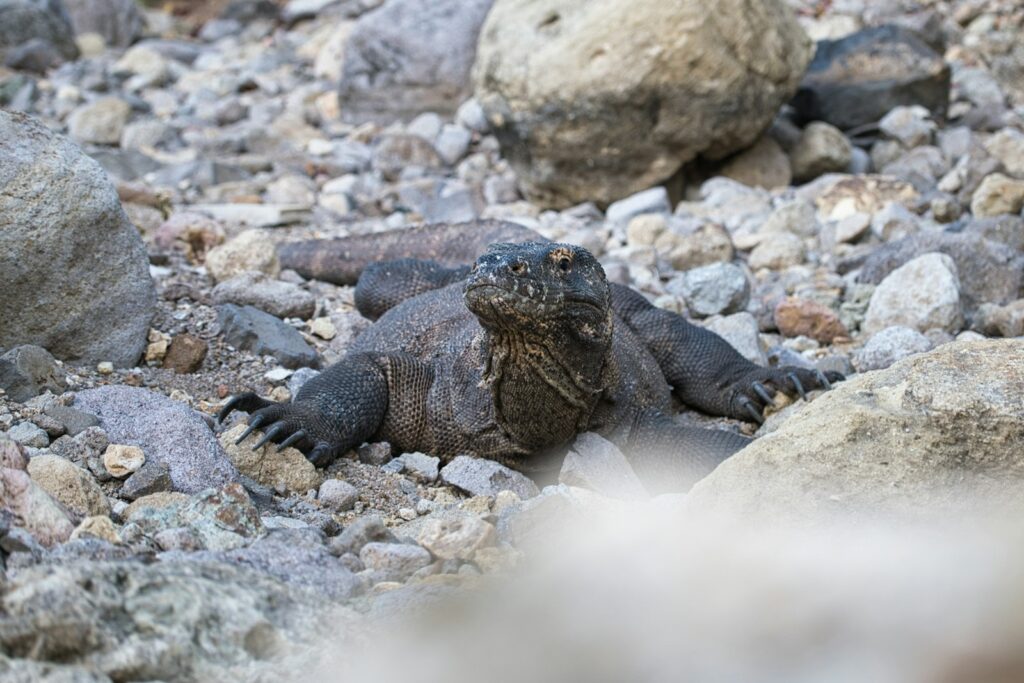
A Rinca Island day trip is a guided visit to Loh Buaya ranger station on Rinca Island — one of the two principal Komodo dragon habitats inside Komodo National Park — departing from Labuan Bajo harbour and typically returning the same day. Rinca sits roughly 25–30 km from Labuan Bajo (approximate chart distance), less than half the distance to Komodo’s main ranger post at Loh Liang (~60–65 km). That proximity gap is what makes Rinca the natural anchor for slow-boat days, short-window itineraries, and the classic budget combo of Kelor Island + Rinca + one snorkel stop — all of it feasible before dark on a wooden boat that cruises at 6–8 knots.
Why Rinca Gets Overlooked — and Why That’s Backwards
Most promotional material for Komodo day trips leads with Komodo Island itself. Understandable: the name has global recognition, and the long savannah treks at Loh Liang have a wilder, less curated feel. But for many travelers flying in for a single day, Komodo Island’s distance (~1 hour by speedboat from Labuan Bajo) is a real constraint on total time at each stop. Rinca changes the arithmetic completely.
By speedboat, Loh Buaya is roughly 30–45 minutes from the harbour. By slow wooden boat, it’s the difference between arriving mid-morning and arriving at the wrong end of the afternoon. If you’re on a budget boat, or if your departure window from Labuan Bajo is shorter than ideal, the route logic points directly at Rinca. The dragons are the same species. The ranger protocol is identical. The fee structure matches. What changes is the geography — and, significantly, the on-island experience since Loh Buaya’s redevelopment in 2021–22.
Loh Buaya After the Redevelopment: What Honest Visitors Report
This is worth stating plainly because the gap between pre-2021 Rinca and the current site is large. Loh Buaya received a substantial infrastructure upgrade — elevated boardwalks, an expanded ranger complex, improved visitor facilities. The practical result is that viewing at Rinca is now heavily centred on those boardwalks. Dragons congregate around the kitchen and dining areas beneath the ranger station; encounters happen at designated viewpoints along the elevated walkway rather than on open savannah.
Whether that’s better or worse depends on what you want. The structure makes encounters more predictable — if you’re going primarily to see a dragon in the wild (a reasonable goal), Loh Buaya currently delivers good odds without a long hike. It also means the experience feels more managed and platform-style than a Komodo long trek, where you’re walking through dry grassland with a ranger out front and genuinely don’t know when you’ll round a corner and find a two-metre dragon sunning itself on a flat rock.
No official trail documentation for Rinca’s current trek options is publicly available — the above is anecdotal consensus from guides and operators active since the redevelopment. Longer savannah hikes at Loh Buaya are sometimes offered but inconsistently. Before booking, ask your operator directly: Is the long route currently available, and at what season is it open? Don’t assume.
Distance and Time: The Core Advantage
The numbers below come from published itinerary data and chart estimates. They are not official park figures — label them in your own planning as approximate.
- Labuan Bajo to Loh Buaya (Rinca)
- ~25–30 km straight-line. By speedboat: roughly 30–45 minutes. By slow wooden boat (6–8 knots): 1.5–2.5 hours one-way.
- Labuan Bajo to Loh Liang (Komodo)
- ~60–65 km straight-line. By speedboat: roughly 55–70 minutes. By slow wooden boat: 4–6 hours one-way — which is why the full 6-stop loop is realistically a speedboat product only.
- Labuan Bajo to Kelor Island
- ~8–10 km. A common first stop on the classic budget slow-boat day: Kelor + Rinca + one snorkel site.
The slow-boat constraint is real and it matters. A wooden boat departing at 06:00 has a genuine shot at Kelor, Rinca, and a snorkel stop at a site like Siaba or a patch reef near the Molo Straits, back to Labuan Bajo by early evening. The same boat attempting Komodo would reach Loh Liang around midday at best — cutting the trek window in half and pushing the return to 20:00 or later. Guides are honest about this when you ask them directly; operator marketing frequently is not.
Fees, Permits, and What to Bring in Cash
The fee structure at Rinca mirrors Komodo exactly. Nothing at Loh Buaya costs extra relative to Loh Liang — same park entry, same ranger levy, same port charge.
| Fee type | Amount (IDR) | Notes |
|---|---|---|
| Park entrance — foreigner | IDR 150,000–250,000 / person / day | Sources split between flat IDR 250,000 and weekday/holiday tiering; confirm with your operator before departure |
| Park entrance — Indonesian | IDR 50,000 weekday / IDR 75,000 weekend-holiday | Widely cited; single-source — treat as approximate |
| Ranger / guide fee (Loh Buaya) | IDR 200,000 per group up to 5 pax | Same rate as Komodo (Loh Liang); confirmed by multiple 2026 sources |
| Harbour / port levy | ~IDR 25,000 / person / day | Bundled into operator costs; you may see it itemised |
| Snorkeling surcharge | None | Base ticket covers snorkeling; no separate fee |
| Diving surcharge | IDR 25,000 / diver / day | One outlier source says IDR 100,000 — flag and confirm |
Practical budget: IDR 300,000–500,000 per person all-in for park fees, paid in cash on the day. Park fees are almost universally excluded from the headline tour price. Bring clean IDR notes — the ranger station does not have card facilities. The park ticket is valid park-wide across all islands for that calendar day, so you do not pay a second entrance fee if your itinerary combines Rinca with Kelor or a snorkel stop.
One fee structure to be aware of in 2026: the park authority introduced a 1,000 visitor per day cap park-wide, with a mandatory advance booking system via the SiORA app. In practice, operators handle the reservation — but this makes spontaneous walk-up day trips genuinely difficult. If you’re planning travel in peak season (June–August), confirm that your operator has already locked in a slot before you book anything else.
Dragon Sightings: Honest Odds
Komodo dragons are not zoo animals and cannot be summoned. That said, Loh Buaya has consistently strong odds in the morning — dragons are cold-blooded and shade-seek once midday heat arrives. Most visitors who arrive at Rinca between 08:00 and 10:30 see at least one adult dragon near the ranger station area or on the boardwalk route. Some days there are five or six; some days you’ll see tracks and not the animal. No operator or ranger can guarantee a sighting, and any that claims to is overselling.
A few behavioural notes grounded in general biology (not official park statements):
- Mating season runs roughly May–August. Males are more active and visible, occasionally engaging in combat. This overlaps with peak tourist season — if you’re visiting in June or July, the dragons are more likely to be moving around.
- Nest-guarding runs approximately September–December. Females become more territorial; rangers adjust group positioning accordingly.
- Dragons in deep midday heat are largely sedentary. Morning arrivals give you sharply better chances of seeing them active.
Ranger Protocol and Safety Rules
The safety protocol at Loh Buaya is identical to Komodo. A licensed ranger leads every group. You stay grouped, on the designated path, no straying or running. Minimum distance to any dragon: 3–5 metres. No crouching near them, no sudden loud sounds, no food carried openly on the trek.
Rangers carry forked sticks — these are crowd-management tools and calm-exit tools, not weapons. If a dragon moves toward the group, the ranger steps between it and the visitors and uses the stick to redirect. This works because the dragons are accustomed to this interaction; it does not make them tame.
One safety advisory worth flagging: women menstruating are typically asked to inform their ranger before the trek begins. Blood scent is a documented sensory trigger. This is a guide practice and operational advisory — it is not a written regulatory ban, and the phrasing matters. Inform your ranger; they will adjust group positioning. It is not a reason to skip the visit.
Attack incidents are extremely rare. A fatal tourist attack was reported in 2009 (single safety-guide source). No official year-by-year bite statistics are published — guides and websites that quote specific incident counts are extrapolating, not citing official records. The meaningful safety advice is simple: stay with your ranger, maintain distance, move calmly.
The Classic Rinca Slow-Boat Combo: Kelor + Rinca + Snorkel
This is probably the most reliable budget day trip available from Labuan Bajo, and it works precisely because of Rinca’s proximity. The route typically runs:
- Kelor Island (~8–10 km from Labuan Bajo): a short, steep 20–30-minute hike to a saddle viewpoint above a turquoise bay. No dragon risk, no ranger fee — just a view. A good warm-up stop for groups with mixed fitness levels.
- Rinca / Loh Buaya: the dragon trek, 1–1.5 hours on site. Pay ranger fee (IDR 200,000 per group), follow the boardwalk, see the animals.
- Snorkel stop: a coral patch reef or bay near the return route. Rinca’s immediate waters have reasonable visibility when the tidal windows cooperate; your guide will pick the best accessible spot based on conditions that day.
Total trip duration on a slow boat: 10–12 hours including transit, but with a later departure possible than the 06:00 speedboat start — some operators run slow-boat Rinca trips departing at 07:30 or even 08:00. The transit leg gives you time to sleep, watch the coastline, and recover between stops rather than being rattled across open water at 30 knots.
If this route appeals to you and you want a second opinion on conditions or a recommended operator, use our planning form — or reach us on WhatsApp for a faster turnaround. We are an independent guide; if you proceed with a partner operator after using our free research, they may pay us a referral fee at no extra cost to you.
Rinca vs Komodo: Which Should You Choose?
This question comes up constantly and the honest answer is: it depends on your boat type, your available time, and what kind of on-island experience you want.
| Factor | Rinca (Loh Buaya) | Komodo (Loh Liang) |
|---|---|---|
| Distance from Labuan Bajo | ~25–30 km (approx) | ~60–65 km (approx) |
| Speedboat transit time | ~30–45 min | ~55–70 min |
| Slow-boat feasibility | Yes — core of the classic 3-stop slow-boat day | Difficult — very long transit cuts island time severely |
| On-island experience style | Boardwalk-centred, more managed; encounters near ranger station | Savannah trek options; wilder, less infrastructure-heavy feel |
| Trek variety | Short boardwalk route standard; long savannah hike inconsistently available — confirm in advance | Short (~45–60 min), medium (~90 min), long/adventure (~2–3 h) formally available |
| Ranger fee | IDR 200,000 / group up to 5 | IDR 200,000 / group up to 5 — identical |
| Dragon sighting reliability | Good — concentrated around station/boardwalk | Good on short trek; longer treks involve more terrain variability |
| Best for | Slow-boat days, short windows, budget combos, visitors who want reliable encounters without a long hike | Speedboat 6-stop days, visitors wanting the full savannah trek experience |
If you are on a speedboat doing the full 6-stop loop, your itinerary almost certainly includes Komodo rather than Rinca — the extra distance is absorbed easily at speed, and operators build their flagship route around Loh Liang. If you’re on a slow boat, or if you want the 3-stop focused day rather than a rushed 6-stop marathon, Rinca is the better-suited choice.
One thing both islands share: neither guarantees dragon sightings, neither has predictable trail durations down to the minute, and neither is a passive experience. You are walking in an open habitat with the world’s largest extant lizard. Pay attention to your ranger.
What to Bring on a Rinca Day Trip
- Cash in IDR — park fees, ranger fees, and harbour levies are almost never included in the tour price. IDR 400,000–600,000 per person is a safe cash buffer.
- Closed shoes or sturdy sandals — the boardwalk is flat but extends onto paths with loose gravel and uneven ground. Flip-flops are technically allowed but impractical; trail shoes or hiking sandals are better.
- Sun protection — Rinca’s savannah terrain offers minimal shade outside the ranger station. Hat, sunscreen (reef-safe if you’re snorkelling after), and a light long-sleeved layer are practical, not optional in June–August heat.
- Water — bring more than you think you need. Hydration on the boardwalk trek is important; the ranger station does not reliably sell water.
- Snorkel gear — if a snorkel stop is included, check whether fins are provided. Budget boats often include mask and snorkel but not fins. Fins matter in current.
- Minimal bag — leave large daypacks on the boat if possible. The boardwalk trek moves faster without bulk, and rangers will ask you not to carry open food containers.
Booking a Rinca Island Day Trip in 2026
The 2026 visitor cap of 1,000 per day park-wide, with mandatory pre-booking via the SiORA system, changes the logistics for independent travellers. Walk-up bookings are being phased out. Tour operators handle the SiORA reservation as part of the booking process — but this means you need to book at least several days in advance during peak season (June–August), not the morning you want to go.
Shared slow-boat trips incorporating Rinca typically run IDR 500,000–1,200,000 per person (~USD 30–80), excluding park fees. Shared speedboat day trips that include Rinca as the primary dragon stop (rather than Komodo) run roughly IDR 1,200,000–1,800,000 (~USD 75–120), again excluding park fees. These are ranges across a volatile market — individual operator quotes will vary, and peak-season surcharges of 10–30% apply in June–August.
When evaluating quotes, the single most important clarifying question is: Are park fees included, and if so, which fees exactly? The answer should be transparent. If an operator says everything is included without itemising, ask for the breakdown. It’s your cash they’ll be collecting at the dock.
Ready to compare options for your specific dates? Start with our planning form, drop your travel window and group size, and we’ll come back to you with current operator availability. WhatsApp works too if you’d rather talk it through directly.
Frequently Asked Questions
Is Rinca Island better than Komodo for seeing Komodo dragons?
Neither is objectively better — they’re different experiences. Rinca’s post-2021 redevelopment means viewing is concentrated around the elevated boardwalk near the ranger station, making encounters relatively reliable without much hiking. Komodo (Loh Liang) offers longer savannah treks with a less managed feel, but more varied terrain and trek options. If you want the most predictable sighting with a shorter time commitment on land, Rinca’s current setup suits that well. If you want to walk further into the habitat, Komodo’s longer routes are the better fit.
Can I do a Rinca Island day trip on a slow/budget boat?
Yes — and Rinca is actually the destination that makes a slow-boat day trip viable. At roughly 25–30 km from Labuan Bajo, a wooden boat cruising at 6–8 knots covers the distance in 1.5–2.5 hours one-way, leaving enough time for Kelor Island, the Rinca trek, and a snorkel stop before the return. Komodo Island (~60–65 km) is effectively not reachable on a slow-boat day trip without cutting the on-island experience to almost nothing.
What are the ranger fees at Rinca, and are they included in my tour price?
The ranger fee at Loh Buaya is IDR 200,000 per group of up to five people — the same rate as Komodo Island (Loh Liang). It is almost universally not included in tour headline prices; you pay it cash at the ranger station. Combined with the park entrance fee (IDR 150,000–250,000 per person, depending on day and sources) and harbour levy (~IDR 25,000), budget IDR 300,000–500,000 per person in cash for all on-the-day park costs. Confirm with your operator exactly which fees they include before departure.
Are Komodo dragon sightings guaranteed on a Rinca day trip?
No, and any operator that guarantees sightings is overselling. Dragons are wild animals in their natural habitat — they move, they hide in the heat, and their behaviour varies by season. That said, Loh Buaya’s boardwalk-centred layout means dragons congregate near the kitchen and ranger station area, and morning arrivals (before 10:30) consistently report good encounter rates. The mating season from roughly May through August makes dragons more active and visible. Show up early, follow your ranger, and expect a good-but-not-certain chance.
Do I need to book a Rinca Island day trip in advance, or can I arrange it on arrival in Labuan Bajo?
In 2025–2026, advance booking is strongly recommended and increasingly necessary. The park authority introduced a 1,000 visitor per day cap with mandatory pre-registration via the SiORA online booking system — walk-up visits are being phased out. In practice, your tour operator handles the SiORA booking, but they need time to secure a slot. During peak season (June–August), booking 7–14 days ahead is prudent. Off-peak you may have more flexibility, but same-day arrangements carry real risk of being turned away at the park entrance.