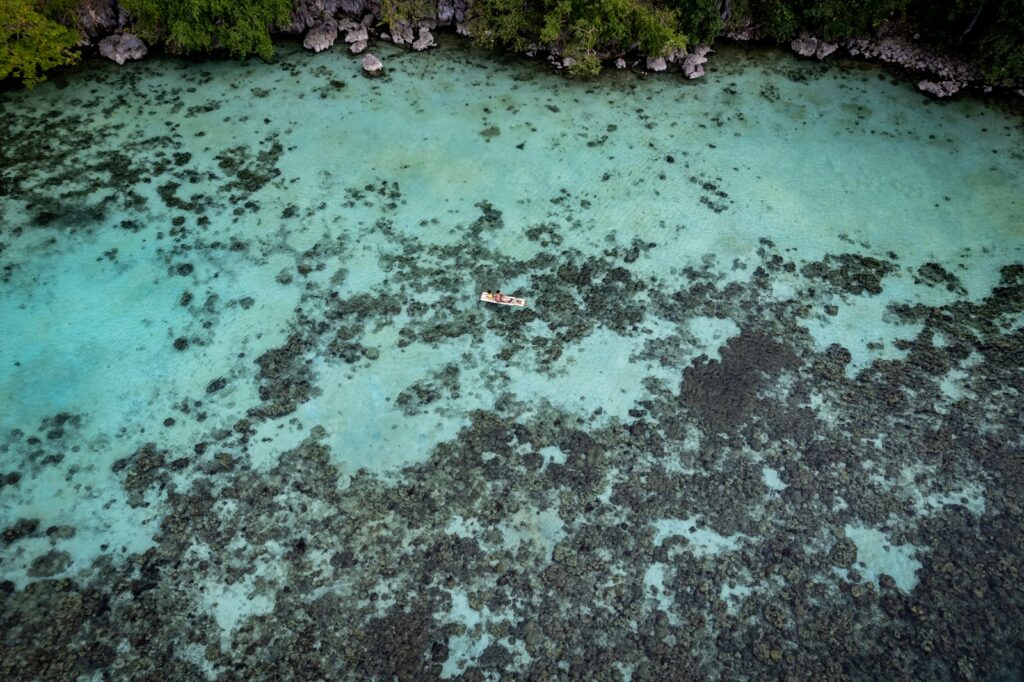
Kanawa Island snorkeling is the closest thing to a hotel house reef that Komodo National Park offers: a shallow fringing coral garden beginning less than ten metres from the jetty, with calm water that rarely tests your swim confidence. Your fins barely touch down before the coral begins. For the majority of stops in the park — Manta Point, Pink Beach, Taka Makassar — you need to drift with current, time the tide, or at minimum swim with purpose. At Kanawa, you slide in from the wooden jetty steps and the reef is already there.
That distinction matters more than it sounds. A six-stop day trip runs ten to twelve hours door-to-door. By the time the boat reaches its final snorkel, some guests are tired, a little sunburned, and done with fighting surge. Kanawa rewards them. It also means that the guests who never felt fully relaxed at the bigger, more exposed snorkel sites often get their best underwater moment of the day here, at the stop they nearly skipped.
Where Kanawa Sits in the Park — and in the Route
Kanawa is a small island in the eastern section of Komodo National Park, positioned between Labuan Bajo and the main park islands of Komodo and Rinca. That geography matters for route logic: it sits closer to Labuan Bajo than Padar, Pink Beach, or Loh Liang, which means it works naturally as a final stop on the return leg rather than an outbound detour.
The standard six-stop speedboat itinerary runs roughly: Padar viewpoint at dawn → Pink Beach → Komodo (Loh Liang) → lunch on board → Taka Makassar sandbar → Manta Point → final snorkel stop → Labuan Bajo. That final snorkel slot, arriving mid-to-late afternoon, is where operators rotate between three alternatives: Siaba Besar (the turtle-point site), Kelor Island (a short viewpoint hike with snorkel below), and Kanawa. Which one you get depends on the operator, the day, and sometimes the sea state.
Not every route includes Kanawa. Budget slow-boat trips running two to three stops will not reach it — the slow boat simply cannot cover the full loop in a day (the transit time alone from Labuan Bajo to Padar is three to four hours on a traditional wooden boat, versus roughly one hour by speedboat). If seeing Kanawa specifically matters to you, confirm when booking that it is on the stated itinerary, and ask whether the operator treats it as fixed or as weather-dependent. Some operators list all three alternatives as interchangeable and decide on the morning based on current and conditions.
What the Reef Actually Looks Like
The fringing reef at Kanawa is not the most dramatic coral structure in the park — Manta Point has the theatrical drift element, Siaba has its resident green turtles, and Pink Beach has the famous rosy shoreline. What Kanawa has is accessibility and density close to the entry point.
The reef table begins at about one to three metres depth near the jetty, shelving gradually as you swim out. Hard corals — branching Acropora formations and brain coral heads — dominate the shallower sections. Fish life is typical of a healthy Indonesian reef: schools of sergeant majors and fusiliers, parrotfish working the coral edge, butterflyfish in pairs. Visibility in the dry season (April to November) is generally good, often ten to fifteen metres on a calm day, though this can drop during the wet months or after heavy rain stirs up sediment from nearby channels.
The key practical advantage: there is no meaningful current running directly over the shallow reef table near the jetty. This sets Kanawa apart from every other snorkel stop in the standard rotation. At Manta Point (Karang Makassar), the point of the stop is the current — you drift over the cleaning station. At Pink Beach, a tidal push can pull guests off the main reef into deeper water faster than expected. At Kanawa’s near-shore section, you can stop swimming entirely, tread water above a coral head, and stay exactly where you are. For a seven-year-old, a sixty-eight-year-old, or anyone for whom snorkeling is genuinely new, that difference is the whole experience.
Who This Stop Is Designed For
Kanawa is genuinely the right final stop for groups or families with mixed swim ability. That is not a soft qualifier — it changes the calculus of the whole day. If you are booking a private charter and one member of your group is nervous in open water, routing through Kanawa as your snorkel stop (in place of the more current-prone Siaba or the exposed Pink Beach) gives everyone a comfortable entry without sacrificing the reef experience.
The jetty entry also removes the need to drop from a rocking boat into open water, which is how most snorkel stops in the park work. Guests simply walk down the jetty steps and descend a short ladder. For older travelers with limited mobility, or children who find open-water entry intimidating, this is a meaningful advantage. Life jackets are standard equipment on licensed day-trip boats; there is no reason not to wear one here if you want the extra buoyancy — the snorkeling experience does not require you to free-dive below two metres.
One honest caveat: Kanawa does have a small resort on the island, and jetty areas see boat traffic from both day-trip speedboats and resort tenders. Be aware of engine noise and prop wash near the jetty — always surface and check before swimming back toward the ladder. Keep children close to the jetty on the near-shore section and let them range further only once you have had a chance to assess the current further out. This is not a dangerous setup, but it requires the same basic spatial awareness you would use in any harbour with working boats.
Snorkeling the Reef: Practical Guidance
Entry and Exit
Use the jetty steps rather than entering from the beach unless your guide specifically directs you otherwise. The steps give a controlled descent and prevent you from shuffling across the coral flat in fins. Keep fins on during the entire water entry — walking barefoot or in socks across exposed coral to get deeper before putting fins on is the most common cause of accidental coral damage at jetty sites like this. Back-roll entries from the boat hull are not the norm here; the jetty is the preferred access point.
No-Touch Rules
Komodo National Park is a protected marine area, and the no-touch rules are park law, not operator preference. Do not touch coral, stand on coral heads, or pick up anything from the seafloor — this includes shells, rocks, and sand. The park authority BTNK can inspect boats and gear. Reef-safe sunscreen is strongly recommended by operators (standard chemical sunscreens bleach coral over time); while no verified written BTNK ban on chemical sunscreen exists as of mid-2026, expecting operators to enforce it is reasonable and the right call regardless of regulation.
Buoyancy is the key skill here, and it matters more on a shallow reef than in open water. If you are a less experienced snorkeler, ask for fins at the start of the day and practise controlling your depth in open water before you are over coral. Kicking into a coral head is an easy mistake and an irreversible one.
Depth and Time Allocation
Most itineraries budget around thirty minutes at the final snorkel stop — similar to the Siaba Bay allocation in the published Green Rinjani itinerary. That is enough time to cover the near-jetty reef table twice at a relaxed pace. Do not swim aggressively outward into deeper sections in the first ten minutes expecting to find more spectacular coral; the best density is in the shallower zone where the light penetrates fully and the coral growth is most active.
Gear
Day-trip boats include a basic mask and snorkel in their standard kit; fins are inconsistent on budget and mid-range boats — confirm when booking if fins matter to you. On a calm, shallow site like Kanawa a snorkel vest or float belt is a real option for weaker swimmers and does not significantly impede visibility or enjoyment. Underwater cameras and housings are fine to bring; there is no camera or photography fee for standard snorkeling at park snorkel sites (the reported drone fee of approximately IDR 2,000,000 per unit per day applies only to aerial filming — confirm with BTNK in advance if you plan any drone work).
How Kanawa Compares to the Other Final-Stop Options
| Stop | Entry type | Current at snorkel zone | Key feature | Best for |
|---|---|---|---|---|
| Kanawa Island | Jetty steps | Low to nil near jetty | Dense shallow fringing reef, calm water | Beginners, families, seniors, nervous swimmers |
| Siaba Besar | Boat drop | Mild to moderate | Green turtles feeding on seagrass beds | Turtle encounters, confident swimmers |
| Kelor Island | Beach entry or boat drop | Mild (exposed to channel) | Short viewpoint hike + reef below the bluff | Guests who want a hike with their final stop |
The table above reflects general site character — individual conditions vary by tide, season, and sea state. Siaba’s turtle sightings are not guaranteed; Kelor’s hike is short (the summit takes around fifteen minutes) but the trail is steep and exposed in midday heat. If your group includes guests for whom the turtle encounter is the draw, Siaba is the better request. If a final stretch of legs appeals after a day mostly spent on a boat, ask for Kelor. If easy, gentle, reliable snorkeling for everyone on board is the priority, Kanawa is the call.
Park Fees at a Snorkel-Only Stop
One question that comes up often: do you pay extra to snorkel at Kanawa? The answer is no — the base park entrance fee covers snorkeling, and there is no separate snorkel surcharge at any site in Komodo National Park. The base foreigner ticket runs IDR 150,000 to 250,000 per person per day (sources differ on whether the higher rate applies only on Sundays and public holidays or across the board — confirm the current rate with your operator or on arrival). A diver’s surcharge of approximately IDR 25,000 per diver per day applies for scuba — this does not affect snorkelers.
All park fees are paid in cash on the boat, almost always excluded from the tour price. Budget IDR 300,000 to 500,000 per person all-in for the full day’s park costs (entrance, ranger fees for trekking sites, harbour fees), and bring enough cash to cover that before departure. Labuan Bajo has ATMs but the marina area is tight for time on an early-morning departure day.
Planning a route that includes Kanawa? Use our planning form to describe your group — experience level, ages, any mobility considerations — and we will help you match to operators whose itineraries actually include it, not just list it as a possibility.
Booking a Route That Includes Kanawa
Kanawa appears on some six-stop speedboat routes but is not universal. Whether it lands on your itinerary depends on the operator and, on the day itself, on the guide’s read of conditions and timing. Here is how to improve your odds of getting it specifically:
- Ask explicitly when booking. Request confirmation in writing (WhatsApp message, booking form) that Kanawa is a stated stop, not a weather-dependent optional. Many operators will confirm it for private charters with more flexibility than on shared open trips.
- Consider a private speedboat charter if Kanawa is important to your group. Private charters cost more — roughly IDR 8,000,000 to 18,000,000 per boat per day depending on size and season (indicative, quote-on-request market; peak season June–August adds 10 to 30 percent) — but they give you direct control over the stop list. On a shared open trip, the guide balances the whole group’s preferences and the day’s conditions.
- Early-morning departures matter. Boats that leave Labuan Bajo by 06:00 to 07:00 have enough time to run Padar at sunrise, complete the full middle-of-the-day loop, and still arrive at Kanawa with daylight and unhurried time in the water. Later departures cut time at every stop.
- Check 2026 booking requirements. As of early 2026, Komodo National Park operates a reported visitor cap of 1,000 visitors per day park-wide, with mandatory advance booking via the SiORA reservation system. In practice, licensed operators handle the reservation for their guests. If you are booking last-minute during peak season (June through August), confirm your operator can still secure a park slot — this is genuinely new in 2026 and the system is still being enforced. Last verified April 2026; confirm current status before travel.
No one can pay to change what we write here — our job is to give you the honest picture. If you proceed with one of our vetted partner operators after using our free planning help, they may pay us a referral fee at no extra cost to you. Our recommendations reflect itinerary fit and operator transparency, not commission rates.
Frequently Asked Questions
Is Kanawa Island snorkeling good for complete beginners?
Yes — it is one of the most accessible snorkel sites in the park for people with no prior experience. The entry is from a fixed jetty rather than a moving boat, the water is shallow close to the structure, and the current near the jetty is minimal. Wearing a snorkel vest or buoyancy aid is perfectly reasonable and does not diminish the experience. Ask your guide to accompany nervous swimmers for the first few minutes until they are comfortable.
Which day-trip routes include Kanawa as a stop?
Kanawa appears as a final-stop option on some six-stop speedboat itineraries, typically as an alternative to Siaba Besar or Kelor Island. It is not included on budget slow-boat routes (those cover two to three stops in a day, nowhere near enough time to reach the full loop). Confirm with your specific operator before booking — itineraries vary by company and by day. It is most reliably confirmed on private charter bookings where you can specify the stop list directly.
Can kids snorkel at Kanawa from a day trip?
Yes, and it is one of the better spots for it. The controlled jetty entry removes the open-water drop that many children find intimidating, the depth near the jetty is shallow enough for supervised snorkeling with floats, and the coral comes quickly. Standard life jackets are on board all licensed day-trip boats. Keep children in the near-jetty zone and monitor boat traffic — speedboat tenders from the island’s small resort occasionally use the same jetty approach.
Is there an extra fee for snorkeling at Kanawa?
No. Snorkeling is covered by the standard park entrance fee — there is no additional snorkel surcharge at Kanawa or any other snorkel site in Komodo National Park. Park fees (foreigner entrance currently IDR 150,000–250,000 per person per day, last verified 2026 — confirm on the day) are almost always excluded from the tour price and paid in cash on the boat. Budget IDR 300,000–500,000 per person all-in for a full-day park cost across all stops.
What should I do if I want Kanawa instead of Siaba or Kelor?
Request it explicitly at the booking stage and, if possible, in a written message to your operator so it is documented. On a private charter, substituting Kanawa for another final stop is straightforward. On a shared open trip, the guide may accommodate it if conditions and group preference align, but cannot guarantee it for one guest’s preference alone. If the itinerary is important, a private charter gives you the clearest control — though at a higher per-person cost unless your group fills the boat. See our full guide to planning your trip, and reach out via WhatsApp if you want a direct recommendation on which operators run Kanawa as a confirmed stop rather than an occasional alternative.