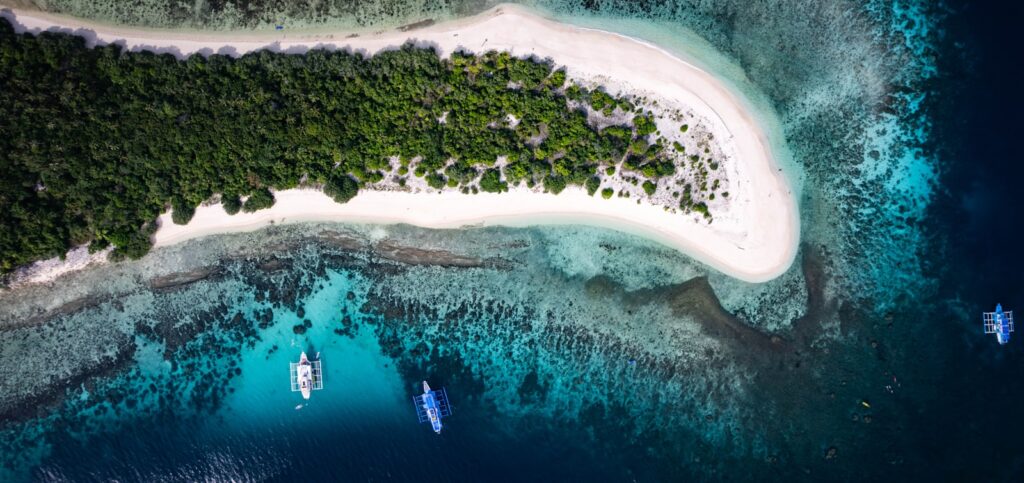
Taka Makassar sandbar is a crescent-shaped strip of white sand inside Komodo National Park that sits a few centimetres above the waterline at low tide and disappears entirely when the tide comes in. That is not a marketing exaggeration in reverse — it is the defining fact about the place. The sandbar has no permanent elevation, no guarantee of its above-water dimensions on any given morning, and no published tide-table that your operator can pin to a specific departure slot. Whether you step onto dry sand, wade through ankle-deep water, or find the crest just barely breaking the surface depends entirely on where the tidal cycle sits when your boat arrives. Your guide will know. You will not, until you get there.
Where It Fits in the Day-Trip Route
On the standard six-stop speedboat itinerary from Labuan Bajo, Taka Makassar is stop four — it comes after Padar, Pink Beach, and Komodo Island’s Loh Liang dragon trek, and before Manta Point. The transit from Komodo Island takes roughly 30 minutes by speedboat. From Taka Makassar, Manta Point (Karang Makassar) is only about five minutes away, which is why the two stops are almost always run back-to-back in the afternoon slot.
The placement in the middle of the day is not arbitrary. By the time the group reaches Taka Makassar — typically early to mid-afternoon — the morning shade on Padar is gone, the dragon walk at Loh Liang is done, and the pace shifts. Taka Makassar is shorter and quieter. Around 45 minutes on site is the standard window. It is a transition stop as much as a destination: water-entry is shallow, the sandbar is flat, and people spread out, take photographs, and drift before being collected for the Manta Point run.
- Location
- Inside Komodo National Park, between Komodo Island and the approach to Manta Point (Karang Makassar)
- Transit from Komodo / Loh Liang
- ~30 minutes by speedboat
- Transit to Manta Point
- ~5 minutes by speedboat
- Time on site (standard day trip)
- ~45 minutes
- Surface type
- Fine white sand, no vegetation
- Tide dependency
- High: sandbar size and exposure change significantly with tidal phase; may be fully submerged at peak high tide
- Entry depth (typical low-tide)
- Shallow — ankle- to knee-deep from boat to sandbar
- Current risk
- Present; tidal currents run through this area; strong at certain tidal phases
- Take-nothing rule
- Removing sand, shells, coral, or any natural material is prohibited; boats can be checked
The Tide Question: Why There Is No Precise Answer
People ask their operators for a tide forecast before booking. It is a reasonable instinct. The honest answer is that no published, operator-accessible tide prediction for Taka Makassar pinpoints exactly how much sand will be exposed at 1 pm on any specific date — certainly not with enough precision to restructure a day-trip itinerary around it. The regional tidal pattern is predictable in a general sense. The Flores Sea is a semi-diurnal system, which means two high and two low tides per day of unequal height. A guide with several years of experience routing boats through these waters has a working sense of where the tide should sit at a given hour on a given date. That is the best available input.
What this means practically: the sandbar can range from a wide, fully exposed crescent — wide enough for 20 or more people to spread out comfortably — to a sliver of wet sand barely clearing the waterline, to nothing visible at all. Experienced guides aim to time the Taka Makassar stop to coincide with a lower tidal phase. That does not mean they always succeed. Sea conditions on the day, delays at earlier stops, and the behaviour of neighbouring boats all affect the final approach time. Your stop may be magnificent or it may be anticlimactic, and the difference is mostly tide.
If you are booking a day trip and Taka Makassar is your single most anticipated stop, it is worth being candid with your operator about that before departure. A good operator will flag the risk, not suppress it. And for most people the sandbar is one strong stop within a full day — when it coincides with low tide and clear water, it genuinely earns its place on the itinerary; when the tide is less cooperative, the Manta Point run five minutes later quickly takes over as the day’s centrepiece.
Photography at Taka Makassar: Light, Timing, and What Actually Works
The images that circulate from Taka Makassar — the ones with the bright crescent of white sand against turquoise water, the horizon of green islands, the boat anchored a short distance off — are taken at low tide under clear midday to early-afternoon light. That is the realistic best case. The flat topography of the sandbar means there is no shade and no high vantage point. You are shooting at sea level, in direct sun, with water on all sides.
A few specifics worth knowing before you arrive:
- The light at midday is harsh. Overhead sun creates flat exposure and washed-out sand. Early afternoon — say 13:00 to 14:00 — gives you slightly warmer, more directional light while still being within the typical stop window. Shooting toward the horizon with the sun slightly behind you or to the side produces better results than shooting directly into it.
- Waterproof housing or a sealed case for your phone is worth the preparation. Even in shallow water at the sandbar edge, wave action and boat wakes can reach equipment at ankle level.
- The aerial perspective you see in promotional photos requires a drone. Drone use in Komodo National Park effectively requires an advance filming permit via BTNK, and two operator sources report a fee of around IDR 2,000,000 per unit per day — though this figure is unverified and should be confirmed directly with BTNK before you bring a drone into the park. Casual visitor drone use is not a realistic option here.
- The sandbar photograph that actually tells the story of the place is usually taken from just inside the water line, wide-angle, with the curved shore visible and the boat in the mid-ground. That shot is available to anyone with a waterproof camera and the patience to wade to the right angle.
One note on crowd management: Taka Makassar sits on a route used by multiple boats on the same daily schedule. If your boat arrives at the same low-tide window as three or four other operators, the sandbar will be busy. Private charters have slightly more flexibility to time the stop earlier or later; shared open-trip boats run on a fixed sequence that rarely accommodates significant deviation.
Currents and Water Safety
The shallow entry at Taka Makassar lulls some visitors into treating it as a completely benign stop. It is not. Tidal currents run through this part of the park — the same forces that produce the strong drift at Manta Point five minutes away are present in attenuated form around the sandbar. The entry from the boat to the sandbar is typically ankle- to knee-deep and calm. The deeper water off the sandbar edges, on the other hand, can carry a meaningful lateral pull, particularly as the tide is actively running in or out.
The currents at Taka Makassar, Manta Point, and Pink Beach are all in the same category: real enough that even confident swimmers can be caught off guard, according to consistent operator guidance. Stay within the shallow zone around the sandbar unless you are a strong swimmer and your guide has indicated the offshore water is calm on that day. Children should be watched closely at the sandbar edge. The depth increases quickly as you move away from the crest.
There is no lifeguard at Taka Makassar. Your guide is on the water with you, and the crew stays with the boat. Know where your guide is before you wade in.
The Take-Nothing Rule — and the Enforcement That Backs It
Removing sand, shells, coral fragments, rocks, or any natural material from Komodo National Park is prohibited under Indonesian protected-area law. This applies fully at Taka Makassar. Pocketing a handful of white sand as a souvenir is not a grey-area: boats can be searched when they leave park waters, and the rule has teeth.
This is not a lecture — it is a practical note. The sand at Taka Makassar is fine and clean and tempting precisely because it is protected. The same logic applies to shells and coral fragments in the shallows. Leave them where they are.
Single-use plastic follows the same principle. Most operators running quality boats enforce no-plastic policies; bring a refillable water bottle and expect it to be the norm rather than the exception. BTNK has not published a verified park-wide plastic ban in text that independent sources have confirmed, but the operator-level enforcement is consistent across reputable boats.
Taka Makassar on Slow Boats vs Speedboats
Taka Makassar is a speedboat stop. Slow wooden boats cruising at 6–8 knots take three to four and a half hours from Labuan Bajo to Padar alone — the furthest reach of the standard route. A slow-boat day trip that also covers Komodo Island, Taka Makassar, and Manta Point would push well past a 14-hour day, which is why slow-boat operators typically offer a two- or three-stop itinerary rather than the full six-stop loop. If Taka Makassar is on your list, the speedboat is the realistic vehicle.
Private speedboat charters have the additional advantage of timing flexibility. A private group that has completed the dragon walk at Loh Liang ahead of schedule can ask the captain to hold the Taka Makassar approach for an hour to improve the tidal window. Shared open-trip boats run a fixed daily schedule, and guide judgment on arrival time at Taka Makassar is the only variable.
If you are comparing boat options for a Komodo day trip and want help matching your priorities — whether that is maximising the Taka Makassar window, hitting Manta Point at the right stage of the tide, or building in more time at Padar — our planning form is a straightforward place to start. You can also reach us via WhatsApp for a quicker back-and-forth on timing and boat type. Describe what matters most to your group and we can point you toward the operator and boat configuration that gives it the best chance. No one can pay to change what we publish; if you use our free help and proceed with a partner operator, they may pay us a referral fee at no extra cost to you.
Taka Makassar in the Bigger Picture of the Day
The six-stop speedboat day out of Labuan Bajo departs around 06:00–07:00 and returns between 16:30 and 18:00. It is a full day: a 75-minute climb at Padar, a 50-minute swim at Pink Beach, an 80-minute walk through Loh Liang’s savanna with the Komodo dragons, then Taka Makassar, Manta Point, and a final snorkel stop before the one-hour run home. Taka Makassar sits at approximately the two-thirds mark of the day, which is a good place for a stop that asks nothing more demanding than standing on a sandbar and looking at the water.
Some groups find it the most photogenic stop of the day. Others, arriving at high tide, find it a brief float in shallow water before the Manta Point approach takes over. Both outcomes are legitimate. The sandbar is what it is when the water gives it back, and the guide is the right person to set your expectations on the morning you leave.
Frequently Asked Questions
Will Taka Makassar sandbar be above water when I visit?
It depends on the tide, and there is no published guarantee. The sandbar is fully exposed at low tide and fully submerged at high tide, with a wide range of partial exposure in between. Experienced guides who run this route regularly have a working sense of the tidal window on any given day and aim to time the stop accordingly. If you visit during a low-tidal phase the exposed crescent can be wide and photogenic; at a higher tidal phase you may wade through ankle-deep water over a barely visible crest. Ask your operator what the tide is expected to be doing at the time they plan to reach Taka Makassar — a good guide can give you a rough forecast, not a guarantee.
Can you swim at Taka Makassar sandbar?
You can enter the water, but it is primarily a sandbar stop rather than a snorkelling site. The shallow zone immediately around the sandbar is calm and easy. The deeper water off the edges carries tidal currents that can be strong at certain phases — the same tidal system that makes Manta Point five minutes away a drift-snorkel rather than a still-water swim. Stay in the shallow area around the sandbar unless you are a strong swimmer and your guide indicates conditions offshore are safe. Children should stay close to the sandbar crest and be supervised carefully at the edges.
Can I take sand from Taka Makassar as a souvenir?
No. Removing sand, shells, coral fragments, or any natural material from Komodo National Park is prohibited. Boats can be searched when leaving park waters. This applies to everything on and around the sandbar — including the fine white sand that makes the stop photogenic in the first place. Leave it as you found it.
Is Taka Makassar sandbar included in shared day trips, or only private charters?
It is a standard stop on most six-stop shared speedboat day trips from Labuan Bajo, typically listed between the Komodo Island dragon trek and Manta Point. Slow wooden boat day trips almost never reach it — the transit distances make a full six-stop slow-boat day impractical within daylight hours. If Taka Makassar is specifically on your list, confirm with your operator that it is in the itinerary and ask roughly what time they expect to arrive there.
How do I get the best photographs at Taka Makassar?
Arrive at or near low tide — that is the condition that produces the wide crescent visible in most promotional images. Early afternoon light (roughly 13:00–14:00) gives slightly warmer and more directional sun than harsh midday overhead light. Shoot from the water line, wide-angle, with the curved shore in the foreground and the boat or distant islands in the mid-ground. Bring waterproof protection for your phone or camera — shallow water and boat wakes can reach ankle level even close to the sandbar. Drones require a BTNK filming permit plus a reported fee of around IDR 2,000,000 per unit per day (unverified — confirm with BTNK before bringing aerial equipment into the park).