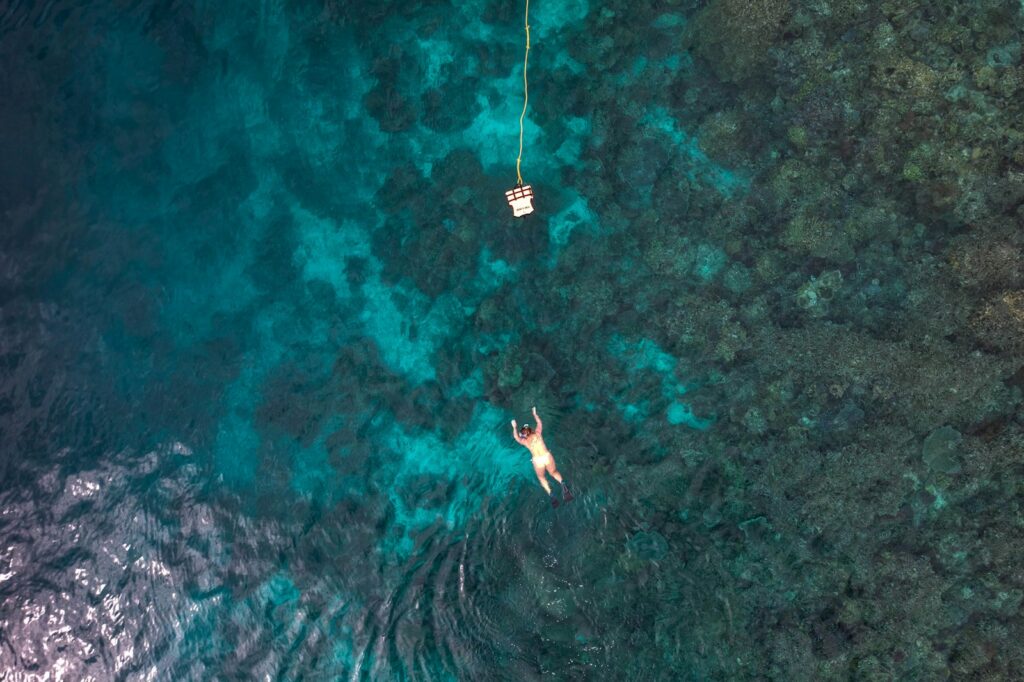
A Komodo snorkeling day trip is a full-day boat excursion out of Labuan Bajo into Komodo National Park where non-divers and families see the same reef systems, mantas, and turtles as dive groups — from the surface, on mask and snorkel, no certification required. The park entrance ticket covers snorkeling with no separate surcharge; diving, by contrast, carries an extra IDR 25,000 per diver per day (one source cites IDR 100,000 — confirm with your operator). That fee gap is one practical reason many travellers choose to snorkel only, even if they are technically capable of diving.
The six classic stops on a speedboat day trip — Padar viewpoint, Pink Beach, Komodo Island’s Loh Liang, Taka Makassar sandbar, Manta Point, and a final spot such as Siaba Bay or Kelor Island — are all accessible to snorkelers. You do not need a wetsuit, a buoyancy compensator, or any training beyond basic water confidence. What you do need is the right information about which spots suit which ability level, what gear actually comes on the boat, and where the currents demand respect.
The Snorkeling Stops: Honest Difficulty Ratings
Not all six stops read the same from the water’s surface. Here is what each one actually involves for a snorkeler, from the calmest to the most demanding.
Siaba Bay — Easiest
Siaba Bay (sometimes called Siaba Besar) is the gentlest snorkel stop on the standard itinerary. The water is relatively protected, currents are mild on most days, and green sea turtles are a reliable resident — one of the more consistent marine wildlife sightings in the park. The stop runs around 30 minutes and suits all ability levels, including nervous swimmers and children with flotation support. If your group includes people who are unsure about open-water snorkeling, this is the stop where confidence usually builds.
Taka Makassar — Easy to Moderate
Taka Makassar is a white sandbar that emerges at low tide, surrounded by clear shallow water on the lagoon side and stronger current on the open side. The sandbar itself is a wading and photography stop; the snorkeling happens in the shallower, calmer water around the bar. Current on the outer edge can catch you off guard, so stay inside the sheltered zone. The stop is approximately 45 minutes. It is genuinely beautiful — the kind of location that photographs well at any time of day — and the snorkeling is accessible to most swimmers as long as you don’t push toward the exposed edges.
Kanawa Island — Easy
Kanawa Island appears on some itineraries as an alternative final stop, particularly on private charters. The house reef is shallow and well-protected, with coral gardens starting close to the surface. It is among the most beginner-friendly sites in the park and works well for families with young children who want a low-stakes first experience of coral snorkeling. Not every operator includes it; if it matters to you, ask when booking.
Kelor Island — Easy to Moderate
Kelor Island, roughly 8–10 kilometres from Labuan Bajo harbour, often appears as the final stop of the day. There is a short hillside walk to a viewpoint, and the snorkeling around the island’s base is sheltered and clear. Currents are manageable on most days. It is a common slow-boat stop as well as a speedboat add-on, and suits families and nervous swimmers better than the open-channel sites.
Pink Beach — Moderate
Pink Beach — Pantai Merah on Komodo Island — gets the most operator marketing attention and delivers the most mixed results. The sand’s pink tint comes from fragments of red foraminifera (Homotrema rubrum) and coral, and it is real, though the intensity varies with light and tide. The snorkeling directly off the beach can be strong on current and variable on visibility. Plankton blooms occasionally reduce visibility to a few metres; strong tidal flow can push even capable swimmers sideways. Life jackets are a sensible choice here for anyone less than confident. Budget roughly 50–60 minutes at the stop. Experienced reef snorkelers will find coral coverage worth seeing; anxious swimmers should stay close to the shoreline and the guide.
Manta Point (Karang Makassar) — Most Demanding
Manta Point is a drift snorkel, which changes the physical equation entirely. The boat drops you up-current of the cleaning station, and you drift slowly over the reef while mantas — if present — circle below. The Flores Strait tidal currents here are genuine. Strong swimmers have been caught off guard. Children and anyone uncertain about open water should wear a life jacket; watching from the boat deck on a calm day is also a legitimate call and not a missed experience — the mantas are sometimes visible from deck level.
Mantas at Karang Makassar are possible year-round and guaranteed on zero days. Operator field reports (not formal survey data) suggest larger aggregations during the plankton-rich wet months, roughly December through February. June through August — peak tourist season, calmest seas — does not correspond to the highest manta frequency. That trade-off is real and worth knowing before you book.
Gear: What Is Actually on the Boat
This is where operator marketing and operational reality diverge most sharply on budget trips. Here is the honest picture:
- Mask and snorkel
- Included as standard on virtually all speedboat day trips, from budget shared boats to mid-range private charters. Quality varies — shared-boat gear is often well-worn and basic. If you have your own mask, bring it; a proper fit matters for both comfort and visibility.
- Fins
- Inconsistent on budget boats. Some operators include them; many do not, particularly on lower-priced open trips. At Manta Point specifically, fins make a practical difference — the drift current means you want directional control, not just flotation. On a private charter you can usually request them explicitly when booking. Confirm before you depart the harbour, not after you are anchored at the site.
- Life jackets
- Good operators carry them on deck for any swimmer who wants one. There is no stigma in using one — for weak swimmers, children, or anyone uncomfortable at current-exposed sites, a life jacket is the difference between an enjoyable stop and a frightening one. If an operator discourages or refuses to provide them on request, that tells you something meaningful about how they handle safety generally.
- Wetsuit or rash guard
- Not standard equipment on day trips. Bring a rash guard for sun protection and for warmth if you plan multiple snorkel stops — entering and exiting the water several times across a 10–12 hour day leaves you cooler than you expect, particularly in the afternoon. Water temperatures in the Komodo channel typically run 26–29°C but localised upwellings bring cold patches, especially near Manta Point.
- Underwater camera
- Not provided. If you have a waterproof camera or housing, bring it. Phone underwater housings work for the calmer sites; Manta Point’s current makes handling any device harder — secure it with a wrist strap.
Which Boat Type Suits Your Group?
The boat you choose determines more than the price: it shapes the group size in the water, the safety margins, and whether the six-stop itinerary is actually achievable in a day.
Shared Speedboat (Open Trip) — Families and Mixed Groups
The standard shared speedboat product covers all six stops in a 10–12 hour day, departing Labuan Bajo at 06:00–07:00 and returning by 16:30–18:00. Boats typically carry 15–22 passengers. The coverage is the best on offer for a snorkeling-focused day — every major site is reachable. The trade-off is group size in the water: at Manta Point, ten or more snorkelers entering simultaneously raises the chance that someone’s behaviour disrupts the cleaning station. On calm days this works fine; on busy peak-season days it can feel crowded at the site.
Shared speedboat prices run approximately IDR 1,200,000–1,800,000 per person (roughly USD 75–120), not including park fees paid cash on the day. Peak season — June through August and the Christmas/New Year period — pushes toward the higher end, with some operators applying explicit high-season surcharges. Budget separately for park and ranger fees: a realistic all-in park-fee estimate for a six-stop day is IDR 300,000–500,000 per person, paid cash at the park entry points. Do not rely on a single online figure; the fee structure has shifted in 2025–2026 and figures circulating in blogs and forums vary widely.
Shared speedboats are well-suited for solo travellers, couples, and small groups of adults who are comfortable in open water. For families with young children or seniors with mobility considerations, a private boat gives you more control over pace and gear.
Private Speedboat Charter — Kids, Seniors, Nervous Swimmers
A private charter changes three things that matter for a snorkeling-focused family or mixed-ability group. First, your guide’s attention is not split across 20 passengers. Second, you can adjust timing — extending a calm, gentle stop if the children are loving it, skipping Manta Point’s current-swept water if it does not feel right on the day. Third, you can request specific gear (fins, extra life jackets) before departure without competing for shared equipment.
Private speedboat charter costs run approximately IDR 8–12 million per boat per day for a small vessel taking up to around six passengers (roughly USD 500–800), rising to IDR 12–18 million for a medium boat handling 10–15 passengers. At a group size of four adults, the per-person cost is comparable to or only modestly above the shared trip price. These are indicative, quote-on-request figures — the private charter market in Labuan Bajo is price-by-negotiation and peak season adds 10–30%.
If travelling with toddlers, elderly relatives, or anyone who needs extra time in and out of the water, a private boat is the cleaner choice. You are not holding up a group, and you are not being held up by one.
Slow Wooden Boat — Not Recommended for Snorkeling Focus
Slow wooden boats cruise at 6–8 knots. From Labuan Bajo, the transit to Padar alone takes three to four and a half hours each way. A slow-boat day trip realistically covers two or three stops — typically Kelor Island, Rinca, and one snorkel site — and runs 12–14 hours even so, sometimes with pre-dawn departures. The six-stop route that includes Manta Point and Taka Makassar is a speedboat product. If snorkeling multiple sites is the goal, the slow boat is not the vehicle.
Slow boats do offer a more relaxed, less motorised experience on the water, and the price — broadly IDR 500,000–1,200,000 per person — is lower. But for a snorkeling-focused non-diver who wants access to the full range of the park’s marine sites in a single day, the slow boat leaves most of the best snorkeling stops unreachable before the tide or the daylight runs out.
Phinisi Day Cruise — Comfort-First Option
Phinisi vessels are traditional Bugis wooden sailing boats, typically converted for tourism with covered decks, shaded seating, and sometimes cabin space. Shared phinisi day cruises run broadly IDR 2–5 million per person (roughly USD 130–330); private day charters for boutique vessels of 8–12 passengers start around IDR 25–40 million (USD 1,600–2,600) and scale up considerably for larger vessels. Prices vary significantly by boat and operator and should be treated as indicative.
A phinisi day cruise is a comfortable, unhurried experience on the water. The itinerary is more flexible than a shared speedboat run and typically covers four to five sites rather than six. For seniors or guests who want shade, deck space, and a more relaxed pace between snorkel stops, it is the most comfortable platform. The trade-off versus a private speedboat is transit speed: reaching Padar or Komodo takes longer on a phinisi hull than a speedboat, which affects which stops are practical within the day’s light.
The No-Touch Coral Rule — and the Sunscreen Question
Touching coral is prohibited under Indonesian marine protected area law. That includes standing on reef, resting fins on coral heads, and brushing against formations while snorkeling. The rule applies everywhere in Komodo National Park. This is not a recommendation — it is the law, and rangers and guides enforce it.
Reef-safe sunscreen is strongly recommended by operators and guides throughout the park. It is worth being clear about what is verified here: as of mid-2026, no independent source has confirmed a published BTNK regulation banning conventional sunscreens park-wide in enforceable text. What is consistent is that quality operators enforce a reef-safe preference at their level, and the ecological reasoning — that chemical UV filters in conventional sunscreen are harmful to coral and juvenile fish — is well-supported by independent research. Apply sunscreen 30 minutes before entering the water, whatever formulation you use.
Single-use plastic is another area where operator-level policy runs ahead of verified park law. Expect quality boats to enforce no single-use plastic aboard — bring a refillable water bottle. A few operators run active refill systems on deck.
A Practical Snorkeling Timeline for the Six-Stop Day
The sequence below is the standard speedboat route. Order varies by operator and sea state — your guide makes the final call on the water. Timings are from a published operator itinerary cross-referenced against multiple sources.
| Stop | What snorkelers do | Difficulty | Time on site |
|---|---|---|---|
| Labuan Bajo departure | Board, brief from guide | — | 06:00–07:00 departure; pickups from ~05:30 |
| Padar Island | Viewpoint hike (snorkeling not the draw here) | Physical — ~800 steps, ~30–40 min up | ~75 min |
| Pink Beach | Beach swim and snorkel off the shore | Moderate — current variable | ~50–60 min |
| Komodo / Loh Liang | Dragon trek with ranger (snorkeling not included here) | Easy walking on short trail | ~80 min |
| Taka Makassar | Sandbar walk + snorkel in sheltered lagoon | Easy–Moderate; avoid outer edge | ~45 min |
| Manta Point | Drift snorkel over cleaning station | Most demanding — strong current | ~30 min |
| Siaba Bay / Kelor / Kanawa | Reef snorkel or beach stop | Easy — calmest water of the day | ~30 min |
| Return to Labuan Bajo | — | — | Arrive 16:30–18:00 |
Padar does not involve snorkeling — it is a viewpoint hike. The Komodo dragon trek at Loh Liang is a land activity with a licensed ranger and also does not involve water. The snorkeling content of the day is concentrated at Pink Beach, Taka Makassar, Manta Point, and the final stop. That is four dedicated in-water opportunities across the day, which is more than enough for most non-diver travellers, and the variety of difficulty levels within those four sites means most groups find at least two or three they are genuinely comfortable with.
Park Fees: What Snorkelers Pay vs Divers
The fee advantage for snorkelers over divers is real and worth understanding before you budget the day.
- Park entrance ticket
- IDR 150,000–250,000 per person per day for foreign visitors. Sources conflict on whether the higher rate applies only on Sundays and public holidays or applies flat every day — confirm on the day at the entry point. The ticket is valid park-wide for the calendar day: you do not pay a separate entrance fee per island.
- Snorkeling surcharge
- None. The base entrance ticket covers snorkeling. This is confirmed across multiple independent sources.
- Diving surcharge
- IDR 25,000 per diver per day (one source cites IDR 100,000 — confirm with your operator and at the entry point). Divers pay this on top of the entrance ticket.
- Ranger/guide fee at trek sites
- IDR 200,000 per group of up to five persons at Komodo Island (Loh Liang) and Rinca Island (Loh Buaya); IDR 150,000 per group at Padar. This applies per trekking site — a day including both Padar and Komodo Island means two separate ranger fees.
- Harbour/port fee
- Approximately IDR 25,000 per person per day.
- All-in park-fee estimate
- IDR 300,000–500,000 per person for a standard six-stop day, paid in cash. Some operator-collected totals (Viator listings cite approximately IDR 475,000 per person) are on the higher end of this range when ranger fees for multiple trek sites are included. Fees are almost always excluded from the tour price and paid on the day — your operator should tell you exactly what to bring.
The 2022-announced IDR 3,750,000 annual conservation membership fee — which generated a wave of cancellations — was officially cancelled and is not in force in 2025–2026. One source circulating in 2026 mentions a one-off IDR 650,000 ticket; this is contradicted on the same source page and unsupported elsewhere — do not plan around it.
New in 2026: the park operates under a 1,000-visitor-per-day cap, announced by the Ministry of Forestry and reported as fully enforced from approximately April 2026. Advance booking through the SiORA reservation system is now standard — in practice, tour operators handle this for their guests, but it means walk-in availability is no longer reliable, particularly in peak season. Book through an operator who confirms they handle SiORA registration; verify this is still the current system before travel, as the policy is new and implementation details may shift.
Thinking through your full-day budget — tour price plus park fees plus transport — before you commit to a boat? Our planning form walks through the numbers for your group size, and we are happy to run the math via WhatsApp if you have a specific departure date in mind. No one can pay to change what we publish; if you use our free help and proceed with a partner operator, they may pay us a referral fee at no extra cost to you.
Is a Komodo Snorkeling Day Trip Right for Your Group?
Most non-diver travellers do fine on a standard shared speedboat trip. A few specific group profiles are worth thinking through before you book.
Children aged five and older generally handle the day trip well on a shared speedboat, particularly if the adults in the group are comfortable in the water and can supervise at each stop. The Padar hike involves roughly 800 steps and 30–40 minutes at a moderate pace — manageable for older children and healthy adults, though the sun exposure at midday is real, and early morning departure makes it cooler. At the dragon trek, children must stay in the ranger-guided group and follow the same distance rules as adults (minimum 3–5 metres from dragons at all times). For younger children or toddlers, a private charter removes the group-pace pressure and lets you skip stops that are not appropriate.
Seniors with good mobility handle the standard itinerary without particular difficulty. The Padar hike is optional — operators can and do skip it for guests who flag it as impractical. The main physical demands of the day are sun exposure, boat motion on the crossing (the speedboat ride in choppy conditions is rougher than it sounds), and extended periods standing or sitting on a boat deck. A phinisi day cruise offers significantly more comfort and shade for guests who want a relaxed pace; a private speedboat gives flexibility to modify stops. If seasickness is a concern, take appropriate medication at least two hours before departure.
Nervous swimmers who want to snorkel rather than sit out can do so productively at Siaba Bay, Taka Makassar’s sheltered lagoon, and Kanawa Island. These three sites have the calmest water on the standard itinerary. Manta Point and the outer edge of Pink Beach carry genuine current risk; a life jacket and a guide who stays close make both manageable for low-confidence swimmers who still want to try. Being in the water with a life jacket is snorkeling. There is no rule that says you must swim strongly to participate.
The family-specific logistics and the beginner-friendly stop breakdown pair naturally with our guide on Komodo day trips for families, and for the full picture on Manta Point’s current and etiquette, the dedicated Manta Point guide covers everything a beginner snorkeler needs to know before entering the water there.
What to Bring for a Snorkeling-Focused Day
The standard packing list for a Komodo day trip leans toward sun protection and water readiness. For a snorkeling-first traveller:
- Your own mask if you have one — rental fit is inconsistent and a well-sealed mask makes the difference between a frustrating stop and a clear one
- A rash guard or thin wetsuit top — multiple entries across a 10-hour day leave you cooler than expected, particularly at afternoon stops
- Reef-safe sunscreen applied before departure
- Water shoes or sandals for Pink Beach and the sandbar — coral debris on the shoreline is sharp underfoot
- Sturdy shoes with grip for the Padar hike if you plan to do it — sandals on loose stone steps are an avoidable problem
- A refillable water bottle — most quality operators provide drinking water but enforce no single-use plastic policy
- Cash for park and ranger fees — IDR 300,000–500,000 per person is a realistic budget; there are no ATMs in the park
- A dry bag for your phone, documents, and anything that should not get wet — the open speedboat takes spray on crossing legs in any swell
- Anti-nausea medication if the boat crossing is a concern — take it at least two hours before departure, not on the boat
Ready to match your group’s ability level and budget to the right Komodo day trip? Use our planning form or reach out via WhatsApp — we typically reply within a few hours during Labuan Bajo business hours and can point you toward operators whose snorkeling setup genuinely fits the group you are travelling with.
Frequently Asked Questions
Do I need to pay extra to snorkel in Komodo National Park?
No. Snorkeling is covered by the standard park entrance ticket — IDR 150,000–250,000 per person per day for foreign visitors, depending on the day of the week (sources conflict on the weekday versus Sunday/holiday rate; confirm on the day). There is no separate snorkel fee. Divers pay an additional IDR 25,000 per diver per day on top of the entrance ticket, which is one practical reason many travellers choose to snorkel only. Budget IDR 300,000–500,000 per person across the full day for entrance, ranger, and harbour fees combined — all paid in cash at park entry points.
Which snorkeling stop in Komodo is easiest for beginners?
Siaba Bay is the calmest and most beginner-friendly stop on the standard itinerary. The water is relatively protected, currents are mild on most days, and green turtles are a regular presence. Taka Makassar’s sheltered lagoon side and Kanawa Island are similarly gentle. Manta Point is the most demanding: strong tidal currents run through Karang Makassar at all times, and even experienced swimmers can find them difficult. Weak swimmers and children should wear life jackets at Manta Point and Pink Beach; watching from the boat deck at Manta Point is a legitimate choice when the swell is up.
Are fins and life jackets provided on Komodo snorkeling day trips?
Mask and snorkel are included as standard on virtually all speedboat day trips. Fins are inconsistent — included on many mid-range and private boats, absent or unreliable on some budget shared trips. Life jackets are carried as standard on reputable operators and should be available on request for any swimmer who wants one; if an operator declines to provide one, treat that as a warning sign. If fins matter to you — and at Manta Point specifically they are worth having — confirm availability before you depart the harbour, not when you are already anchored at the site.
Can I do a Komodo snorkeling day trip if I cannot swim confidently?
Yes, with the right boat and the right stops. The calmer sites — Siaba Bay, Taka Makassar’s lagoon, Kanawa Island — are manageable for low-confidence swimmers with a life jacket and a guide nearby. Manta Point and the outer zone of Pink Beach carry real current risk and are best skipped or watched from the boat if you are not comfortable in open water. A private charter gives you the flexibility to adjust the itinerary around your group’s ability; on a shared open trip, the guide controls the pace and you are responsible for communicating your limits before entering the water. Tell your guide clearly before the first snorkel stop — a good guide adjusts, a poor one doesn’t, and that distinction is worth knowing before you book.
Is a Komodo snorkeling day trip suitable for children?
Generally yes for children aged five and older, with some conditions. The Padar hike (roughly 800 steps, 30–40 minutes up) is optional and can be skipped. Dragon trekking at Loh Liang requires staying within the ranger-guided group and maintaining 3–5 metres distance from the animals — this is enforced, and children who cannot reliably follow instructions should stay close to an adult. At snorkel stops, children should wear life jackets in the water unless they are strong, confident swimmers. For toddlers or children under five, a private speedboat charter allows you to skip stops that are not safe or appropriate, rather than being tied to a shared itinerary. Check whether children’s pricing applies when booking — some operators (last verified: Green Rinjani lists 30% discount for ages 0–3 and 50% for ages 4–5) offer age-based rates, though these vary by operator and change periodically.