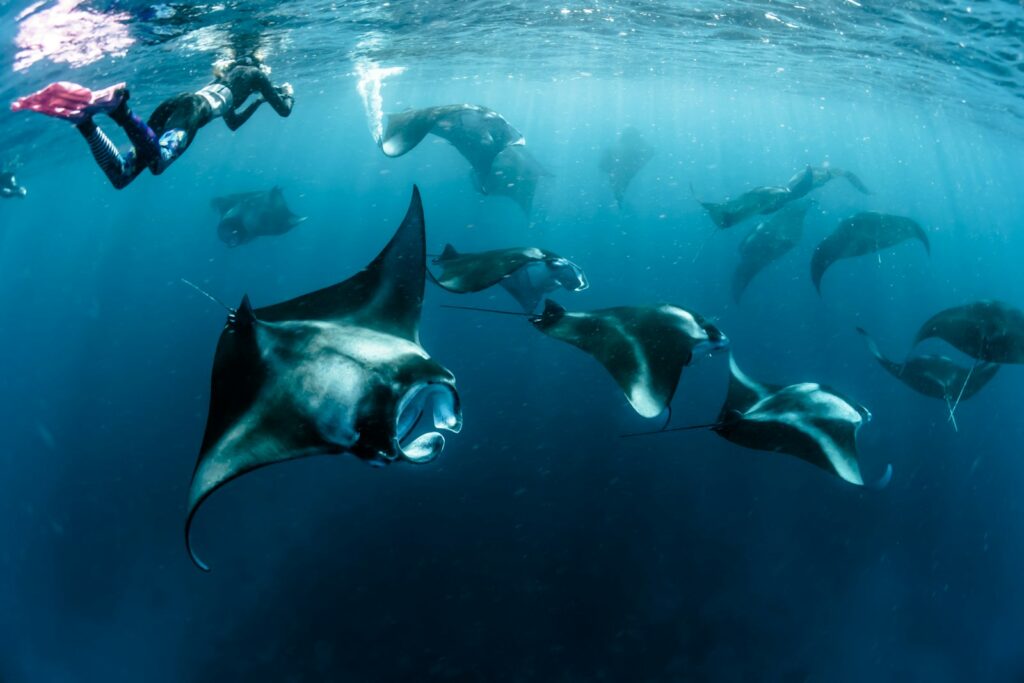
The best month to see manta rays in Komodo is not a single month — mantas are present at Karang Makassar (Manta Point) year-round, and that year-round presence is the only claim that holds up under scrutiny. Operator reports suggest larger aggregations in the plankton-rich wet months of roughly December through February. That pattern is worth knowing. It is not, however, based on published ecological survey data — it is field lore from guides who have worked the site for years. The two things are different, and conflating them is exactly how “guaranteed manta” marketing gets written. This piece separates what is defensible from what is not, and tells you what either means if you are visiting in June, July, or August.
What We Actually Know About Mantas at Karang Makassar
Karang Makassar is a submerged reef plateau inside Komodo National Park. Reef manta rays (Mobula alfredi) visit it to be cleaned by smaller fish — wrasse and other reef species that remove parasites from the manta’s skin. The manta circles slowly over the cleaning station, which is why a 30-minute drift snorkel works here: the boat drops you up-current and you float across the site while the animal does its business below you, largely indifferent to your presence if you behave correctly.
The population is resident. These are not long-distance migrants that appear for a defined window and vanish. They live in and around the park year-round, which is why no single month delivers a guaranteed sighting — and why every month carries a genuine chance of one.
No official body publishes manta sighting statistics for Karang Makassar. The Indonesian park authority (BTNK) does not maintain or release a public record of sighting frequency by month. Any source quoting you a percentage probability — “70% chance in December,” that sort of thing — is working from operator logbooks at best, and fabricating at worst. We do not quote figures that cannot be sourced.
The Lore: What Operators and Guides Report
Here is the honest version of the seasonal pattern that guides and operators describe. Treat every part of this as field experience, not scientific data.
The wet season — roughly December through February — brings plankton blooms to the Flores Sea. Upwelling and nutrient cycling run harder in these months, and more plankton in the water column means more food-chain activity around the cleaning station. Guides who have worked Karang Makassar for years report seeing larger manta aggregations during this period more often than at other times of year. Some days you might see five or six animals working the same station; that happens less frequently in the dry months, by their account.
The operative word is “report.” This is a pattern from professional observation, not a controlled study. There is no formal peer-reviewed survey of Manta Point aggregation sizes by month that independent sources have confirmed as of mid-2026. The pattern is plausible — it is consistent with what is known about manta feeding ecology globally. But “plausible and consistently reported by experienced guides” is not the same as “proven and forecastable.”
Label this what it is: operator lore with a reasonable ecological basis. Worth factoring in. Not worth treating as a booking guarantee.
The Catch: Wet-Season Seas Are Genuinely Rough
December through February is also when the northwest monsoon is at its strongest. These are the months with the heaviest rainfall, the most swell, and the highest number of day-trip cancellations. The harbour master (syahbandar) in Labuan Bajo has the authority to close the port to small craft when sea conditions exceed safe operating limits — and uses it most frequently in January and February. When the port closes, your manta trip does not depart, and no aggregation size compensates for that.
The trade-off is real and worth stating plainly: the months that operators associate with larger manta aggregations are the same months most likely to prevent you from reaching Manta Point at all. A cancelled trip gets you zero mantas. A rough crossing with a group of seasick passengers on a wet-season sea is not the drift-snorkel experience the photographs suggest.
If you are considering a December or January trip specifically because of the manta lore, weigh it honestly. A flexible itinerary with a buffer day, a private charter with a captain who can adjust the route in real time, and a clear-eyed cancellation policy discussion with your operator before any deposit changes hands — those are the practical requirements for wet-season travel. Without them, the plankton-bloom theory is largely academic.
What “Year-Round Presence” Actually Means for Your Trip
Saying mantas are present year-round sounds like a hedge. It is not — it is the most accurate and useful statement that can be made about the site. For practical planning, it means two things:
- No month makes a sighting impossible. You can encounter mantas at Karang Makassar in April, in July, in October, in any month the sea allows you to reach the site.
- No month makes a sighting certain. Wild animals follow their own schedule. The cleaning station is visited regularly but not continuously. On any given day, a manta may be there for two hours, or none, or many.
The honest framing for trip planning is: Karang Makassar gives you a genuine chance, not a promise. That chance exists in every month the site is reachable. The variables that most affect whether you see a manta on your specific day are sea state (affects whether the stop happens at all), timing within the day (the guide’s read of the tide window), and luck. Month of year comes third, maybe fourth.
June, July, August: What Peak-Season Visitors Should Know
Right now — June 2026 — is peak season. If you are planning a Komodo day trip in the next few months, here is the specific picture for Manta Point.
The sea conditions in June through August are the best of the year. The southeast trade winds produce calm, reliable crossings. The six-stop speedboat itinerary runs as smoothly as it ever does, and cancellations due to weather are uncommon in this window. Karang Makassar is visited on nearly every shared day-trip itinerary in peak season, and the drift snorkel conditions — clear water, calm surface, good visibility — are as good as they get.
Manta sightings during peak season are common. This is not the plankton-bloom period that operator lore associates with larger aggregations, but it is also not a dead season for mantas. The population is resident. The cleaning station operates year-round. Peak-season sighting frequency, based on collective operator accounts, is solid — not dramatically lower than any other non-wet-season period.
The catch for peak visitors is different from the wet-season catch. It is not sea conditions. It is group size. Shared boats in peak season carry 15 to 22 passengers, and ten or more snorkelers entering the water simultaneously near a cleaning station changes the dynamic. Volume of people — even well-behaved people — raises the probability that the manta moves on before everyone has had a proper look. On a private charter with four to eight guests, that pressure is absent.
That distinction matters for how you book rather than when you book. If Manta Point is a priority and your group is four people or more, the per-person maths on a private speedboat charter become competitive with shared-boat rates — small private charters for roughly six passengers run approximately IDR 8–12 million per boat per day (around USD 500–800), which splits to IDR 1.3–2 million per person at full capacity, comparable to peak-season shared-boat rates of IDR 1,500,000–1,800,000 per person. The quieter in-water experience is part of what you are paying for.
Want help figuring out which boat type fits your group and budget for the manta stop? Our planning form is the fastest way to get a straight answer — describe your group size and priorities, and we will match you with options that make sense. No one can pay to change what we publish; if you use our free help and proceed with a partner operator, they may pay us a referral fee at no extra cost to you.
Snorkeling vs Diving: A Real Difference in Sighting Probability
This distinction gets buried in most manta content, and it should not. How you enter the water at Karang Makassar changes your odds.
Snorkelers drift on the surface. If a manta is working the cleaning station 10–15 metres below, you see it from above — visible, potentially impressive, but distant depending on water clarity. The drift snorkel still works well when mantas are present in the shallower cleaning approach, but depth is a limiting factor that surface snorkeling cannot overcome.
Divers have access to the full water column. A manta circling the cleaning station at 12 metres is a significantly different encounter when you are at 10 metres beside it versus floating 12 metres above it at the surface. Guides who have worked both experiences are consistent on this: the dive version of Manta Point, when mantas are present, is a different category of encounter.
Day trips out of Labuan Bajo are primarily snorkel products. The park applies a diving surcharge of IDR 25,000 per diver per day (last verified 2026; one outlier source quotes a higher figure — confirm with your operator), and some boats carry dive equipment for guests who want to add it. If a close-up manta encounter is the primary goal and you are a certified diver, it is worth asking specifically whether your chosen boat carries gear and whether the guide can take a small dive group to depth at Karang Makassar. Not all shared day-trip boats accommodate this — but some do, and for the right guest it changes the trip significantly.
Season Summary: Manta Probability vs Trip Reliability
| Period | Manta aggregation pattern (operator lore — not survey data) | Sea conditions for reaching the site | Practical verdict |
|---|---|---|---|
| Dec–Feb (wet season) | Larger aggregations reported by guides; plankton-rich upwelling | Roughest of year; cancellation risk highest; port closures possible | Higher manta lore, lower trip reliability — buffer day essential, private boat recommended |
| Mar (transition) | Normal resident population; no specific pattern reported | Improving through the month; late March acceptable | Late March viable with forecast monitoring |
| Apr–May (dry season) | Normal resident population; solid sighting frequency | Calm and settling; among the most reliable months | Strong all-round choice — good conditions, good manta probability, low crowds |
| Jun–Aug (peak season) | Common sightings; not the plankton-bloom period but resident population active | Best of year; reliable and calm | Good manta chance with excellent sea conditions; book ahead, consider private for smaller group in water |
| Sep–Oct (second sweet spot) | Normal resident population; good visibility for encounters | Excellent; often flat; second-best period overall | Best all-round balance of manta probability, sea conditions, and low crowds |
| Nov (late dry) | Normal resident population | Early month fine; late month watch forecast | Early November solid; later requires flexibility |
Manta aggregation descriptions are based on collective operator field reports, not formal ecological survey data. No official body publishes monthly sighting statistics for Karang Makassar. Treat the pattern as informed lore, not a forecast.
Directly Contradicting “Guaranteed Manta” Marketing
Some operator listings and booking platforms use language like “almost certain manta sightings,” “manta guaranteed at this site,” or “you will see mantas at Manta Point.” That language is false. It is false in January and it is false in July. Karang Makassar is a cleaning station, not an aquarium. The animals are wild. They leave when they choose to leave.
The single honest thing you can say about Manta Point is that it offers a genuine, year-round chance that no other stop on the standard day-trip itinerary matches. That is a strong enough claim on its own. It does not need inflation.
The only operator question worth asking on this topic is not “is it guaranteed?” — any operator who says yes is telling you what you want to hear, not what is true. The question is: “What has the sighting record been at Karang Makassar in the last two to three weeks?” A good operator tracks this. They will give you a straight answer. That real-time data is more useful than any seasonal lore, because it tells you what the actual animals are doing right now.
For the full picture on Manta Point — currents, drift snorkel mechanics, manta etiquette, and how the stop fits into the day’s route — see our detailed Manta Point Komodo guide. For month-by-month planning across all the stops, sea conditions, and the 2026 visitor cap implications, the best time to visit Komodo page covers the full year.
If you are booking now for a June or July trip, the window is tight. The 1,000-visitor-per-day cap introduced in 2026 means advance SiORA reservations through a registered operator are essential — walk-up access is effectively gone. Reach out via our planning form or WhatsApp and we can check current availability and flag if particular dates are under pressure. We can usually respond within a few hours during Labuan Bajo business hours.
Frequently Asked Questions
Is there a guaranteed best month to see manta rays in Komodo?
No single month guarantees a manta sighting. Mantas are present at Karang Makassar year-round as a resident population. Operator field reports suggest larger aggregations in the wet months of December through February, when plankton levels run higher — but that pattern is based on guide experience, not published ecological data, and those same months bring the roughest sea conditions and the highest cancellation risk of the year. For most travellers, April–May and September–October offer the best balance: dry-season sea reliability, consistent manta presence, and no peak-season crowds. In peak season (June–August), sightings are common and conditions are excellent — just not the plankton-rich period the lore points to.
Do more mantas appear in the wet season, and is it worth visiting then?
Guides who have worked Manta Point for years consistently report larger aggregations during the wet months, roughly December through February. The ecological explanation — richer plankton, more active upwelling — is plausible. But these are also the months with the highest cancellation risk due to northwest monsoon swell and potential port closures by the Labuan Bajo harbour master. A cancelled trip delivers zero mantas regardless of what the aggregation data would have shown. If you travel in the wet season for manta reasons, build in a buffer day, book a private charter for route flexibility, and confirm the operator’s weather cancellation policy before paying any deposit.
Do snorkelers and divers have the same manta experience at Karang Makassar?
No, and the difference matters. Snorkelers drift on the surface and view mantas from above — a good encounter when animals are in the shallower cleaning approach, but limited by depth when they are working lower in the water column. Divers have access to the full depth range and can position alongside a manta at the cleaning station rather than looking down at it from 12 metres above. Day trips out of Labuan Bajo are primarily snorkel products, but some boats carry dive equipment and can take certified divers to depth at Manta Point for an additional diving surcharge (IDR 25,000 per diver per day, last verified 2026; confirm with your operator). If a close-up encounter is the priority and you are a certified diver, ask specifically whether your chosen boat accommodates in-water diving at this stop.
What should I ask an operator about manta sightings before booking?
Skip the “is it guaranteed?” question — the correct answer is always no, and any operator who says otherwise is not being straight with you. Instead ask: “What has the sighting record been at Karang Makassar in the past two or three weeks?” A reputable operator tracks this and will give you a concrete, honest answer. Recent field data from the actual site beats any seasonal generalisation. Also ask: what do you do if sea conditions make Manta Point inaccessible that day? A good answer names an alternative snorkel site. A poor answer restates the guarantee you should not have been offered.
Will visiting Komodo in peak season (June–August) mean I miss the mantas?
No. Manta sightings during June through August are common. The sea conditions are the best of the year, the full six-stop itinerary runs reliably, and Karang Makassar is included on nearly every shared day-trip route. June–August is not the plankton-rich period that operator lore associates with the largest aggregations, but the resident manta population is active and the cleaning station is visited regularly. What peak season does affect is group size in the water — shared boats carry 15–22 passengers, and large numbers of snorkelers near a cleaning station can shorten sighting windows. If a close encounter is the priority, a private charter with a smaller in-water group changes the experience meaningfully.