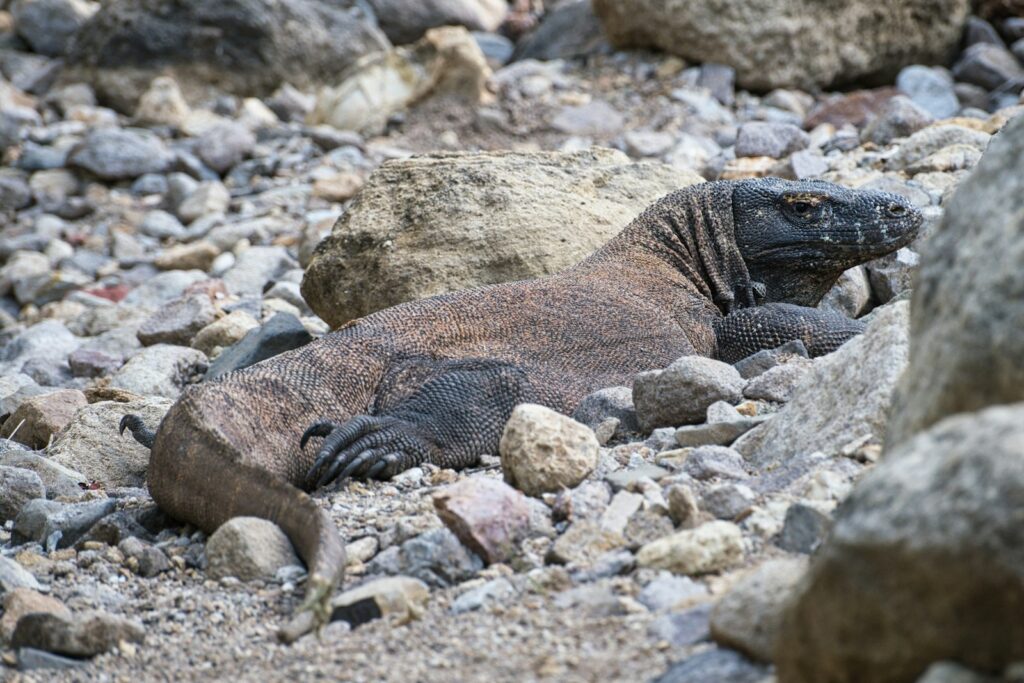
Komodo dragon attacks on tourists are extremely rare — far rarer than the animal’s fearsome reputation suggests. Under the mandatory licensed-ranger system that has governed Komodo National Park visits for decades, no year-by-year attack statistics are published by the park authority BTNK, and the last reported tourist fatality is cited as 2009 in a single safety-guide source (we attribute it that way here, not as a confirmed official figure). What the record shows, honestly, is that the protocol works: thousands of visitors walk within metres of the world’s largest living lizard every year without incident.
That said, Komodo dragons are apex predators with serrated teeth, powerful limbs, and a documented ambush hunting style. The rarity of attacks is not luck — it is the direct result of a ranger system, route discipline, and behavioural rules that visitors are expected to follow. This page lays out the record as it actually stands, explains the mechanics behind the protocol, and flags the specific situations that have produced the rare close calls.
What We Actually Know About the Attack Record
The honest answer to “how many tourists have been attacked?” is: there is no official, year-by-year bite statistic. BTNK (Balai Taman Nasional Komodo), the park management authority, does not publish a public incident log. What exists instead is a scattered trail of contemporaneous news reports and safety-guide attributions.
The last reported tourist fatality is cited as 2009 in safety-guide sources — we repeat it as reported, not as a verified official figure, because we have not been able to confirm it against a primary government record. A 2017 incident involving a Singaporean tourist bite was widely covered in international media at the time (BBC and The Straits Times reported on it); however, we have not independently re-verified the details in this research pass, so we note it as historically referenced in contemporaneous news rather than a confirmed fact we stand behind.
Beyond those two cases, specific dated incidents that have reached international media are sparse. That sparseness is itself data. Komodo National Park receives hundreds of thousands of visitors a year — well over 100,000 international tourists in peak years, with a new 1,000-visitor-per-day cap introduced in 2026 as a management measure. Over decades of guided tourism, the number of serious tourist injuries attributable to dragon bites is tiny enough that each one was international news. By contrast, dog bites hospitalize millions globally each year and are not news at all.
The point of saying all this is not to minimise the animal. It is to give you an accurate picture instead of a sensationalised one.
Why the Protocol Works: The Four Pillars
The ranger system in Komodo National Park is not a formality. At both Loh Liang (Komodo Island) and Loh Buaya (Rinca Island), a licensed ranger accompanies every visitor group on every trek. Rangers carry forked wooden sticks — not as a tourist prop, but as a genuine intervention tool. A ranger can use the stick to redirect a dragon that moves toward a person, blocking its path without harming the animal.
Four behavioural rules underpin almost everything about safe dragon viewing:
- 3–5 metre minimum distance
- Komodo dragons sit still for long periods and then strike fast at short range. Staying outside roughly 3–5 metres keeps visitors outside the realistic lunge zone. Rangers position the group and hold that distance actively — they are not just walking alongside you, they are managing the spatial relationship between your group and every dragon in the vicinity.
- Grouped single-trail walking
- Visitors stay together on designated trails and do not scatter. This matters because rangers can only monitor a clustered group. A visitor who wanders off trail, crouches behind vegetation, or separates from the group creates a situation the ranger cannot manage. Dragons do not distinguish between a photographer who stepped off-trail to get a cleaner angle and a small animal investigating the grass — proximity and low profile read the same way to the lizard.
- No open food on treks
- Komodo dragons have an acute sense of smell and can detect blood and food scent across surprisingly large distances. Bringing open snacks, unwrapped food, or anything with a strong food odour onto the trek is prohibited. This is one of the most practical rules: the dragons that have caused close calls near ranger stations and park facilities have typically been drawn by food smells from staff or unofficial visitors, not by guided tourist groups following the no-food rule.
- No sudden movements, crouching, or running
- Dragons identify prey partly by low profile and erratic movement. A person who crouches down to photograph a dragon at eye level or who runs suddenly is displaying the body language of potential prey. Rangers will stop you from crouching low near a dragon. If something startles you, walk briskly away rather than running — running triggers a chase response.
The forked stick that rangers carry addresses the rare situation where a dragon moves toward the group despite the distance rules. Rangers use it as a non-harmful redirector — presenting the stick at the dragon’s nose to steer it sideways. It does not harm the animal; it exploits the dragon’s disinclination to push past an obstacle.
The Situations That Have Produced Close Calls
The pattern across documented incidents and ranger accounts points to a consistent set of circumstances. None of them involve a tourist who was following the protocol correctly.
Unguided entry or rule-breaking near facilities
Komodo dragons are not confined to the forest during treks. They move freely around Loh Liang and Loh Buaya, including near the ranger stations, canteen areas, and jetty zones. Incidents involving park workers, local staff, and (historically) visitors who bypassed the ranger system tend to cluster around these facilities — places where food is prepared, waste is present, and the dragon has learned to associate human activity with food smells. This is categorically different from the guided single-file trail experience that tourists have.
Photographing at ground level, too close
The combination of crouching low and moving inside the 3–5 metre zone is the highest-risk tourist behaviour on record. A dragon at rest can spring forward several body lengths in a second. Photographers who ignored ranger warnings and moved in for a closer shot at low level account for a disproportionate share of the minor incidents that have made it into safety briefs.
Menstruation — what the advisory actually says
Women are asked to inform the ranger if they are menstruating. This is an operational safety advisory and guide practice — it is not a written ban in park regulation, as far as published sources establish. The reasoning is that blood scent may heighten dragon alertness. The practical implication is that rangers may position menstruating visitors toward the back of a group, maintain greater distance, or shorten a route. It is worth knowing before your trek so you can have that conversation with your ranger at the start rather than mid-trail.
Night-time and off-hour exposure
Visitors are not permitted on Komodo or Rinca islands after dark, and the park’s day-trip structure means tourists return to Labuan Bajo by late afternoon. Night restriction exists partly because dragons are unpredictable at lower temperatures (they are ectothermic and move more slowly in the morning, but night is a different matter) and partly because low-light conditions make distance judgment and ranger reaction harder. The cases that have made international news have more often involved local workers or researchers who were on-site outside regular visitor hours than day-trip tourists.
Does the Visitor Cap Change the Safety Picture?
Since approximately April 2026, Komodo National Park has been operating under a 1,000-visitor-per-day park-wide cap, introduced by the Ministry of Forestry and managed through the SiORA advance booking system. This is primarily a conservation measure — reducing pressure on the ecosystem — but it has a secondary safety effect: smaller, more controlled group flows make ranger monitoring easier. Under the old walk-in system at peak, ranger-to-visitor ratios could become stretched on busy days. The cap means pre-booked groups, timed slots, and a more manageable ratio.
In practice this also means you can no longer show up at Loh Liang unannounced and join a trek. Your operator books the slot through SiORA as part of tour preparation. If you’re planning a trip in June through August — peak season — this is a real operational constraint: plan your trip with enough lead time for the booking to clear, and confirm your operator has handled the reservation.
Komodo Dragon Biology: Why They Are What They Are
Understanding what you are looking at makes the safety rules feel less arbitrary.
Komodo dragons (Varanus komodoensis) are the largest living species of lizard, reaching up to 3 metres and 70 kg in large adults. They are ambush hunters. In the wild, they prey on deer, wild boar, and water buffalo — animals far larger than a human — by biting deeply and withdrawing, then tracking the prey as it weakens. Their saliva carries a diverse bacteria load and recent research has confirmed venom glands that cause anticoagulant effects; a bite left untreated becomes dangerous from both infection and bleeding. The dragons at Loh Liang are accustomed to human presence and rarely approach visitors unprompted — habituation works in the visitors’ favour here — but they are not tame. A dragon that is hungry, disturbed from a shaded resting spot, or provoked by food smell can move quickly and without clear warning signals that a non-expert would recognise.
Dragon behaviour also shifts seasonally. Mating season runs roughly May through August; during this period males are more active and territorial. Nest-guarding behaviour occurs roughly September through December. Rangers are briefed on current behavioural patterns and will adjust trail routing accordingly — another reason the mandatory ranger system is not optional box-ticking.
Rinca vs Komodo: Does the Choice Affect Risk?
Both islands have the same mandatory ranger system. Both have had incidents historically. The main practical difference is trail experience: post-2021 renovation, Rinca’s (Loh Buaya) primary viewing is now heavily centred on an elevated boardwalk complex, which provides a degree of physical separation. Komodo’s Loh Liang offers more open savannah walking with dragons encountered on the ground at trail level. Neither is inherently more dangerous when the protocol is followed; the boardwalk at Rinca simply means less direct ground-level proximity by design.
If you want the more immersive walking experience — forest trail, open grassland, dragons at ground level — Loh Liang is the option. If you prefer a more structured, physically separated viewing arrangement, Loh Buaya post-renovation suits that preference. The safety record of both, under guided conditions, is the same.
For a deeper comparison of these two sites and how they fit into a day-trip route, see our Rinca vs Komodo comparison and the Loh Liang guide.
What to Actually Do on the Day
Practical checklist before you step off the boat at Loh Liang or Loh Buaya:
- Confirm your ranger is licensed — your operator will have arranged this, but it does not hurt to verify at the ranger station.
- Leave food, wrappers, and strongly scented snacks on the boat. Water in a closed bottle is fine.
- Wear closed footwear, not flip-flops. You may need to move quickly, and ankle protection matters.
- Tell your ranger if you are menstruating — discreetly, before the trek starts.
- Keep your camera on a strap, not in your hand at ground level while crouching. Photograph standing up, at full group distance.
- Follow your ranger’s positioning signals. If they move the group, move without asking why first — questions come after you have moved.
- Do not use selfie sticks extended toward a dragon. The stick reads as an intrusion into the animal’s space.
The morning is the better time on both islands. Dragons are more active and visible (they emerge to thermoregulate in early sun), the light is better for photography, and the trail is cooler before midday heat. Standard day-trip itineraries that run Padar first, then reach Komodo mid-morning, land in the right window. See our full one-day itinerary for route timing detail.
Considering a trip and want a candid assessment of operators, boat types, and whether the route suits your group? Use our planning form or reach out via WhatsApp — we help with honest comparisons rather than pushing a single product. If you proceed with one of our vetted operator partners, they may pay us a referral fee at no extra cost to you; no one can pay to change what we publish.
Frequently Asked Questions
Has a tourist ever been killed by a Komodo dragon?
The last reported tourist fatality is cited as 2009 in a single safety-guide source — we attribute it as reported rather than as a confirmed official figure, because no public incident log from BTNK reconciles it. Serious injuries to tourists under the guided ranger system are extremely rare, each one historically significant enough to receive international news coverage. Under correct protocol, the guided tour record over decades is very strong.
Are Komodo dragons dangerous to tourists on the current guided tours?
Under the mandatory ranger system — licensed guide, 3–5 m distance, grouped single-trail walking, no open food — the risk is very low in practice. The animals are apex predators with fast striking capability, so the rules are not theatre; they exist because the risk is real if the rules are broken. Visitors who follow ranger guidance have an extremely strong safety record across many years of guided tourism.
What happens if a Komodo dragon approaches the group?
The ranger steps between the animal and the group, using the forked wooden stick to redirect the dragon without harming it. The group is moved back as a unit. Rangers are trained specifically for this scenario and conduct it regularly — it is not a crisis situation for them. Your job is to move when directed, calmly and without running.
Can Komodo dragons swim to the boat?
Yes — Komodo dragons are strong swimmers and have colonised islands across the Lesser Sunda chain by swimming between them. However, a dragon swimming to an anchored boat to attack tourists has no documented history in published records. Dragons in the water are occasionally spotted from boats in the park, particularly in shallower channel areas, but they are not hunting boats. Keep food smells off the exterior of the boat near island anchorages as a sensible precaution.
Do women on their period need to avoid the Komodo dragon trek?
No — there is no written park regulation banning menstruating visitors from the trek. The advisory is to inform your ranger before the walk begins. Rangers treat it as operational information: they may adjust your position in the group, maintain slightly greater distance from dragons, or shorten the route if conditions warrant. Being upfront at the start is the entire practical requirement.