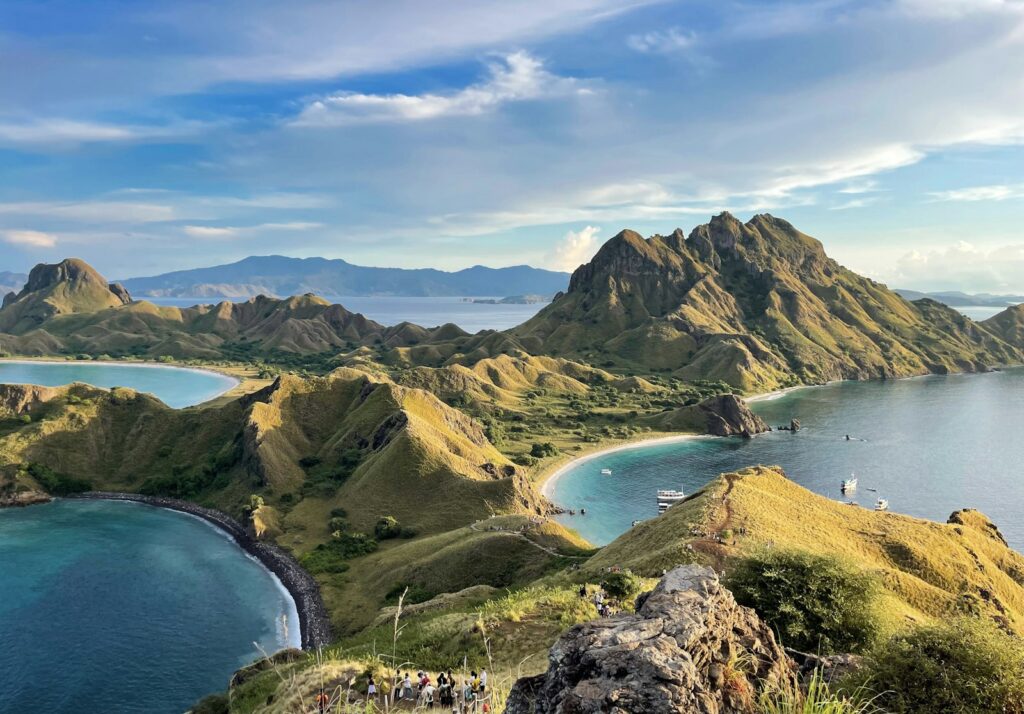
One day is enough for Komodo Island if your goal is the highlights: the Padar viewpoint, a Komodo dragon trek at Loh Liang, a drift snorkel at Manta Point, and a stop at Pink Beach. You will do all four, and you will get back to Labuan Bajo before dinner. What one day is not enough for is doing any of it slowly, catching dawn light on Padar’s ridgeline, or recovering comfortably if the Flores Sea decides to throw a metre of chop at a fast speedboat hull.
That’s the short answer. The longer one requires knowing exactly what the day looks like at each stop — and being honest about where the trade-offs actually bite.
What a Full Day Actually Looks Like
A standard six-stop speedboat day departs the Labuan Bajo marina between 06:00 and 07:00. Most operators ask you to arrive 30 minutes earlier for paperwork and the park-fee collection. You return between 16:30 and 18:00. Door to door from your hotel: 10 to 12 hours.
Here is the realistic breakdown of how that time gets used.
| Stop | Time on site | Notes |
|---|---|---|
| Padar Island viewpoint | ~75 min | Roughly 800 steps (figures vary), ~180–200 m elevation gain; 30–45 min to the top at a moderate pace |
| Pink Beach (Pantai Merah) | ~50–60 min | Swim and snorkel; the pink tint comes from red foraminifera mixed into the sand |
| Komodo / Loh Liang dragon trek | ~80 min | Day-trippers nearly always take the short trail (~45–60 min walking); longer trails require more time than the stop allows |
| Lunch on board | ~30 min | Served underway between stops; simple rice meal |
| Taka Makassar sandbar | ~45 min | Wading, photographs; tidal — visible most of the day but changes shape |
| Manta Point (Karang Makassar) | ~30 min | Drift snorkel; boat drops you up-current over the cleaning station |
| Final snorkel (Siaba Bay or Kelor Island) | ~30 min | Operator-dependent; some swap Kelor or Kanawa here |
Transit eats whatever is left. Labuan Bajo to Padar is roughly one hour on a speedboat; Pink Beach to Loh Liang another 20 minutes; the return leg from the final stop back to harbour takes close to an hour again. Add boarding and anchoring time at each site and a six-stop day has almost no slack. If conditions delay one stop, the last one usually gets cut.
The Honest Case for Yes
If you have one day and access to a speedboat, take the trip. The sites are genuinely impressive in a way that a single photo or a SERP snippet cannot fully convey. Standing on Padar’s ridge with three bays below you — each a different colour — is one of the better viewpoints in eastern Indonesia. Komodo dragons are real prehistoric animals up close on a savannah trail, not zoo exhibits. Manta rays at Karang Makassar appear frequently enough that operators build the whole day around the drift. These are not consolation prizes for people who could not afford a week.
The six-stop format has also been optimised over many years of operator trial and error. The route order — Padar first, Komodo mid-morning, Manta Point in the afternoon — is not arbitrary. Padar gets climbed before the midday heat makes the stairs punishing. Dragons at Loh Liang are more active in the morning before they move into shade. Manta Point is visited when afternoon currents suit drift snorkelling. The logic holds.
The Honest Case for No
There are specific situations where one day will leave you genuinely unsatisfied.
You want to dive, not just snorkel
Komodo’s underwater sites — Batu Bolong, Crystal Rock, the current channels around Gili Lawa — are regarded among the strongest diving in Southeast Asia. A six-stop day trip does none of them properly. There is no time for two dives at a single site, and day-trip operators do not carry dive-grade equipment on standard shared boats. If diving is your reason for going, a liveaboard or a two-day-one-night trip built around dive sites is the right product. Our day trip vs liveaboard comparison covers the full trade-off.
You want dawn light on Padar
Komodo is a photography destination for good reason. The classic Padar ridge shot — three bays, pre-dawn colour — requires arriving at the viewpoint around 05:30 to 06:00. That means leaving Labuan Bajo at 04:30 at the latest. No shared day-trip operator runs that departure. Overnight trips that anchor near Padar and send guests up before first light are a different product entirely. If light quality is your priority, one day will not satisfy.
You get badly seasick
This deserves blunt treatment. Speedboats cross open water between Labuan Bajo and Padar at speed, and the Flores Sea in peak season (June–August, which is now) has consistent wind chop. A fast hull on short-period waves produces a hard, rhythmic impact that is worse for nausea than the slower roll of a traditional wooden boat. The crossing to Padar takes roughly an hour each way under those conditions. If you are prone to motion sickness, take appropriate medication at least two hours before boarding — and seriously consider whether a six-stop speedboat day is the right format. A slower phinisi day cruise covers fewer stops but at a pace that is substantially less punishing on the body. It is worth asking the question before you book rather than asking it mid-crossing.
You are coming from Bali the same day
This is one of the most common planning mistakes. There are no boats from Bali to Komodo. You must fly Bali (DPS) to Labuan Bajo (LBJ) — roughly 1 hour 15 minutes in the air. The earliest departure from Denpasar is around 07:00, which puts you into Labuan Bajo around 08:10 to 08:30. Day-trip boats leave at 06:00 to 07:00. You will miss the window by two hours on the best possible flight connection.
The correct plan from Bali is: fly the day before, sleep in Labuan Bajo (the airport is 10 minutes from the harbour), do the day trip, then fly out that evening or the next morning. Operators themselves recommend arriving the night before. The 2026 visitor cap — 1,000 people per day park-wide, enforced through the SiORA online booking system as of approximately April 2026 — makes this even more important: there are no walk-up slots anymore. Book in advance, and arrive the night before.
If you are planning from Bali and want help timing it correctly, our planning form or WhatsApp is the quickest way to check availability and logistics before you commit to flights.
What the Day Costs — and What to Budget
Tour prices and park fees are two separate line items, and the confusion between them is one of the most consistent complaints from first-time visitors.
- Shared speedboat day trip (6 stops)
- IDR 1,200,000–1,800,000 per person (~USD 75–120). Peak season June–August runs toward the upper end. Park fees are excluded from this price and collected in cash on the day.
- Park fees — all-in practical budget
- IDR 300,000–500,000 per person, cash. This covers the park entrance ticket (IDR 150,000–250,000 for foreigners — sources conflict on weekday vs daily rate; confirm on the day), ranger fees (IDR 200,000 per group at Loh Liang, IDR 150,000 at Padar; both apply on a Padar-plus-Komodo day), and the harbour fee (~IDR 25,000). Snorkelling has no separate surcharge.
- Private speedboat charter
- IDR 8,000,000–18,000,000 per boat depending on size (~USD 500–1,200 for 6–15 passengers). Suitable for couples or families wanting a flexible schedule and fewer strangers on board.
- Budget wooden boat day trip
- IDR 500,000–1,200,000 per person. Longer crossings (3–4 hours each way to Padar vs 1 hour on a speedboat); realistically covers 2–3 stops, not 6. The full six-stop loop is a speedboat product.
- Phinisi day cruise (shared)
- IDR 2,000,000–5,000,000 per person (~USD 130–330). Covers fewer stops than a speedboat day but offers a qualitatively different experience: more deck space, a proper meal, slower movement between sites.
Bring enough IDR cash for fees. ATMs in Labuan Bajo work fine, but having cash ready means the boat does not wait for stragglers at the harbour. Most operators accept credit cards for the tour itself; the park collects cash only.
The 2026 Visitor Cap — What Changes for You
From approximately April 2026, Komodo National Park enforces a limit of 1,000 visitors per day park-wide, allocated through the SiORA online reservation system. This is a real operational change, not a threat that never materialised — unlike the IDR 3,750,000 annual conservation membership fee announced in 2022, which was officially cancelled before it took effect.
In practice, for most visitors this means your operator handles the SiORA reservation as part of booking — which makes advance booking mandatory, not optional. Spontaneous same-day bookings at the port are effectively gone during peak months. June and July are peak season. If you are reading this during that window, book at least two weeks out.
The cap may also push prices upward as supply tightens during peak periods. All price figures in this article were last verified in June 2026; confirm with your operator before booking.
Dragon Safety at Loh Liang — the Basics
A licensed ranger accompanies every group at Loh Liang (Komodo Island) and Loh Buaya (Rinca Island). This is not optional and the ranger fee is not negotiable. The rules are practical rather than bureaucratic: stay grouped, keep to the trail, maintain 3–5 metres from any dragon, no crouching near them, no sudden movements, no food on the trek. Rangers carry forked sticks as a deterrent.
Fatal attacks are extremely rare — one reported tourist fatality, in 2009, appears in safety guides. The more common risk is the same one that applies to any large wild animal: complacency. Dragons move faster than they look. Respect the distance, follow the ranger, and the trek is genuinely safe.
Women are asked to inform the ranger if they are menstruating — this is an operational safety advisory based on the animals’ sensitivity to blood scent, not a written regulatory ban.
Manta Point — What to Expect Honestly
Manta rays at Karang Makassar are not guaranteed. The site is a cleaning station: mantas come to have parasites removed by smaller fish, and they are present year-round in some numbers. That said, larger aggregations are associated with plankton-rich water — more common in the December–February rainy months than in June–August peak season. You are likely to see mantas during peak season, but likely is not certain.
The drift is done without fins on some boats, which makes it accessible to weaker swimmers who are comfortable in the water with a life jacket. The current at Manta Point is strong. If you are not a confident open-water swimmer, tell your operator before the trip — not at the site.
Standard etiquette applies regardless of whether the park has codified it: stay about 3 metres from any manta, approach from the side rather than above, do not touch, do not block their path over the cleaning station, no flash photography.
Should You Take a Second Day Instead?
If you have the time, yes — a two-day one-night trip changes the quality of the experience more than any upgrade within the day-trip format. Sleeping on the boat or near Padar means you are already there for sunrise. You can do an evening dive and a morning dive without rushing. You visit sites that day trips skip entirely.
Our day trip vs liveaboard guide runs through the full comparison with costs, so you can decide based on what you actually want rather than what the itinerary thumbnails suggest. If the day trip is your only option given your schedule, it is a good option. If you have one extra night to spare, the trip becomes a different order of experience.
Plan With Us
We are an independent guide — we explain what the options are and what they cost. If you decide to proceed with a vetted operator through us, they may pay us a referral fee at no extra cost to you. That arrangement does not change what we publish.
If you want help matching your available time, budget, and seasickness tolerance to the right boat type, reach out via our planning form or WhatsApp. We respond quickly during peak season and we know which operators still have SiORA availability.
Frequently Asked Questions
How rushed does a Komodo island day trip actually feel?
Rushed, but not frantic. Each stop gets enough time to do the main thing — climb Padar, trek with the dragons, drift at Manta Point — but not enough time to linger or explore independently. The pace is set by the boat’s schedule and the tide windows at each site, not by you. Most people find it satisfying. People who wanted a meditative experience in nature find it exhausting.
Can you see Komodo dragons on a day trip, or do you need an overnight stay?
You can see them on a day trip. The short trail at Loh Liang reliably passes through areas where dragons rest during the cooler morning hours. There is no guarantee of seeing a specific number, and morning is better than afternoon because dragons shade-seek in midday heat. The 80-minute window at Loh Liang is workable for the short trail; the longer and adventure trails require more time than the stop allows.
What cash should I bring for park fees?
Budget IDR 400,000–500,000 per person as a working figure. The practical all-in park-fee estimate for a standard six-stop day is IDR 300,000–500,000: entrance (IDR 150,000–250,000 for foreigners — weekday vs weekend rates conflict across sources, so the range is genuine), ranger fees at both Padar and Loh Liang (IDR 150,000–200,000 per group at each site), and the harbour fee (~IDR 25,000). Fees are always paid cash on the day and are always excluded from the tour price.
Is a speedboat or slow boat better for a one-day Komodo trip?
If you want all six stops, you need a speedboat. A traditional wooden boat cruises at 6–8 knots, making the crossing to Padar 3–4 hours each way. A slow-boat day trip realistically covers two or three stops — typically Rinca (closer to Labuan Bajo), one snorkel site, and perhaps Kelor Island. That is a reasonable trip on a tighter budget or for travellers prone to seasickness on hard-hull speedboats. It is not the same trip as the six-stop route, and operators marketing a slow-boat full Komodo day are overpromising.
Do I need to book Komodo tickets in advance in 2026?
Yes — in practice, your operator handles this through the SiORA booking system as part of your tour reservation. The 1,000-visitor-per-day park cap introduced in April 2026 has effectively eliminated walk-in slots during peak season. Book your tour at least two weeks before your planned date in June–August, and confirm that your operator will secure the SiORA reservation. This is a new enforcement that is still being embedded into operator workflows — worth asking about explicitly when you book.