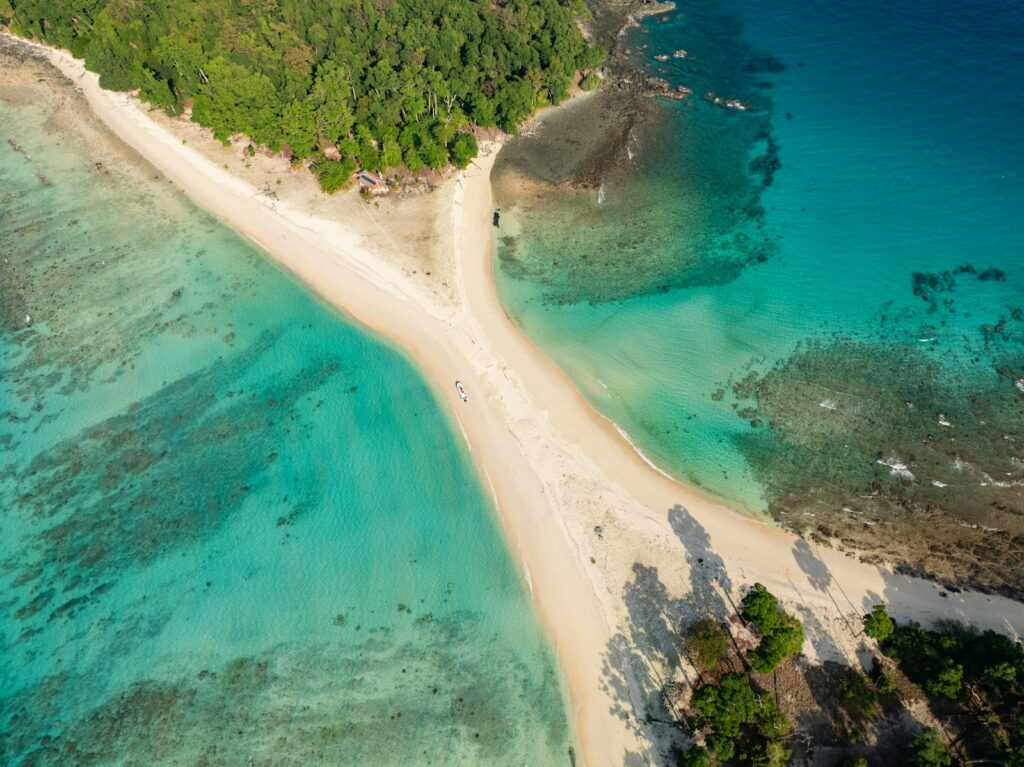
Kelor Island, located approximately 8–10 km from Labuan Bajo harbour by chart distance (an estimated figure — label it as approximate), is the closest landmass inside Komodo National Park that offers both a hill climb and snorkeling from the same small beach. The summit trail is short and steep: most people reach the viewpoint in 15 to 20 minutes, look out over a wide bay panorama, and are back on the boat within 45 minutes. That combination of proximity to town and brevity of effort makes Kelor a natural first or last stop — and the defining piece of the classic slow-boat three-island day.
Quick Facts: Kelor at a Glance
- Distance from Labuan Bajo
- Approximately 8–10 km by straight-line chart distance (roughly 4–5 nautical miles). These are approximate figures derived from charts — not a published official measurement. By speedboat, the crossing takes around 20–30 minutes depending on sea conditions; for a slow wooden boat, it is closer to 45 minutes to an hour.
- Summit climb time
- 15–20 minutes up for most people at a moderate pace; the trail is short and the gradient steep in places. Allow 30–40 minutes total on the island for the climb, a few minutes at the top, and the descent.
- Snorkeling
- Off the beach below the hill — accessible without additional kit beyond a mask and snorkel (basic gear typically provided on boat tours). No separate snorkeling surcharge beyond the park entrance ticket; the base ticket covers it.
- Park entrance ticket
- IDR 150,000–250,000 per person for foreigners depending on whether it is a weekday or a Sunday/public holiday — this split is genuinely contested across sources, so budget IDR 250,000 and treat anything lower as a bonus. The ticket is valid park-wide for that calendar day; you do not pay separately per island visited.
- Ranger fee
- Kelor does not have Komodo dragons, so the compulsory ranger escort system that applies at Loh Liang and Loh Buaya does not apply in the same form here. No trekking ranger fee comparable to the IDR 150,000–200,000 per group charged at Padar, Komodo, and Rinca has been verified for Kelor — confirm the current arrangement with your operator before departure, as the fee structure across sites can change.
- Shade on the trail
- Minimal above the first stretch. The hillside is open and dry, and the sun is on you for most of the climb.
- Typical stop window
- 30–45 minutes — enough for the hike and a swim if you move at a reasonable pace. Slow-boat itineraries sometimes allow slightly longer; speedboat days are tighter.
Where Kelor Fits: The Two Itinerary Roles
Kelor plays two distinct roles depending on which kind of boat you are on, and understanding the difference is worth a paragraph before you go.
The Slow-Boat Three-Stop Day
For visitors on a budget wooden-boat day trip, Kelor is often the anchor of the itinerary — the first stop after leaving Labuan Bajo, followed by Rinca island (Loh Buaya) for the Komodo dragon trek, then one snorkel site before heading back. This three-stop combination exists because slow boats cruise at 6–8 knots. At that pace, Padar is roughly 3–4.5 hours from Labuan Bajo and Komodo island is 4–6 hours one way. You simply cannot reach those destinations and return in daylight on a slow boat without a pre-dawn departure. Kelor, being the closest park stop, is what the slow boat can reach in a reasonable time.
The honest implication: the six-stop loop — Padar, Pink Beach, Komodo, Taka Makassar, Manta Point, and a snorkel site — is a speedboat product. Slow-boat day tours do 2–3 stops and are marketed honestly as such by the better operators. If you see a slow-boat operator promising six stops in a day, probe that claim carefully.
Slow-boat day trips run IDR 500,000–1,200,000 per person (last verified mid-2026 from multiple sources; the bottom end of that range comes with genuine questions about crowding and safety standards). Park fees are excluded and paid cash on the day on top of that.
The Speedboat Day’s Closer
On a six-stop speedboat day, Kelor appears at the end of the itinerary as an alternative final stop — alongside Kanawa and Siaba Bay — before the boat turns north toward Labuan Bajo. After a full day that started at Padar before 08:00 and ran through dragon trekking at Loh Liang, a long snorkel at Manta Point, and the sandbar stop at Taka Makassar, a 20-minute summit at Kelor is a lighter, more sociable close to the day. The light in the late afternoon often falls well on the bay view from the top.
Not every six-stop tour visits Kelor — Siaba Besar (the turtle snorkel site) and Kanawa are common alternatives depending on the route and the boat’s schedule. If Kelor specifically is important to you, confirm the stop list with your operator before booking rather than assuming it is included.
The Climb: What to Actually Expect
The Kelor summit trail is steep, open, and direct. It climbs a grass-covered hillside to a narrow ridge from which you look out north and west across the strait toward Labuan Bajo and the surrounding smaller islands. The panorama is wide rather than dramatic — it lacks the three-bay geometry of Padar — but it is genuinely expansive, and the scale of the water and the clusters of islands in every direction reads clearly from the top.
The trail has no technical sections. You do not need poles or climbing shoes. But steep means steep: the gradient on the upper portion requires paying attention to your footing, and the descent is slower than the ascent for most people. The hillside grass can be slippery when wet, which is relevant if you are visiting during the wet season (December through March).
On a clear dry-season morning, fit walkers reach the top in 15 minutes. People who are less fit or taking it easy — which is entirely reasonable on a multi-stop day that started at 06:00 — take closer to 20–25 minutes. The 30–45 minute stop window typical on speedboat tours is workable, but it does not leave room for a leisurely summit sit. Slow-boat stops sometimes run longer; ask when you get off the boat.
Heat and Footwear on Kelor
The sun exposure on the Kelor trail is essentially continuous. There is no forest canopy, no shade structure, and the hillside faces the open sky. In peak season — June through August, which is the current period — the surface of the trail is warm underfoot and the combination of gradient and heat makes the climb feel harder than the short duration suggests.
Bring water from the boat. There are no facilities on the island, no stalls, no shade shelter at the summit. A half-litre per person is a realistic minimum for a stop this short; if you are continuing straight from a long morning and it is past midday, take more. Apply sunscreen before you leave the boat — the trail does not give you a chance to do it comfortably once you start walking.
On footwear: Kelor is less demanding than Padar and many people summit in sports sandals without incident. The grass underfoot is uneven, and the upper section has loose dry soil, but there is no extended scree and the trail is well-worn. Closed trainers are comfortable and sensible; sandals are manageable as long as they have a heel strap and some grip. Flat thong-style sandals are the real risk scenario — they can slide on loose ground and provide no heel support on the descent. If that is all you have, go slowly.
Snorkeling Off Kelor Beach
The small beach at the base of Kelor’s hill is one of the better accessible snorkel spots near Labuan Bajo. The water is clear when the tidal conditions are cooperative, coral coverage is reasonable in the shallower sections, and it is calm enough for beginners and nervous swimmers. Most boats on the slow-boat three-stop route schedule the Kelor snorkel as part of the same stop as the hike — you summit first, then cool off in the water.
The snorkel at Kelor is not the standout marine experience of the park. Manta Point, Siaba Besar (the turtle site), and the Pink Beach snorkel generally deliver more memorable encounters. But for a first-stop snorkel close to Labuan Bajo, it is a reasonable warm-up, and for slow-boat visitors who are not making it to the further sites, it is the main snorkel stop of the day.
The base park entrance ticket covers snorkeling — there is no extra snorkel surcharge beyond the standard fee. Bring a mask and snorkel from the boat; fins are useful but inconsistently provided on budget tours (confirm with your operator). If you are a weak swimmer, ask about life jacket availability before the stop rather than at the water’s edge.
Currents at Kelor are generally milder than at Manta Point or Taka Makassar, but conditions vary with tide and season. Do not enter the water far from the boat if the water looks choppy or fast-moving on the day, and always snorkel with awareness of where the boat is anchored.
Kelor vs the Other Final Stops: A Comparison
On a six-spot speedboat day, the final stop rotation typically draws from Kelor, Kanawa, and Siaba Besar. They serve slightly different purposes.
| Stop | Main draw | Summit/land activity | Snorkel quality | Distance from LBJ (approx.) |
|---|---|---|---|---|
| Kelor Island | 20-min summit climb + bay panorama; beach snorkel | Yes — short steep hill | Good, beginner-friendly in calm conditions | ~8–10 km (chart estimate) |
| Kanawa Island | Calm lagoon snorkeling, house reef, relaxed beach stop | Minimal — mostly flat beach and resort area | Good coral, calm sheltered water | ~15–20 km (approx.) |
| Siaba Besar | Turtle snorkel — green turtles in relatively reliable numbers | None — purely a snorkel stop | Best for wildlife; turtle sightings not guaranteed | ~30–35 km (approx.) |
If your priority is a land activity at the end of a long boat day, Kelor is the only one of these that gives you a climb and a view. If you want the best snorkel wildlife experience, Siaba Besar has the edge on turtle sightings. Kanawa suits people who want a calm beach and water without exertion after a physically demanding day.
Note: distances above for Kanawa and Siaba are approximate chart estimates, not published official figures. Confirm with your operator which stop fits your route on the day.
Thinking through the route options before you book? Use our planning form or reach us via WhatsApp — we can walk through what a slow-boat three-stop day versus a six-stop speedboat day actually feels like, and which one suits your group’s priorities.
The 2026 Park Cap and Booking Timing
A park-wide visitor cap of 1,000 people per day has been in effect since approximately March–April 2026, enforced through the SiORA online booking system. Your operator handles the SiORA reservation; you rarely interact with it directly. What matters practically is that walk-in spots on peak days in June through August are not reliable, and the better shared speedboat tours fill their boats two or more weeks ahead of the trip date during peak season.
Kelor being close to Labuan Bajo does not give it any special advantage under this cap — the 1,000-visitor limit applies park-wide across all sites. If you are reading this in June, July, or August 2026, assume peak conditions. Book ahead. Verify the current fee structure and cap status with your operator before travel, since this is a recently imposed system and the details are subject to change.
Practical Summary: Coming or Going?
Kelor works best as a first or last stop precisely because the activity is brief and contained. First thing in the morning, the climb is cooler and the light on the bay is clear; the snorkel is a good warm-up before longer crossings. At the end of the day, the short summit serves as a kind of coda — a final elevated view before the boat points back toward harbour and the light softens over the Flores Sea.
Either way, the essential logistics are the same: sturdy footwear if you have it (sandals with heel straps are fine; flat thongs are not), water from the boat, sunscreen applied before you disembark, and a mask and snorkel if you want the swim. The stop does not require much preparation — which is part of what makes it a reliable anchor for the slow-boat day and a pleasant finale for the speedboat loop.
We do not sell tours directly. If you use our guidance and decide to book through a partner operator, they may pay us a referral fee at no extra cost to you — that arrangement does not change what we publish. Start here to plan your trip, or send us a WhatsApp message with your travel dates and group size and we will point you toward the right boat for your situation.
Frequently Asked Questions
How long does the Kelor Island hike take?
Most people reach the summit in 15 to 20 minutes at a moderate pace; the descent is roughly the same. Allow 30 to 40 minutes total on the hill — slightly more if your group is mixed in fitness or if it is a hot midday stop. The trail is steep but short, with no technical sections. A stop window of 45 minutes is enough for both the climb and a quick snorkel off the beach below, though a longer window is more comfortable.
Is Kelor Island on the standard six-stop speedboat day trip?
Not always — it depends on the operator and the day’s route. Kelor is a common alternative final stop alongside Kanawa and Siaba Besar, but not every tour includes it. If visiting Kelor specifically is important to you, confirm the stop list with your operator before you pay a deposit rather than assuming. On slow-boat three-stop days departing Labuan Bajo, Kelor is typically the first stop given its proximity to the harbour — approximately 8–10 km by chart estimate.
Is there a separate ranger fee for Kelor Island?
Kelor does not have Komodo dragons, so the mandatory ranger escort system and associated fee that applies at Loh Liang (Komodo) and Loh Buaya (Rinca) — IDR 200,000 per group of up to 5 — does not apply in the same form. The park entrance ticket covers access. That said, the fee structure across park sites can be updated; verify the current arrangement with your operator before your trip. The base park entrance ticket for foreigners is IDR 150,000–250,000 per person per day (last verified June 2026 — weekday versus Sunday/public holiday rate is genuinely contested across sources; budget the higher figure).
How does Kelor snorkeling compare to other stops in the park?
Decent, not exceptional. The Kelor beach snorkel is calm, accessible for beginners, and offers reasonable coral in clear water when conditions are cooperative. For wildlife highlights — turtle encounters, manta ray drift snorkels — Siaba Besar and Manta Point (Karang Makassar) are the standout stops. Kelor’s value is the combination: you get both the hill climb and a beach swim at a single short stop close to Labuan Bajo. If you are on a slow-boat day trip and Kelor is your main snorkel opportunity, it is a satisfying stop; if you are comparing it to Siaba or Manta Point, the marine experience is more modest.
Can slow boats reach Kelor Island from Labuan Bajo?
Yes — Kelor is specifically why slow-boat day trips are viable. At roughly 8–10 km from Labuan Bajo harbour by approximate chart distance, it is well within the range of a slow wooden boat cruising at 6–8 knots without consuming half the day in transit. The standard slow-boat day itinerary is Kelor plus Rinca (Loh Buaya) plus one snorkel site — three stops total. The full six-stop speedboat loop (Padar, Pink Beach, Komodo, Taka Makassar, Manta Point, and a final stop) is not achievable on a slow boat in a single day without an impractically early departure; the distances simply do not work at slow-boat speeds.