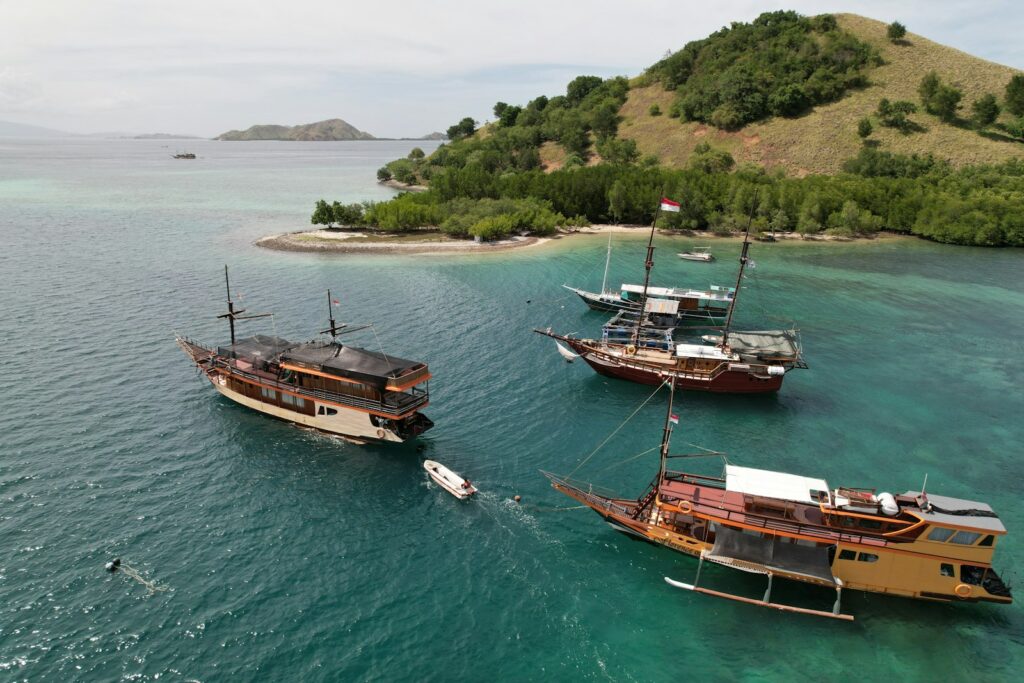
A Komodo day trip runs roughly 10 to 12 hours from Labuan Bajo and back, covering five or six sites in a single push before returning you to your hotel bed. A 2 day 1 night Komodo boat trip does the same core sites but spreads them across two days, anchoring overnight somewhere in the park — often off Gili Lawa or near Padar — so you get a sunset, a sunrise, and a second morning of activity before the return crossing. Between these two and the full multi-night liveaboard sits a gap that the 2D1N format is specifically designed to fill.
Whether it fills that gap well depends almost entirely on which boat you are on. That is the thing almost nobody explains clearly, so let me do it here.
What the 2 Day 1 Night Format Actually Adds
The structural advantage of a 2D1N trip over a day trip is time. You have it, and the park rewards you for it in ways that a 10-hour speedboat loop cannot replicate.
Morning Access Before the Crowd Arrives
Day-trip speedboats leave Labuan Bajo at 06:00 to 07:00 and reach Padar — roughly 45 to 50 km away — after an hour of transit. On a good day that puts the first group on the Padar steps around 07:30 to 08:00. On a 2D1N trip you anchor nearby the previous evening. You wake up to the boat already in position. The climb to the Padar ridge in the half-light before 07:00 is not the same experience as the one you get at 08:30 with three other boats on the hill behind you.
The same applies at Loh Liang on Komodo island. Komodo dragons are more active in the cooler morning hours before midday heat pushes them into shade. A 2D1N itinerary that positions the Loh Liang visit first thing on day two — rather than the day-trip’s mid-morning slot — gives you better dragon behaviour conditions and a quieter trail. Not a guarantee of a better sighting, but meaningfully better odds.
The Sunset Anchorage and What It Actually Looks Like
Anchoring in a Komodo bay at dusk is the single experience the 2D1N format genuinely owns that neither a day trip nor a full liveaboard has any particular claim on. The Flores Sea turns a specific colour around 18:00 in the dry season. The hills go dark. Most of the day-trip fleets are already 45 minutes into the return crossing. The water is yours.
This is not a minor aesthetic point for everyone. For a lot of travelers, it is the main reason to choose 2D1N over a rushed day. If you are doing this trip once and you want one image that is not shared with a hundred other boats, the sunset anchorage is it.
A Slower Pace Between Stops
Day trips move on a fixed clock. The guide controls the timing — there are 20-odd passengers on a shared speedboat and a return window to hit. At Loh Liang you get roughly 80 minutes total, almost all of it on the short ranger trek. At Pink Beach you get 50 to 60 minutes. Taka Makassar sandbar gets 45. Manta Point gets 30. If you are a slow hiker, a frequent photographer, or you want to stay in the water longer, a shared day trip is not built for you.
A 2D1N itinerary spreads the same stops across more hours. Stop durations are not necessarily doubled, but the pressure to move is lower. You are not racing the return crossing. Some operators will let you spend a full morning at a single site if conditions are right — that flexibility simply does not exist on a shared day trip.
The Real Question: Which Boat Are You On?
Here is where most 2D1N advice goes wrong. People compare the format — day trip versus overnight — without comparing the boat class underneath it. The overnight format spans a wide range, from budget wooden open boats to premium phinisi vessels, and those vessels deliver fundamentally different trips even if the itinerary on paper looks identical.
Budget Wooden Boats: What the Published Specs Show
Budget 2D1N wooden boats — the kind priced around IDR 700,000 to 1,500,000 per person per night (last verified 2026; confirm rates directly, the market moves) — are typically traditional kapal kayu vessels around 15 to 18 metres. One published spec from an operator-facing source describes a 50-foot wooden hull with a 12-foot beam and sleeping accommodation for up to 25 passengers on an open upper deck with roughly four feet of headroom. That four-foot ceiling is not a typo. You cannot stand up on the sleeping level.
The sleeping arrangement on budget wooden boats is usually a shared open deck with thin mattresses or foam pads laid side by side, separated from other passengers by the same amount of space the foam takes up. No partitions, no curtains. Toilets on the lower deck — typically a squat toilet without a seat, with bucket flush. Cold water only. If you are used to hostel dormitories and you sleep easily in close quarters, this is manageable. If you are expecting a cabin, a bunk, or a door you can close, you will be unpleasantly surprised.
Budget wooden boats also have fixed open cooking on the lower deck — simple rice-and-fish meals, functional and usually fine. The crew sleeps in the bow. There is usually one common area in the shade amidships where everyone congregates during transit.
What these boats do well: they are slow. Six to eight knots instead of a speedboat’s 25 to 35. The motion is gentler, which matters if you are prone to seasickness. They cost less per night than almost any accommodation in Labuan Bajo town. And the crew on the boats I have worked with knows the water and the park properly — do not underestimate that.
Mid-Range and Premium 2D1N Vessels
At IDR 2,500,000 to 5,500,000 per person (indicative range; varies significantly by vessel and season — last verified June 2026), you move into shared-cabin phinisi territory. A cabin means a door. It means a bunk or a proper berth. The toilet is usually a marine head rather than a bucket squat, though plumbing on boats should not be expected to match a three-star hotel’s. Meals are properly cooked. There is outdoor deck space with sun loungers or seating. AC in the cabin is not guaranteed at the lower end of this bracket — ask specifically.
Luxury day charter phinisi vessels — the kind that charge IDR 2,000,000 to 5,000,000 per person for a single day — exist in a separate category entirely. They are comfortable but they are day boats; they do not anchor overnight with guests. The 2D1N format at the premium end means a proper overnight phinisi with cabin accommodation, which is essentially a two-night liveaboard itinerary compressed into one sailing night. These vessels start at the lower end of liveaboard pricing and overlap considerably with the entry point for three-night trips. At that point you are already most of the way to the full liveaboard format — read our day trip vs liveaboard comparison to understand where the 3D2N format picks up.
What You Actually Gain Over a Day Trip (and What You Don’t)
Let me be direct about this, because the 2D1N format is sometimes oversold as offering liveaboard-quality experiences at a fraction of the cost. It does not. What it genuinely offers:
| Factor | Day trip | 2D1N budget wooden boat | 2D1N mid-range phinisi |
|---|---|---|---|
| Total hours in the park | ~10–12 h | ~22–26 h | ~22–26 h |
| Dawn access to sites | No (arrives mid-morning) | Yes — key advantage | Yes — key advantage |
| Sunset anchorage | No | Yes | Yes |
| Sleep quality | Own hotel bed | Open shared deck, ~4 ft ceiling, foam pad | Private or shared cabin, berth |
| Toilet | N/A (on land each night) | Squat, bucket flush, cold water | Marine head; varies by vessel |
| Dive access | Snorkel only (Manta Point drift) | Usually snorkel only; dive equipment not standard | Dive packages available on many |
| Pace flexibility | Fixed group schedule | More flexible than day trips | More flexible than day trips |
| Indicative price/person (excl. park fees) | IDR 1,200,000–1,800,000 | IDR 700,000–1,500,000/night | IDR 2,500,000–5,500,000 all-in |
| Typical pax count (shared) | Up to ~20–22 passengers | Up to 20–25 passengers | 8–16 passengers typical |
All price figures are indicative ranges only; peak season (June–August, Christmas, New Year) runs 10 to 30 percent higher. Park fees — approximately IDR 300,000 to 500,000 per person all-in for foreigners on a standard day — are paid in cash on the day and excluded from tour prices regardless of format (last verified June 2026; confirm the current structure with your operator, as the 2026 daily visitor cap and SiORA booking system have introduced new fee components). You pay park fees for each calendar day you are in the park, so a 2D1N trip that crosses midnight means two separate days of park fees. Budget accordingly.
The Honest Cost Comparison
People often look at a budget 2D1N price of IDR 700,000 to 1,000,000 per night and assume it is cheaper than a day trip at IDR 1,200,000 to 1,800,000. Sometimes it is, on paper. The reality is more complicated.
A 2D1N trip means two days of park fees instead of one — roughly IDR 600,000 to 1,000,000 extra per person in park costs alone. It also means not paying for a night’s accommodation in Labuan Bajo, which at the budget end might be IDR 200,000 to 400,000 or at the mid-range end IDR 500,000 to 900,000. So the net cost calculation is: tour price difference, plus second day’s park fees, minus saved accommodation.
For many travelers staying in budget guesthouses, the 2D1N trip ends up costing similar to or slightly more than a day trip when the full accounting is done. At the mid-range phinisi level, 2D1N costs noticeably more than a day trip by any measure. Neither format is a trick — just know what you are actually comparing before you decide on price alone.
If the budget 2D1N boat’s comfort spec puts you off but the price of a proper cabin phinisi feels steep, the day trip on a good shared speedboat is the cleaner choice. A bad night’s sleep on an open deck in the Flores heat — shared with 20 strangers and a bucket toilet — is not a minor inconvenience for everyone. Some people genuinely love it; others spend the night regretting the decision. Ask yourself honestly which category you fall into before you book.
The 2026 Visitor Cap Changes the Calculus
Since approximately April 2026, the park enforces a 1,000-visitor daily cap park-wide (announced by the Ministry of Forestry; verify current enforcement status with your operator — details are still evolving). Reservations flow through the SiORA online booking system, handled by your operator. In peak season — June through August, which is right now — this cap is real and limiting.
For the 2D1N format, this matters in two ways. First, a two-day trip requires your operator to secure park entry on two separate days, not one. During peak periods that is harder to arrange at short notice. Second, the cap has pushed operators to recommend booking at least two weeks ahead in high season (one operator publishing Green Rinjani’s booking guidance suggests 15 days for peak). Budget operators running large wooden boats can face a hard stop if the cap is hit. Ask your operator specifically how they handle SiORA reservations for overnight trips, not just single-day entries.
Need help comparing what different operators include for the 2D1N format and how they handle the booking system? Send us your dates and group size and we’ll run through the options with you. Our concierge is also reachable on WhatsApp for quick back-and-forth questions. No one can pay us to change what we publish; if you use our free guidance and then proceed with a partner operator, they may pay us a referral fee at no extra cost to you.
Who the 2D1N Format Is Actually Right For
Having watched people choose between these formats across many seasons, the pattern is pretty consistent. The 2D1N format works well when:
- You have two full days in the area and a tight budget — you save one night’s accommodation cost and gain the sunrise access and sunset anchorage
- You are comfortable sleeping rough in outdoor conditions and are genuinely fine with shared open-deck sleeping, basic toilets, and no air conditioning — budget boats are not glamorous, but they are not dangerous; they are just basic
- The dawn light and evening anchorage matter to you more than comfort in the hours between stops
- You do not need a full liveaboard itinerary (3D2N or longer) but you want more than a single-day loop
- You are a solo traveler or a pair on a budget who can fill the remaining spots on a shared budget wooden boat without chartering the whole thing
The 2D1N format is not a good fit if:
- You sleep poorly in non-private spaces — the open deck is genuinely communal and there is no alternative on a budget vessel
- You need a private toilet or reliable hot water at night
- You are traveling with young children who need regular sleep routines
- You expect the overnight experience to mirror a cabin liveaboard at a fraction of the price — it does not; you are paying for a different product, not the same one cheaper
- You are an active diver — the budget 2D1N boats do not carry dive equipment as standard, and you will want a proper dive phinisi for the park’s best sites
The Middle Path vs the Other Options
There are three broad formats on offer from Labuan Bajo’s port strip, not two. The day trip is at one end. The 3D2N or longer liveaboard is at the other. The 2D1N sits between them, and the honest answer is that it serves a specific traveler profile rather than splitting the difference cleanly.
If you have two days and limited budget, 2D1N on a budget wooden boat gives you the timing advantage — dawn access, sunset anchorage — at a cost that can be close to a single-day speedboat trip once accommodation savings are factored in. You pay for it in sleep comfort. If you have two days and are willing to spend more, a mid-range phinisi 2D1N is a more comfortable version of the same core advantage, but you are now approaching liveaboard pricing and it is worth asking whether you should just do 3D2N properly.
For travelers deciding between the 2D1N format and a full liveaboard, our day trip vs liveaboard comparison covers the full picture including what a 3D2N itinerary adds over both shorter formats, and how the dive site access changes. For 3D2N and multi-night trips specifically, our liveaboard sister resource covers vessel classes, itineraries, and pricing in depth — reach out via our planning form and we will point you toward the right resource.
Frequently Asked Questions
Is a 2 day 1 night Komodo trip worth it over a day trip?
It depends on what you are optimizing for. If dawn access to Padar and Komodo, the sunset anchorage, and a slower pace matter to you, then yes — 2D1N adds real experiences that a day trip structurally cannot offer. If you are primarily comparing on cost, note that two days of park fees (roughly IDR 600,000 to 1,000,000 extra per person) narrow the gap between the two formats considerably. And if you are considering a budget wooden boat, read the sleeping-deck specs carefully before you book — comfort expectations need to be set correctly.
What are budget 2D1N boats like to sleep on?
Budget wooden boats in the IDR 700,000 to 1,500,000-per-night range typically offer an open shared sleeping deck with foam mattresses laid side by side. Headroom on the sleeping deck is often around four feet — you cannot stand upright. Toilets are usually squat style with bucket flush and cold water. There are no private cabins and no air conditioning. The experience is closer to camping on a boat than to a hostel. Many seasoned backpackers and budget travelers find it perfectly fine; others do not. Ask your operator for specific vessel specs, including the ceiling height on the sleeping deck, before committing.
How much do 2D1N Komodo trips cost compared to day trips?
Budget 2D1N wooden boats run approximately IDR 700,000 to 1,500,000 per person per night (last verified June 2026), which can look cheaper than a day-trip speedboat at IDR 1,200,000 to 1,800,000. However, a 2D1N trip requires two days of park fees (roughly IDR 300,000 to 500,000 per day per person for foreigners, paid in cash) rather than one, which typically adds IDR 300,000 to 500,000 or more to the true total. Mid-range phinisi 2D1N trips run IDR 2,500,000 to 5,500,000 per person all-in, which is noticeably more than a standard day trip. Always ask for the full price breakdown including park fees before comparing.
Can I do a 2D1N Komodo trip without diving?
Yes. The core 2D1N itinerary — Padar viewpoint, Pink Beach snorkel, Komodo island dragon trek, Manta Point drift snorkel, Taka Makassar sandbar — is fully accessible without any diving experience or equipment. Snorkel gear is typically included on both budget and mid-range vessels, though fin availability is inconsistent on budget boats (confirm before departure). If you want to dive on top of snorkeling, you will need a mid-range or premium phinisi that carries dive equipment and has a divemaster on board; budget wooden boats do not typically offer diving as part of the package.
Should I book 2D1N or just do the Komodo day trip twice?
Doing two separate day trips from Labuan Bajo is an underrated option that very few people consider. Two day trips cover the same ground, return you to a real bed each night, and can be booked on separate boats if you want variety. The cost is broadly similar to a mid-range 2D1N phinisi once park fees are counted for both days. What two day trips cannot give you is the sunset anchorage experience and the dawn positioning that the overnight format provides. If those specific experiences are a priority, book the overnight trip. If they are not, two day trips — or one day trip plus a different activity like snorkeling at a different site — may suit you better.