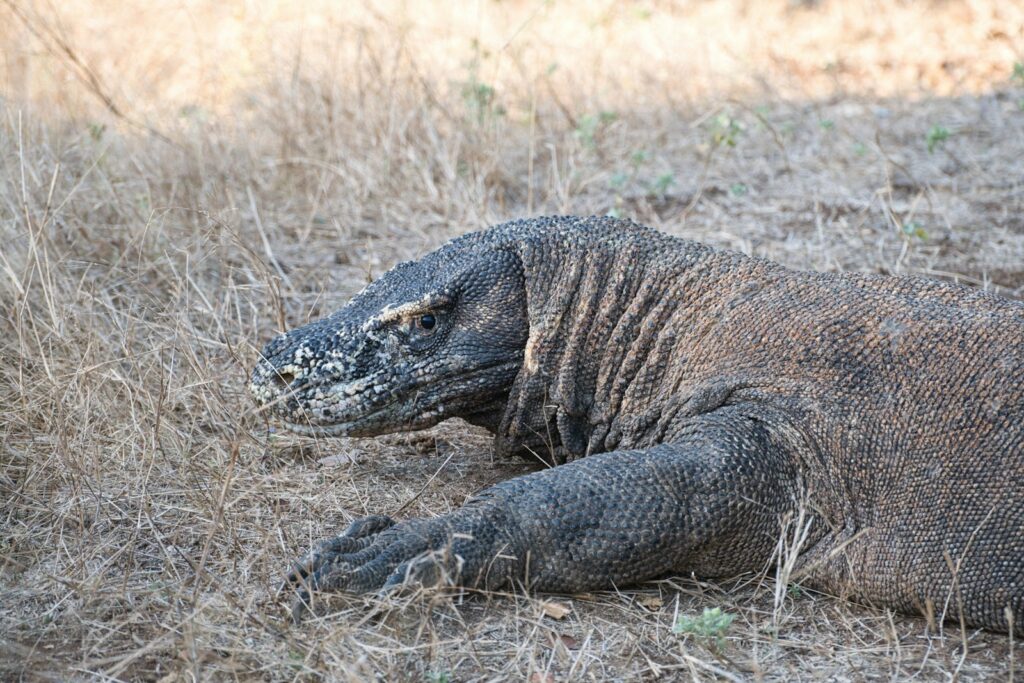
The chances of seeing Komodo dragons on a day trip to Loh Liang (Komodo Island) or Loh Buaya (Rinca Island) are genuinely high — most groups on a guided trek see at least one dragon. But no official sighting-rate statistics exist, and any website quoting you a percentage like “95% guaranteed” has invented that figure. What I can tell you honestly is what affects your odds, what the ranger protocol actually looks like on the ground, and which choices — morning versus midday, Rinca versus Komodo — change the picture in ways that matter.
Why No One Can Give You a Reliable Percentage
Balai Taman Nasional Komodo (BTNK), the park authority, does not publish per-trek sighting data. No independent research body tracks “dragons seen per 100 visitors” at Loh Liang or Loh Buaya. What we have is ranger field knowledge and the accumulated experience of operators who send boats out daily. That picture is broadly positive — Komodo dragons are not shy, the population at both sites is healthy, and the habitat is small enough that a one-hour short trek almost always brings you close to at least one. But almost always is not always, and honesty matters here.
Factors outside your control: rain can drive dragons into dense scrub where visibility is poor; if a large group spooked a dragon before your group arrived, it may have moved off-trail; individual animal behavior simply varies. Plan for a good sighting, but do not build your entire trip around the assumption of one.
The Biology You Should Understand Before You Go
Komodo dragons (Varanus komodoensis) are ectotherms — they regulate body temperature through their environment, not internal metabolism. This has a direct practical consequence for day-trippers.
Morning vs. Midday: Why It Matters
In the morning, dragons are often active: basking near the trail, moving toward water sources, or patrolling the lower savannah. As the day heats up — and Loh Liang and Loh Buaya are open, dry, extremely hot by 10:00–11:00 — the dragons seek shade. They move under dense canopy, into rocky overhangs, or simply flatten against a shaded embankment and become very hard to spot. A midday trek on a hot dry-season day can still produce a sighting near the ranger post (where kitchen scraps have historically attracted dragons, though feeding is prohibited), but the active, open-ground encounters are far more likely early.
The standard speedboat day trip from Labuan Bajo departs around 06:00–07:00 and reaches Komodo’s Loh Liang somewhere between 09:30 and 11:00, depending on the itinerary order. Operators who put Padar first (the more common route) typically arrive at Loh Liang late morning — already warm. If dragon sightings are your primary goal, ask your operator whether they can arrange an itinerary that hits Komodo or Rinca first, before Padar. Some private charters will accommodate this. On a shared open-trip boat, the route is usually fixed.
Mating Season: General Life-History Context
Dragon behavior shifts with the season. The mating period runs roughly May through August — as a general life-history pattern based on field research, not an official BTNK announcement. During this window, male dragons are more active in territorial and courtship behavior: more movement, more open-ground encounters, sometimes dramatic combat displays near the ranger station. Nesting behavior follows later, roughly September through December, when females are more territorial around nest sites. Neither phase guarantees a sighting, but both tend to produce more dragon activity than the quiet shoulder months of February and March. June through August — which is also peak tourist season — happens to coincide with the period when dragons are behaviorally most active. That is not a coincidence worth ignoring.
Loh Liang (Komodo Island) vs. Loh Buaya (Rinca Island)
This is the choice that most day-trippers gloss over, and it deserves a direct comparison.
| Factor | Loh Liang — Komodo Island | Loh Buaya — Rinca Island |
|---|---|---|
| Distance from Labuan Bajo | ~60–65 km (~32–35 nautical miles) | ~25–30 km (~13–16 nautical miles) |
| Speedboat transit time | ~1 hour each way | ~35–45 minutes each way |
| Trek style post-2022 | Open trail, wilder terrain, less structured | Elevated boardwalk complex, more managed feel |
| Dragon concentration near entrance | Variable — dragons roam wider territory | High — boardwalk focuses viewing near water source |
| Trek options (day-trip short) | ~45–60 min short trek (~1–2 km est.) | Boardwalk walk, shorter time commitment |
| Ranger fee (per group up to 5) | IDR 200,000 | IDR 200,000 |
| Overall atmosphere | More expedition-feel, open landscape | More controlled, quicker concentrated sightings |
The honest read: Rinca’s post-2021 redevelopment centered viewing on an elevated boardwalk system. You are likely to encounter dragons concentrated near the water and the ranger station complex — the boardwalk funnels visitors and dragons into the same space efficiently. For a traveler whose top priority is a close, reliable encounter in limited time, Rinca delivers. Komodo’s Loh Liang offers a wilder, longer walk through dry savannah and monsoon forest — dragons can be anywhere along the trail, and that unpredictability is both the appeal and the risk. Many serious wildlife watchers prefer Komodo precisely because the sightings feel earned rather than managed.
If your itinerary includes both — some full-day routes do — you get both experiences. Most shared speedboat day trips visit only one dragon site, and the default is usually Komodo. If Rinca is not on your operator’s standard route, a private charter gives you the flexibility to include it.
Ready to figure out which route suits your group? Plan your trip with our free concierge — tell us your priorities and we’ll match you to the right operator and itinerary. You can also reach us on WhatsApp for a quick conversation before you book.
Follow the Ranger. This Is Not Optional.
A licensed ranger is mandatory at both Loh Liang and Loh Buaya — you cannot do these treks unguided. This is not bureaucratic box-ticking. Rangers read the landscape continuously: they know which areas had recent activity, where a dragon was spotted at dawn, and when an animal is stressed or defensive. Staying in a tight group behind your ranger, keeping three to five meters minimum distance from any dragon, and moving quietly without sudden gestures are the behaviors that produce the best encounters. Groups that spread out, rush ahead, or crouch down near animals see less, not more.
Rangers carry forked sticks — the traditional tool for gently redirecting a dragon if it moves toward the group. They are not weapons, and rangers do not provoke animals. The stick is a last resort and has worked well historically. Fatal dragon attacks on tourists are extremely rare; the last reported tourist fatality in the park was cited as 2009 in safety literature. The protocol exists because the animals are large, fast over short distances, and should be treated with the same respect you would give any apex predator in its natural habitat.
Women are asked to inform the ranger about menstruation before the trek begins. This is an operational safety advisory and a common guide practice — it is not a written regulatory ban. The concern is scent sensitivity; the ranger will factor it into group positioning.
What You Can Reasonably Expect
On a morning trek with an attentive ranger at either Loh Liang or Loh Buaya, the realistic outcome for most groups is: at least one dragon sighting, often within fifteen minutes of starting the walk, frequently near the ranger station where a water source draws animals. Multiple sightings across a short trek are common during the May–August active period. Full short-trek walks of forty-five to sixty minutes at Loh Liang often produce two or three individual dragons at different points along the trail.
What you should not expect: a dragon at a dramatic angle, close-up and alert, perfectly lit for photography, for exactly as long as you want. Wild animals are wild. The ranger will not stage an encounter, and you should leave immediately if an animal shows signs of stress. The photographs you see in brochures are usually taken by professional wildlife photographers on multi-day research permits, not by day-trippers on a standard short trek.
If you arrive at midday during a hot cloudless day and take a hurried fifteen-minute walk near the entrance, your chances drop meaningfully. That is not the ranger’s fault, the park’s fault, or bad luck — it is the biology of ectothermic animals in a tropical environment.
The 2026 Visitor Cap: What It Changes
From approximately March–April 2026, the Ministry of Forestry implemented a 1,000-visitor-per-day cap across the park, enforced through the SiORA online booking system (last verified 2026 — confirm current status with your operator or via the SiORA app before travel). In practice, your operator handles the reservation; you will not book independently on SiORA. What this cap changes for dragon sightings: groups are smaller and better spaced than in the pre-cap era when boats could stack up at Loh Liang simultaneously. A more controlled visitor flow is better for the animals and better for your sighting experience. The trade-off is that spontaneous walk-up visits no longer work — you need an operator who has secured your slot.
A Practical Checklist for Maximising Your Chances
- Book an early-departing boat
- Departure from Labuan Bajo at 06:00–07:00 is standard for speedboat day trips. Ask specifically what time you will arrive at the dragon site — before or after 10:00 makes a real difference.
- Ask about itinerary order
- If dragons are your top priority and you are booking a private charter, request that Komodo or Rinca comes before Padar, not after. On a shared boat, you usually cannot change the order — factor this in when choosing between shared and private.
- Take the short trek at minimum; consider the medium if time allows
- At Loh Liang, the short trek (~45–60 min) gives you real exposure to dragon habitat. The medium trek (~90 min) covers more ground and more microhabitats — it is worth considering if your boat schedule permits and the heat is manageable.
- Stay behind your ranger
- This is both a safety rule and the single most practical thing you can do to improve the quality of your encounter. Rangers know the terrain; work with them.
- Consider Rinca if you have limited time or need reliability over atmosphere
- Rinca’s boardwalk concentrates encounters. If you are traveling with children, elderly family members, or anyone for whom a long savannah walk is difficult, Rinca is the more accessible and often more reliably productive option.
- Do not visit on a Sunday or public holiday if you can avoid it
- Visitor numbers are higher; the cap may mean earlier slots fill faster; the park entrance fee may carry a weekend surcharge. Weekday visits, especially Tuesday through Thursday, tend to be less crowded even within the 1,000/day cap framework.
For More on Each Dragon Site
We have a full site guide for Loh Liang on Komodo Island — covering the trek options in detail, what the ranger post area looks like, and how the short, medium, and long routes compare for day-trippers. For Rinca, see our Rinca Island day trip guide, which covers the post-redevelopment boardwalk layout, the transit time from Labuan Bajo, and how to make Rinca work as your dragon site if Komodo is your secondary stop.
Thinking through the full itinerary — which islands, which route order, shared versus private boat? Use our planning form or send us a WhatsApp message. We are an independent guide, not a tour operator — no one pays us to recommend any specific boat or operator. If we help you find the right fit and you go ahead, the operator may pay us a small referral fee at no extra cost to you. That is the only way this site earns anything, and it does not change what we publish.
Frequently Asked Questions
Is it guaranteed that I will see a Komodo dragon on a day trip?
No sighting is guaranteed, and any operator claiming 100% certainty is overstating. In practice, sightings at both Loh Liang and Loh Buaya are the norm rather than the exception — most groups on a morning trek see at least one dragon. Your best odds come from an early arrival, a calm and attentive approach behind the ranger, and visiting during the May–August period when dragon activity is higher. No official sighting-rate statistics are published by the park authority (BTNK).
Is Rinca or Komodo better for seeing dragons?
Rinca (Loh Buaya) now operates a concentrated boardwalk viewing area around the ranger post and water source, which tends to produce reliable close encounters in a shorter time. Komodo’s Loh Liang offers a wilder open-trail experience where sightings feel less managed but require more walking. If reliability in limited time is the priority — especially with children or limited mobility — Rinca is the practical choice. If you want the full open-landscape trek experience, Komodo is worth the extra transit time.
What time should I be at the dragon site to see them active?
Earlier is better. Komodo dragons are most active in the cooler morning hours before the savannah heats up significantly — roughly before 10:00–10:30 in dry-season conditions. Standard speedboat day trips departing Labuan Bajo at 06:00–07:00 typically arrive at Loh Liang around 09:30–11:00 depending on whether Padar comes first. If arriving before 10:00 matters to you, discuss the itinerary order with your operator before booking, particularly if you have the flexibility of a private charter.
Can children see Komodo dragons safely on a day trip?
Yes, with sensible precautions. Children should stay close to the ranger and within the group at all times — no running, no crouching down near animals, no trailing behind. The ranger’s forked-stick protocol handles unexpected animal movement. The short trek at Loh Liang or the boardwalk at Loh Buaya is suitable for most children who can walk steadily and follow instructions. Very young children who cannot maintain group discipline reliably are a safety concern in this environment. Discuss your group composition with your operator before departure.
Does the mating season really improve dragon sighting chances?
As a general biological pattern, yes. During the mating period (roughly May through August, based on life-history research — not an official park announcement), male dragons are more active: more territorial movement, more open-ground behavior, occasional combat encounters near the ranger post. The park does not publish seasonal sighting data, so this is field-knowledge context rather than a statistic. Importantly, this window also coincides with peak dry-season tourist traffic — June through August — so increased dragon activity comes alongside increased visitor numbers. Book in advance and confirm your SiORA slot well ahead of travel.