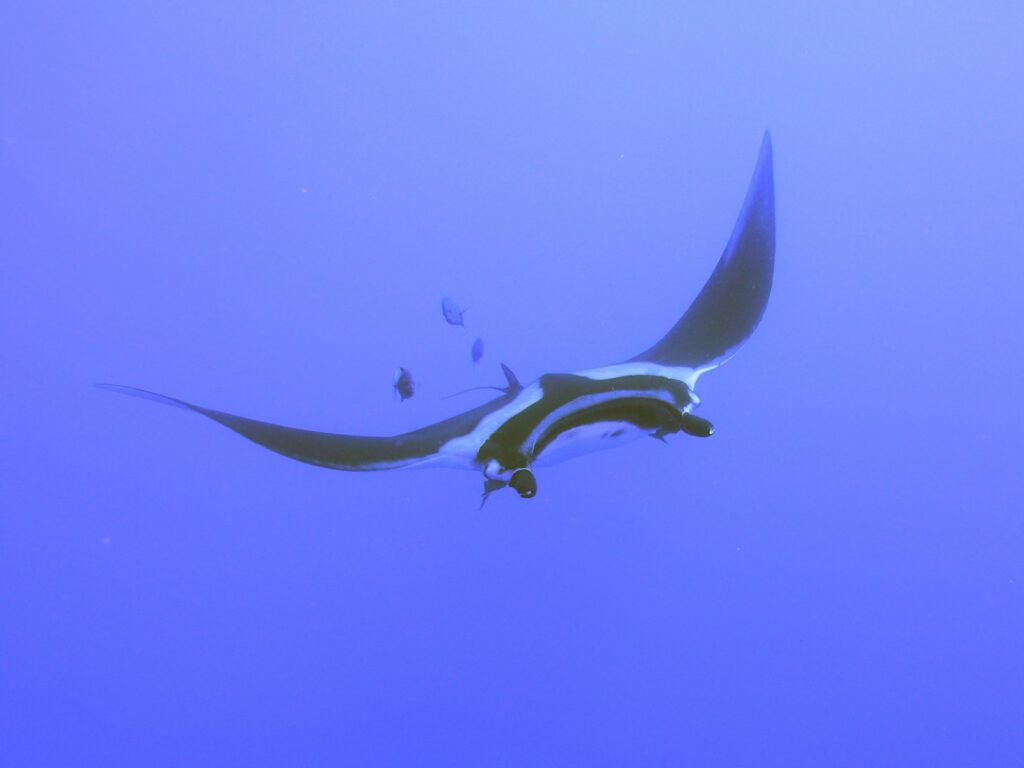
Manta point snorkeling for beginners is possible — but only for confident beginners who are comfortable in open water, willing to follow a guide’s instructions, and prepared to wear a life jacket. If that description does not fit your group, the smartest plan is to stay on the boat: on calm days, mantas at Karang Makassar are sometimes visible from deck level, and that is a genuinely good experience, not a consolation prize. Neither option is a guarantee of a manta sighting. Mantas are possible every day of the year at this site, and promised on none of them.
That is the short answer. The longer answer requires understanding what Manta Point actually is, what the current does to you in the water, and how the drift-snorkel format changes the normal calculus of beginner-friendliness. It is different from anything else on the standard Komodo day-trip itinerary, and it deserves a straight explanation rather than the vague “suitable for all levels” language that too many operators paste into their booking pages.
What Manta Point Actually Is
Manta Point — the name used by almost every operator, though the site’s formal name is Karang Makassar — is a submerged reef plateau in Komodo National Park where oceanic manta rays use resident cleaner fish to remove parasites from their skin. The mantas circle slowly over the cleaning station, sometimes for extended periods. That slow, repetitive movement is why drift snorkeling works here: you do not need to chase anything, because the animal itself is not going anywhere fast while it is being cleaned.
The stop lasts approximately 30 minutes on the standard six-stop speedboat itinerary. The boat drops you up-current of the cleaning area, and you drift slowly over the reef while the guide watches the group. At the end of the drift, the boat collects you. You do not swim back against the current. That is important — and we will come back to it.
On the itinerary, Manta Point comes fifth, just five minutes from Taka Makassar sandbar. It is the last water-entry stop before a brief snorkel at Siaba Bay or Kelor Island and the one-hour run back to Labuan Bajo harbour, which means you arrive at Karang Makassar later in the afternoon when the group is already tired from Padar’s roughly 800-step climb, the dragon trek at Loh Liang, and two or three earlier snorkel stops. That fatigue matters for nervous swimmers: entering strong current when your arms are already spent is not the same as entering it fresh at 08:00.
For the full picture on Manta Point — its seasonal patterns, the reef ecology, what happens when there are no mantas — the dedicated Manta Point Komodo guide covers the site in detail. What follows here is specifically the beginner question.
The Current: The Thing Nobody Explains Clearly Enough
The tidal currents at Karang Makassar are strong. That is the single most important physical fact about the site for any snorkeler, beginner or otherwise. The Flores Strait moves a significant volume of water through the Komodo channel on a tidal schedule — not a tourist schedule — and the forces involved are enough to catch experienced swimmers off guard.
Here is what strong current actually means in practice at this site:
- You move through the water whether you intend to or not. The drift is not a gentle suggestion — it is a current, and it carries you.
- If you panic and try to swim against it to return to a cleaning station you drifted past, you will exhaust yourself quickly and potentially end up in a worse position than if you had let the guide manage your repositioning.
- Staying upright in the water — mask down, relaxed, watching below — requires you to be comfortable with the sensation of moving without controlling your direction. That is a learned comfort, not an instinct.
- Fins provide directional control that makes a practical difference here. On budget shared boats, fin availability is inconsistent. Confirm before you leave the harbour.
None of this is designed to frighten you out of the water. The drift format, counterintuitively, removes one of the most common beginner problems: the exhausting effort of staying in one place while fighting a current. You are not fighting anything. The structure of the stop does the work. But you have to trust that structure, and trusting it means trusting your guide and accepting that you cannot steer yourself wherever you want to go.
Beginners who freeze up in open water, who need constant reassurance, or who cannot follow verbal instructions quickly — particularly instructions that require stopping a natural panic response — are not well-matched to this site. That is not a judgment; it is just the honest version of the usual “moderate difficulty” label.
The Honest Qualification Test
Before entering the water at Manta Point, run through this checklist mentally. It is not a formal test — no one will quiz you at the ladder. It is a self-assessment that experienced operators and guides use to calibrate how much attention each snorkeler in the group needs.
- Can you float on your front for five minutes without effort?
- If floating face-down requires active effort to maintain, the current at Karang Makassar will make it significantly harder. This is the baseline. A snorkel vest or life jacket removes this requirement entirely.
- Are you comfortable with your face submerged and your breathing through a snorkel?
- First-time or very occasional snorkelers often spend the first few minutes adjusting to the breathing rhythm — perfectly normal at a calm lagoon, but at a current-swept site you have less time and less option to stand up and collect yourself.
- Can you follow a pointing hand signal and change direction?
- Your guide will use hand signals underwater. Understanding them — or being willing to follow the general direction of a pointed hand without knowing the vocabulary — is a practical requirement here.
- Do you have a realistic sense of your own anxiety in open water?
- There is a difference between unfamiliarity with snorkeling and active fear of open water. The second one is worth being honest about, because drifting over a 20-metre drop in tidal current is not the place to work through it for the first time.
- Would you be comfortable letting the boat collect you at the end of the drift rather than swimming back to a fixed point?
- This is how the stop works. The boat comes to you. If the idea of drifting away from the boat and waiting for it to reposition produces strong anxiety, that is useful information before you enter the water.
If you answered yes to all five — even with some hesitation — you are a reasonable candidate for the water at Manta Point, with a life jacket and a guide in the water alongside the group. If you answered no to more than one, the boat deck is the more honest plan.
The Life Jacket Question
Wearing a life jacket at Manta Point is not a beginner badge of shame. It is a practical tool that changes the experience in two specific ways: it keeps your head above water without effort during the drift, and it means you cannot accidentally sink when you are distracted by a manta passing below you.
Reputable operators carry life jackets on deck as standard equipment. Any operator who discourages a guest from using one at a current-swept site is telling you something important about how they manage water safety generally. Ask before you book: do your guides enter the water with the group at Manta Point, and are life jackets available for any guest who wants one? A direct, confident yes to both is what you want to hear.
Children and anyone who describes themselves as a weak swimmer should wear a life jacket in the water at Karang Makassar without discussion. The current does not make exceptions for children.
One more note on fins: at the calmer sites earlier in the day — Siaba Bay, Taka Makassar’s sheltered lagoon — fins are helpful but not essential. At Manta Point, they provide the directional correction that makes the drift manageable rather than purely passive. If your shared boat does not include fins as standard (budget trips are inconsistent on this), that is worth flagging when you book, not when you are already at the site.
Plan B Is Not a Failure: Watching from the Deck
This deserves its own section because operators rarely say it plainly: you are allowed to stay on the boat at Manta Point, and it is a legitimate way to experience the stop.
On calm days with good visibility, mantas at the cleaning station are sometimes visible from deck level — particularly on smaller, lower-profile speedboats where you are sitting close to the water’s surface. You do not see them from above the way a snorkeler does, but the experience of watching a manta ray move under the hull of your boat is not nothing. Several travellers who have made this call describe it as one of the more unexpectedly vivid moments of the day.
Watching from the deck also lets you see more of what is happening across the group — the guides’ movements, the drift pattern, where the boat repositions. For nervous swimmers who are genuinely curious about whether they might try it next time, that observation is actually useful preparation.
If you are uncertain, talk to your guide before you anchor at the site — not while 20 other people are shuffling toward the back ladder. A good guide will give you a straight read on the conditions that day and on whether the current feels manageable for someone at your level. Listen to that answer.
Manta Etiquette: Best-Practice Code, Not Park Law
No independently verified BTNK regulation published in enforceable text sets out specific manta interaction rules for Komodo National Park — not as of mid-2026. What guides apply at the site is a globally consistent best-practice code that responsible operators worldwide have adopted. It is a professional standard, not a park bylaw, and it should be followed regardless of whether a ranger is watching.
| Rule | Why it matters |
|---|---|
| Keep approximately 3 metres distance | Mantas have a protective mucus layer. Close contact — even well-intentioned — disrupts it and creates infection pathways. Three metres is the standard reference distance; most experienced guides signal you back before that. |
| No touching | Applies to fins, cephalic lobes, and any other part of the animal. Non-negotiable. |
| No chasing | When a manta decides to leave, it leaves. Chasing terminates the cleaning session and degrades the experience for everyone else in the water. Let it go. |
| Approach from the side, not above | Descending vertically onto a cleaning manta disrupts its field of vision and the cleaning routine. Stay lateral — slightly below or level with the animal if possible. |
| Do not block the cleaning station | The manta needs a clear approach path to circle back to its cleaners. Groups clustering directly over the station are the fastest way to end a sighting. Drift around the perimeter. |
| No flash photography | Turn it off before you enter the water. Flash is disruptive and produces worse photos than ambient light in any case. |
| No riding | This still needs saying. Do not grab any part of the animal. |
On quality boats, guides brief this before you enter the water. If you get no briefing on manta etiquette before the stop, ask. The fact that you are asking tells the guide something useful about how much attention you will need in the water.
Private Charter vs Shared Boat: What Changes for Beginners
For a confident beginner on a well-run shared open trip — typically 15 to 22 passengers — Manta Point is manageable. The guide enters the water and monitors the group. The boat shadows the drift. The ratio of guides to guests varies by operator, and this is worth asking about before you book.
The group-size dynamic at Karang Makassar has a real effect, though. Ten or more snorkelers drifting simultaneously over the same cleaning station increases the chance that someone’s movement — a panicked kick, a sudden lunge toward a manta — disrupts the session. On a private charter with four to eight guests, the guide has far more bandwidth to manage individual swimmers, and the etiquette compliance is simply easier to enforce across a smaller group. For a mixed-ability party that includes nervous swimmers alongside confident ones, the private charter removes the shared-trip constraint that the pace is set by the group average and adjusted by no one.
Private speedboat charters for a small vessel of around six passengers run approximately IDR 8–12 million per boat per day (roughly USD 500–800, last verified 2026 — treat as indicative, confirm with your operator). At a group of four adults, the per-person cost is comparable to a shared trip once park fees are added to both sides. Shared speedboat open trips run broadly IDR 1,200,000–1,800,000 per person (approximately USD 75–120), with all park fees excluded and paid in cash on the day. Budget IDR 300,000–500,000 per person for the full park-fee stack across a six-stop day. These figures are approximate; the fee regime has shifted in 2025–2026 and individual operator quotes are the reliable source.
If you are travelling with nervous swimmers and Manta Point is important to the group, it is worth discussing a private option. Our planning form lets you specify your group’s ability level and swimming comfort — we can help match you to operators whose guide-to-guest ratio and safety setup actually fit. Mention WhatsApp if you want a faster back-and-forth on the logistics. No one can pay to change what we publish; if you use our free help and proceed with a partner operator, they may pay us a referral fee at no extra cost to you.
The Bigger Snorkeling Picture
Manta Point is one of four dedicated snorkel opportunities across the standard six-stop day, and it is the most demanding of the four. Pink Beach has variable current and deserves respect; Taka Makassar’s sheltered lagoon side is calm and beginner-friendly; Siaba Bay at the end of the day is the gentlest water on the itinerary and reliably produces green turtle sightings.
A beginner snorkeler who opts out of Manta Point and enters the water at the other three stops will have a full, satisfying snorkeling day. Manta Point is not the only site where something compelling happens underwater. It is the highest-variance stop — capable of producing the most memorable moment of the trip, capable of delivering nothing, and the only one where the physical conditions require a clear-eyed assessment of your own comfort level before you step off the ladder.
For a full breakdown of every snorkeling stop rated by difficulty, gear requirements, and what to expect from the water, the Komodo snorkeling day trip guide covers the whole itinerary side by side.
Frequently Asked Questions
Can a complete beginner snorkeler enter the water at Manta Point?
A complete beginner — someone who has never snorkeled before — should not enter the water at Manta Point without building basic comfort first. The site is a current-swept drift snorkel, not a protected lagoon. For someone still learning to breathe through a snorkel and float relaxed, the combination of strong tidal current and open-water depth is too much at once. Try Siaba Bay or Taka Makassar’s sheltered lagoon earlier in the day; if those go smoothly, you will have a realistic read on whether Manta Point feels manageable. If they do not, watch from the deck — mantas are sometimes visible from the boat on calm days.
Is a life jacket enough to make Manta Point safe for a nervous swimmer?
It helps significantly, but it is not sufficient on its own. A life jacket removes the buoyancy effort and prevents accidental submersion, which eliminates a major source of panic in open water. But you still need to follow the guide’s signals, stay calm while drifting, and not fight the current. A nervous swimmer who panics in moving water will have a difficult time regardless of their buoyancy — the life jacket keeps them afloat, but the guide’s attention is what keeps the situation managed. Tell your guide before the stop that you are nervous and that you want to be positioned close to them. A good guide adjusts their patrol accordingly.
What happens if there are no mantas when we arrive at Manta Point?
The stop still happens. The reef at Karang Makassar has fish life even without mantas present, and the drift experience over open water is distinctive. The absence of mantas does not make the site unsafe — the current and the physical conditions are the same regardless of whether a ray appears. Ask your operator before you book: what is the plan if conditions at Manta Point are unsuitable? A good answer names an alternative snorkel site. A poor answer reasserts a guarantee that was never honest in the first place.
Should I skip Manta Point if the seas are rough?
Your guide makes that call, not you — and a good guide will make it before you anchor at the site, not after people are already in the water. In rough conditions the guide may substitute another snorkel stop entirely; this is normal, not a failure of the trip. The Flores Sea in the wet season (roughly December through February) brings the highest cancellation risk for exposed snorkel stops. If you are travelling in peak season (June through August), sea conditions are generally calmer, though the swell on the crossing legs of the speedboat can still be significant. If seasickness is a concern, take appropriate medication at least two hours before departure.
Do I need to pay extra to snorkel at Manta Point specifically?
No. There is no separate fee for snorkeling at Manta Point or any other snorkel site in Komodo National Park. The standard park entrance ticket — IDR 150,000–250,000 per person per day for foreign visitors (sources conflict on whether the higher rate applies only on Sundays and public holidays or flat every day; confirm on the day) — covers snorkeling park-wide. Divers pay an additional IDR 25,000 per diver per day on top of the entrance ticket. The all-in park-fee budget for a standard six-stop day runs approximately IDR 300,000–500,000 per person, paid in cash at park entry points. Fees are almost always excluded from tour prices — your operator should tell you exactly what to bring in cash.