Independent guide: Komodo Island Day Trip is an editorial planning guide — not a tour operator and not the official Komodo National Park website. Prices and park fees change with season and regulation; confirm the current total with your operator before paying. Operators cannot pay to change what we publish. Komodo Island Day Trip and operator Komodo Luxury are sister brands within Juara Holding Group — relationship disclosed in full here; bookings through Komodo Luxury may carry referral value to the group at no extra cost to you.
The Komodo National Park new rules for 2026 center on two structural changes that are actually in force: a park-wide 1,000-visitor daily cap managed through the SiORA online reservation system, and a renewed enforcement push on long-standing conduct rules covering take-nothing, no smoking on trails, and a total tourist fishing ban. Several rules that alarmed travelers in earlier years — including the IDR 3,750,000 annual conservation membership and a proposed full island closure — were officially reversed and are not in effect. This page separates what is active from what was reversed, and flags every figure that needs re-verification before your trip.
The New 2026 Rules: Actually In Force
The 1,000-Visitor Daily Cap
This is the biggest structural shift in how the park manages access. The Ministry of Forestry announced a park-wide limit of 1,000 visitors per day, with the trial phase beginning around March 2026 and what multiple operator sources describe as full enforcement from approximately April 2026. The cap applies across the entire national park, not per island. Some sources mention a sub-quota for Padar Island specifically, but that figure comes from a single source and should be treated with caution until confirmed directly with the park authority (BTNK).
What this means in practice: walk-up, spontaneous day trips are effectively gone. Tour operators are now expected to secure slots through SiORA in advance. If you arrive at the port without a reservation, there is a real risk of being turned away, particularly during peak months (June through August) when daily demand can exhaust the cap before midday. Book with an operator who handles the SiORA reservation as part of their service — confirm this explicitly when you book. Last verified: operator and TTG Asia sources, February–April 2026. Verify status before travel, as trial conditions may have been updated.
SiORA: The Mandatory Online Reservation System
SiORA (Sistem Informasi Online Reservasi Wisata Alam) is the national park’s advance booking platform, now required for entry from 2026. In practice, most visitors never interact with SiORA directly — your tour operator handles the reservation on your behalf as part of the booking process. The system is designed to manage the 1,000-visitor daily cap and allocate entry across time slots.
Two things to check when you book: first, confirm that your operator will handle the SiORA slot for you and that this is included in the service — it should not be a surprise add-on. Second, book early. June and July 2026 is peak season; operators who advise booking 10–15 days ahead during peak period are giving you realistic guidance, not just a sales pitch. Note: SiORA’s walk-in elimination is widely reported by operators but has not been confirmed in a primary government announcement — flag this with your operator before travel.
Take-Nothing Rules: Sand, Coral, Shells, and Animal Parts
This rule has been in place for years but is being enforced more actively than before. Removing coral fragments, shells, sand, rocks, or any animal parts from the park is prohibited. It applies everywhere — on islands, in the water, and on beaches. Pink Beach in particular has suffered visible degradation from visitors pocketing the distinctive pink sand (the colour comes from fragments of Homotrema rubrum, a red foraminifera, mixed with coral debris — every handful removed is irreplaceable on the time scale of a human life).
Boats can be checked on departure. If a ranger or park officer spots sand or shells in your bag, you will be asked to return them. Fines and confiscation are both possible. The enforcement is real: operators themselves are incentivized to brief passengers, because a fine on a tour boat creates reputational and operational problems for the company. Take photos. Leave the sand.
No Smoking on Trails and Savanna
Smoking on trails, in savanna habitat, or anywhere on the islands’ natural areas is not permitted. The reason is practical: Komodo and Rinca are covered in seasonally dry grassland that burns readily. Fire damage would destroy both the habitat and the tourism asset. Designated smoking areas exist on boats. Your ranger will be direct about this rule at the briefing before you set out. Comply immediately — rangers have the authority to end your trek and escort you back to the boat.
Tourist Fishing: Prohibited Park-Wide
Recreational and tourist fishing anywhere within Komodo National Park is prohibited. This includes casting lines from boats and spearfishing while snorkeling or diving. The park does maintain zones for registered local fishermen using traditional methods, but that exemption does not apply to tourists. Destructive fishing methods (dynamite, cyanide, trawling) are illegal under Indonesian law generally, and the park takes them seriously. If you see illegal fishing activity during your trip, report it to your ranger or BTNK.
Single-Use Plastic: Operator-Level Enforcement
There is a strong reduction push on single-use plastics across the park. In practice, the enforcement happens at operator level rather than via a verified park-wide ban with written BTNK text. Most reputable operators have stopped providing single-use plastic water bottles and bags. Refill systems are standard on better boats. Bring a refillable water bottle — expect your operator to enforce this as a condition of the trip, and expect the briefing to mention it. If an operator hands you a single-use plastic bottle at 6am with no alternative, that is a signal about their general quality level.
Drone Rules
Effective for casual visitors, drones are not permitted without a filming permit issued in advance through BTNK (Balai Taman Nasional Komodo) via the SIMAKSI system. Two operator sources report a fee of around IDR 2,000,000 per unit per day for permitted commercial or documentary work — treat that figure as reported, not confirmed, and verify directly with BTNK well before your trip. For most day-trippers: leave the drone at home. The paperwork timeline is incompatible with a spontaneous day trip, and enforcement at the landing sites is real.
The Rules That Were Reversed: Why Caution Is Warranted
Komodo National Park’s rules have been announced, cancelled, and revised enough times over the past decade that healthy skepticism is not cynicism — it is the only rational approach. Here is the history that justifies the verify-before-travel flag on everything above.
The 2022 IDR 3,750,000 Membership: Cancelled
In 2022, the provincial government of East Nusa Tenggara announced an annual conservation membership fee of IDR 3,750,000 (roughly USD 230–250 at the time) per person, replacing per-day entry. The fee generated significant international coverage and caused a measurable drop in advance bookings for the following year. It was officially cancelled before implementation. It is not in force for 2025 or 2026. You will not be charged this amount at the gate.
Why does this matter now? Because some older blog posts and travel guides still mention the IDR 3.75 million figure as a current fee. They are wrong. The current park-fee structure for foreigners is IDR 150,000–250,000 per person per day for basic entry (the exact weekday-versus-weekend split is genuinely contested across sources — some list IDR 150,000 on weekdays and IDR 250,000 on Sundays and public holidays; others list a flat IDR 250,000 regardless of day). A practical all-in budget for one person doing a standard 6-stop day — entrance plus ranger fees at multiple trek sites plus the harbour levy — is approximately IDR 300,000–500,000, paid in cash on the day and almost always excluded from tour prices. Confirm the current amounts with your operator before departure. These fees are set as national non-tax state revenue (PNBP) by BTNK and adjust periodically.
The 2020 Island Closure: Also Cancelled
In 2019, the government announced that Komodo Island itself would be closed to all tourists for the full year of 2020, ostensibly for a conservation reset and to allow dragon population counts without human disturbance. The closure was widely reported and contributed to a strategic rerouting of some visitors toward Rinca Island and the surrounding waters. It was reversed before taking effect. Komodo Island (Loh Liang) has been continuously open since.
The relevant lesson: large-scale closures have been proposed and then pulled back when economic and logistical pressures made them impractical. This does not mean future closures are impossible — it means you should verify current status close to your travel date, not rely on information from a year or more earlier.
Rules That Have Always Applied (But Are Worth Knowing)
Ranger Escort Is Mandatory
You cannot walk the trails at Komodo (Loh Liang) or Rinca (Loh Buaya) without a licensed ranger. The fee is IDR 200,000 per group of up to five people at both Komodo and Rinca. Padar Island’s ranger fee is IDR 150,000 per group of up to five. These fees stack per trek site: a day that includes both Padar and Komodo means two ranger fees. Rangers carry forked sticks. The sticks are functional, not ceremonial — rangers have used them to redirect approaching dragons on the trail.
Stay with your group on a single trail. Do not stray, crouch, or run near dragons. Keep at least three to five metres of distance. No touching, feeding, or surrounding. Keep open food away from the trail area entirely. Women are asked to inform their ranger if they are menstruating — this is an operational safety advisory based on scent sensitivity, not a written regulatory ban, but rangers take it seriously and you should too.
Coral and Marine Habitat
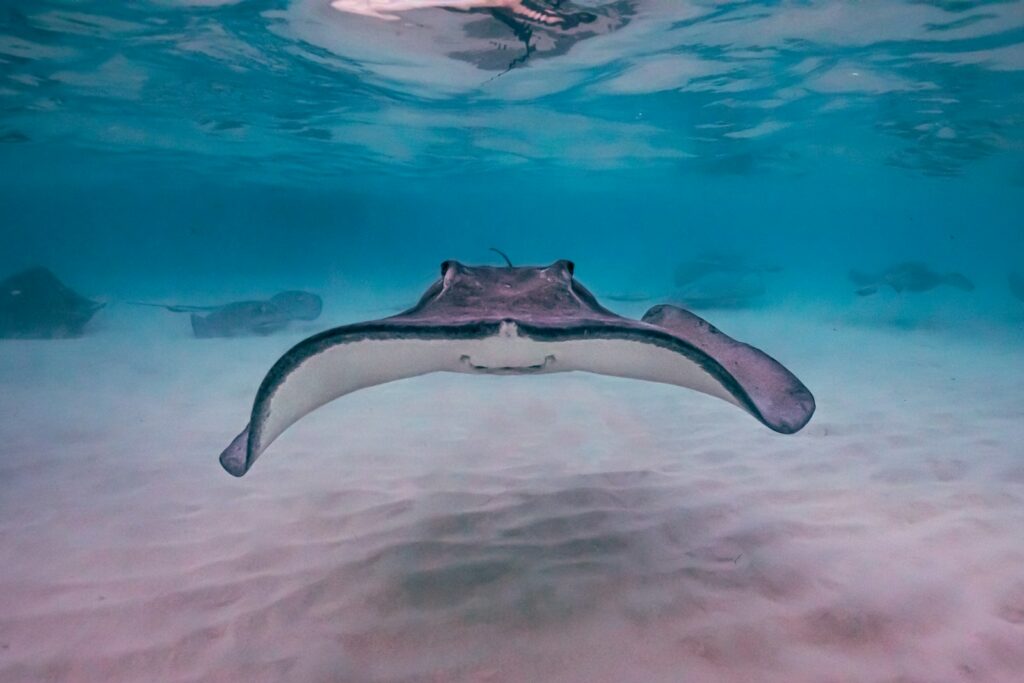
No touching or standing on coral. No fin-kicks into reef. The take-nothing rule described above covers coral fragments in the water as well as on the beach. Reef-safe sunscreen is strongly encouraged by operators across the park — it has not been verified as a BTNK-mandated requirement, but the expectation is consistent enough that you should pack it anyway. Manta rays at Karang Makassar (Manta Point) are protected: no touching, no riding, maintain approximately three metres of distance, approach from the side rather than above, do not block the cleaning station or hover directly over it.
A Quick Reference: Status of Key Rules
| Rule or Fee | Status (2026) | Verify? |
|---|---|---|
| 1,000 visitor/day cap | In force (trial→enforcement from ~April 2026) | Yes — confirm slot booked via SiORA |
| SiORA mandatory advance booking | In force; operators handle for guests | Yes — confirm with operator at booking |
| IDR 3,750,000 annual membership | Cancelled — not in force | No — definitively reversed |
| Komodo Island full closure (2020) | Cancelled — island open | No — definitively reversed |
| Take-nothing (sand, coral, shells) | In force; boats can be checked | No — long-standing MPA law |
| No smoking on trails/savanna | In force | No — apply at all times |
| Tourist fishing ban (park-wide) | In force | No — apply at all times |
| Park-wide single-use plastic ban | Operator-enforced; no verified BTNK ban text | Yes — bring a refillable bottle |
| Drone without permit | Effectively prohibited; permit via BTNK/SIMAKSI | Yes — confirm fee and timeline well in advance |
| Ranger escort at Loh Liang + Loh Buaya | In force — mandatory | No — non-negotiable, apply universally |
How to Stay Current: The Only Reliable Method
Park fees and access rules at Komodo National Park have changed more often in the past five years than at almost any comparable site in Southeast Asia. The 2022 membership reversal was announced within months of implementation. The 2026 visitor cap is operating in trial phase — its exact sub-quotas, time-slot allocations, and exceptions may shift between now and your departure date.
The most reliable verification path, in order of reliability: ask your confirmed tour operator directly, in writing, one to two weeks before travel (operators who manage SiORA daily see changes immediately); check the BTNK official website or social media channels for current PNBP fee rates; and treat any blog post more than six months old — including this one — as a starting point for questions, not a final answer.
We update this guide when significant changes are confirmed, but we are not the park authority. If you are planning a trip for July or August 2026 — peak season, when the daily cap is most likely to be tested — please use our planning form or reach out via WhatsApp. Our operator partners handle SiORA bookings as part of their service and can confirm current slot availability and fee rates in real time.
Frequently Asked Questions
Is the 1,000-visitor daily cap per island or for the whole park?
The 1,000-visitor limit is reported as a park-wide cap, not per individual island. One secondary source suggests a separate sub-quota for Padar Island specifically, but this comes from a single source and should be confirmed with your operator or BTNK before you treat it as definitive. The practical implication is the same either way: book in advance, especially June through August.
Do I need to register on SiORA myself, or does my tour operator do it?
In practice, your tour operator handles the SiORA reservation on your behalf. You should not need to interact with the system directly. When you book, ask the operator explicitly whether SiORA registration is included in the service and whether a confirmation can be provided. If an operator is vague or does not mention it, treat that as a red flag.
Is the IDR 3.75 million conservation fee still being charged?
No. The IDR 3,750,000 annual membership fee announced in 2022 by the East Nusa Tenggara provincial government was officially cancelled before it was implemented and is not in force for 2025 or 2026. Multiple independent operator sources and travel data providers confirm this. If anyone at the port quotes you this figure, do not pay it — ask for an official BTNK receipt and the regulatory basis.
Can I be turned away at the park entrance if there is no SiORA slot?
Yes — this is the intent of the 1,000-visitor daily cap and the SiORA booking requirement. During peak season, the daily quota can be reached, which means visitors without confirmed bookings may be refused entry. Walk-in access is no longer reliable the way it was before 2026. Book your trip with an operator who handles the reservation in advance.
Are the take-nothing rules actually enforced, or are they theoretical?
They are enforced, and enforcement has increased. Boats departing the park can be checked by rangers or BTNK officers. Sand in a bag, shells in a pocket — rangers will ask you to return them. Fines are possible. Operators brief passengers on this before arrival because a compliance problem on their boat creates problems for their operating license. Beyond the legal risk, the ecological argument is real: the pink sand beaches in particular have lost visible amounts of their distinctive sand colour over years of incremental removal. Take photos, leave everything else.